 Add to Chrome
 Add to Firefox
 Add to Edge
CellMaster: Collaborative Cell Type Annotation in Single-Cell Analysis
Feb 12, 2026
Single-cell RNA-seq (scRNA-seq) enables atlas-scale profiling of complex tissues, revealing rare lineages and transient states. Yet, assigning biologically valid cell identities remains a bottleneck because markers are tissue- and state-dependent, and novel states lack references. We present CellMaster, an AI agent that mimics expert practice for zero-shot cell-type annotation. Unlike existing automated tools, CellMaster leverages LLM-encoded knowledge (e.g., GPT-4o) to perform on-the-fly annotation with interpretable rationales, without pre-training or fixed marker databases. Across 9 datasets spanning 8 tissues, CellMaster improved accuracy by 7.1% over best-performing baselines (including CellTypist and scTab) in automatic mode. With human-in-the-loop refinement, this advantage increased to 18.6%, with a 22.1% gain on subtype populations. The system demonstrates particular strength in rare and novel cell states where baselines often fail. Source code and the web application are available at \href{https://github.com/AnonymousGym/CellMaster}{https://github.com/AnonymousGym/CellMaster}.

scPilot: Large Language Model Reasoning Toward Automated Single-Cell Analysis and Discovery
Feb 12, 2026We present scPilot, the first systematic framework to practice omics-native reasoning: a large language model (LLM) converses in natural language while directly inspecting single-cell RNA-seq data and on-demand bioinformatics tools. scPilot converts core single-cell analyses, i.e., cell-type annotation, developmental-trajectory reconstruction, and transcription-factor targeting, into step-by-step reasoning problems that the model must solve, justify, and, when needed, revise with new evidence. To measure progress, we release scBench, a suite of 9 expertly curated datasets and graders that faithfully evaluate the omics-native reasoning capability of scPilot w.r.t various LLMs. Experiments with o1 show that iterative omics-native reasoning lifts average accuracy by 11% for cell-type annotation and Gemini-2.5-Pro cuts trajectory graph-edit distance by 30% versus one-shot prompting, while generating transparent reasoning traces explain marker gene ambiguity and regulatory logic. By grounding LLMs in raw omics data, scPilot enables auditable, interpretable, and diagnostically informative single-cell analyses. Code, data, and package are available at https://github.com/maitrix-org/scPilot
Thought Graph: Generating Thought Process for Biological Reasoning
Mar 11, 2024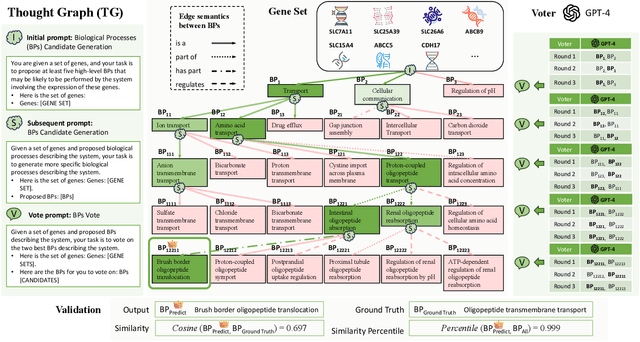
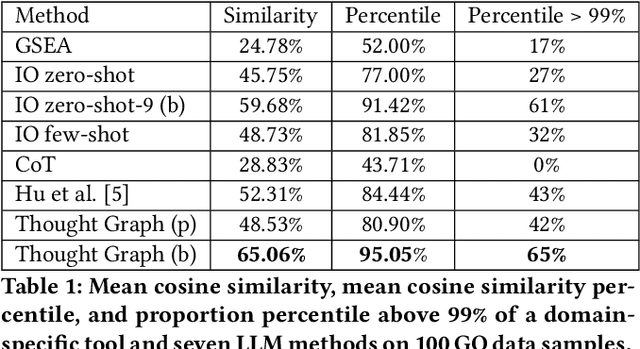
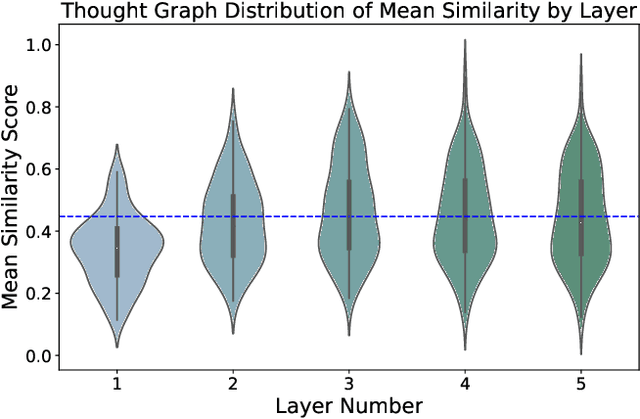
We present the Thought Graph as a novel framework to support complex reasoning and use gene set analysis as an example to uncover semantic relationships between biological processes. Our framework stands out for its ability to provide a deeper understanding of gene sets, significantly surpassing GSEA by 40.28% and LLM baselines by 5.38% based on cosine similarity to human annotations. Our analysis further provides insights into future directions of biological processes naming, and implications for bioinformatics and precision medicine.
Evaluation of large language models for discovery of gene set function
Sep 07, 2023Gene set analysis is a mainstay of functional genomics, but it relies on manually curated databases of gene functions that are incomplete and unaware of biological context. Here we evaluate the ability of OpenAI's GPT-4, a Large Language Model (LLM), to develop hypotheses about common gene functions from its embedded biomedical knowledge. We created a GPT-4 pipeline to label gene sets with names that summarize their consensus functions, substantiated by analysis text and citations. Benchmarking against named gene sets in the Gene Ontology, GPT-4 generated very similar names in 50% of cases, while in most remaining cases it recovered the name of a more general concept. In gene sets discovered in 'omics data, GPT-4 names were more informative than gene set enrichment, with supporting statements and citations that largely verified in human review. The ability to rapidly synthesize common gene functions positions LLMs as valuable functional genomics assistants.