 Add to Chrome
 Add to Firefox
 Add to Edge
A Dual-TransUNet Deep Learning Framework for Multi-Source Precipitation Merging and Improving Seasonal and Extreme Estimates
Feb 04, 2026
Multi-source precipitation products (MSPs) from satellite retrievals and reanalysis are widely used for hydroclimatic monitoring, yet spatially heterogeneous biases and limited skill for extremes still constrain their hydrologic utility. Here we develop a dual-stage TransUNet-based multi-source precipitation merging framework (DDL-MSPMF) that integrates six MSPs with four ERA5 near-surface physical predictors. A first-stage classifier estimates daily precipitation occurrence probability, and a second-stage regressor fuses the classifier outputs together with all predictors to estimate daily precipitation amount at 0.25 degree resolution over China for 2001-2020. Benchmarking against multiple deep learning and hybrid baselines shows that the TransUNet - TransUNet configuration yields the best seasonal performance (R = 0.75; RMSE = 2.70 mm/day) and improves robustness relative to a single-regressor setting. For heavy precipitation (>25 mm/day), DDL-MSPMF increases equitable threat scores across most regions of eastern China and better reproduces the spatial pattern of the July 2021 Zhengzhou rainstorm, indicating enhanced extreme-event detection beyond seasonal-mean corrections. Independent evaluation over the Qinghai-Tibet Plateau using TPHiPr further supports its applicability in data-scarce regions. SHAP analysis highlights the importance of precipitation occurrence probabilities and surface pressure, providing physically interpretable diagnostics. The proposed framework offers a scalable and explainable approach for precipitation fusion and extreme-event assessment.

Communications to Circulations: 3D Wind Field Retrieval and Real-Time Prediction Using 5G GNSS Signals and Deep Learning
Sep 19, 2025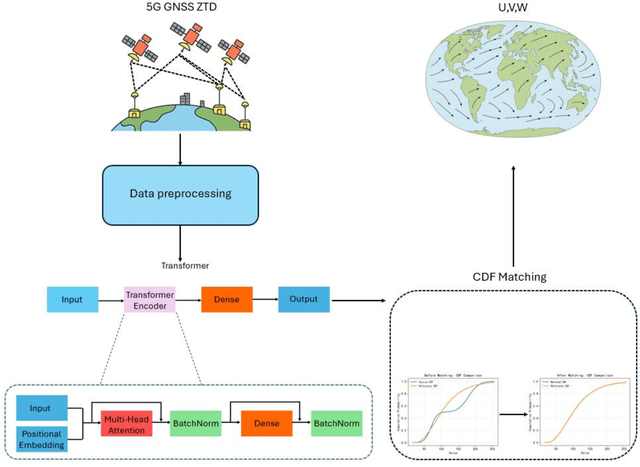
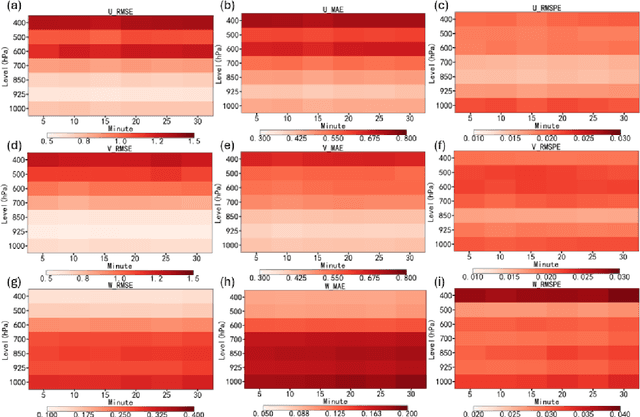
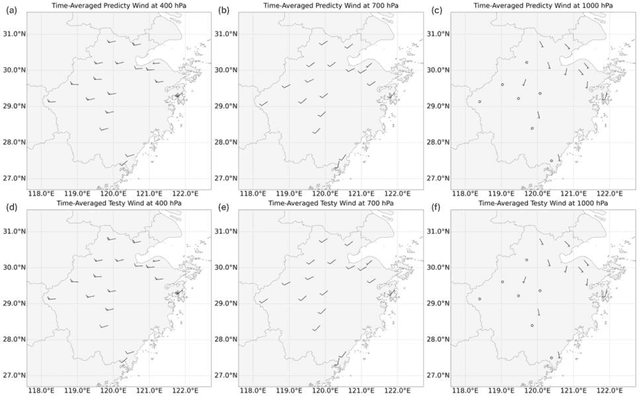
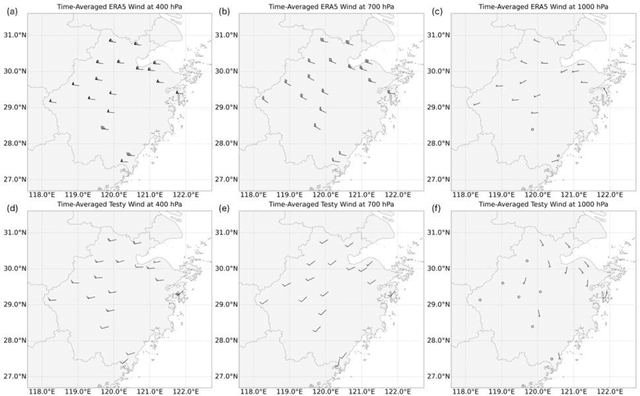
Accurate atmospheric wind field information is crucial for various applications, including weather forecasting, aviation safety, and disaster risk reduction. However, obtaining high spatiotemporal resolution wind data remains challenging due to limitations in traditional in-situ observations and remote sensing techniques, as well as the computational expense and biases of numerical weather prediction (NWP) models. This paper introduces G-WindCast, a novel deep learning framework that leverages signal strength variations from 5G Global Navigation Satellite System (GNSS) signals to retrieve and forecast three-dimensional (3D) atmospheric wind fields. The framework utilizes Forward Neural Networks (FNN) and Transformer networks to capture complex, nonlinear, and spatiotemporal relationships between GNSS-derived features and wind dynamics. Our preliminary results demonstrate promising accuracy in both wind retrieval and short-term wind forecasting (up to 30 minutes lead time), with skill scores comparable to high-resolution NWP outputs in certain scenarios. The model exhibits robustness across different forecast horizons and pressure levels, and its predictions for wind speed and direction show superior agreement with observations compared to concurrent ERA5 reanalysis data. Furthermore, we show that the system can maintain excellent performance for localized forecasting even with a significantly reduced number of GNSS stations (e.g., around 100), highlighting its cost-effectiveness and scalability. This interdisciplinary approach underscores the transformative potential of exploiting non-traditional data sources and deep learning for advanced environmental monitoring and real-time atmospheric applications.
Optimal Model Averaging of Support Vector Machines in Diverging Model Spaces
Dec 30, 2021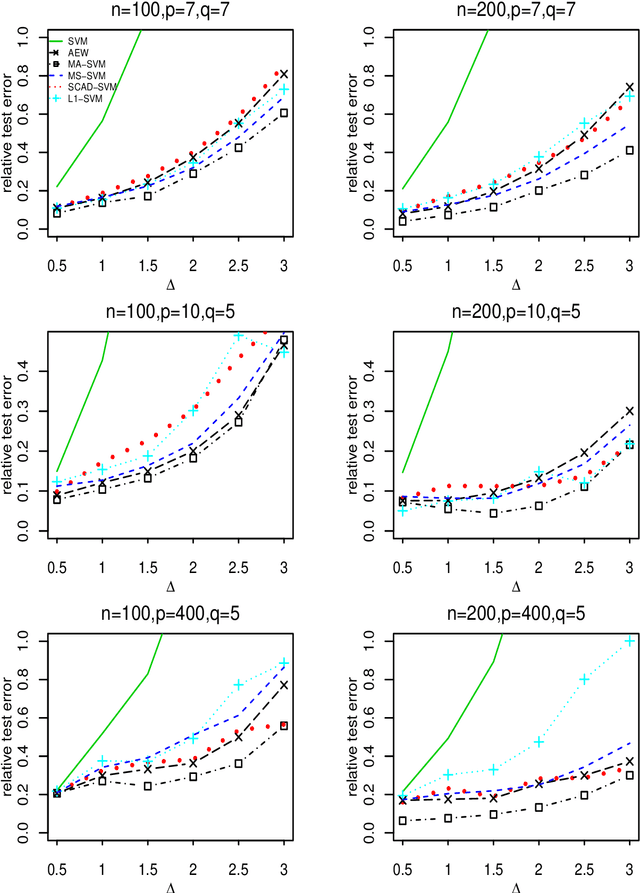
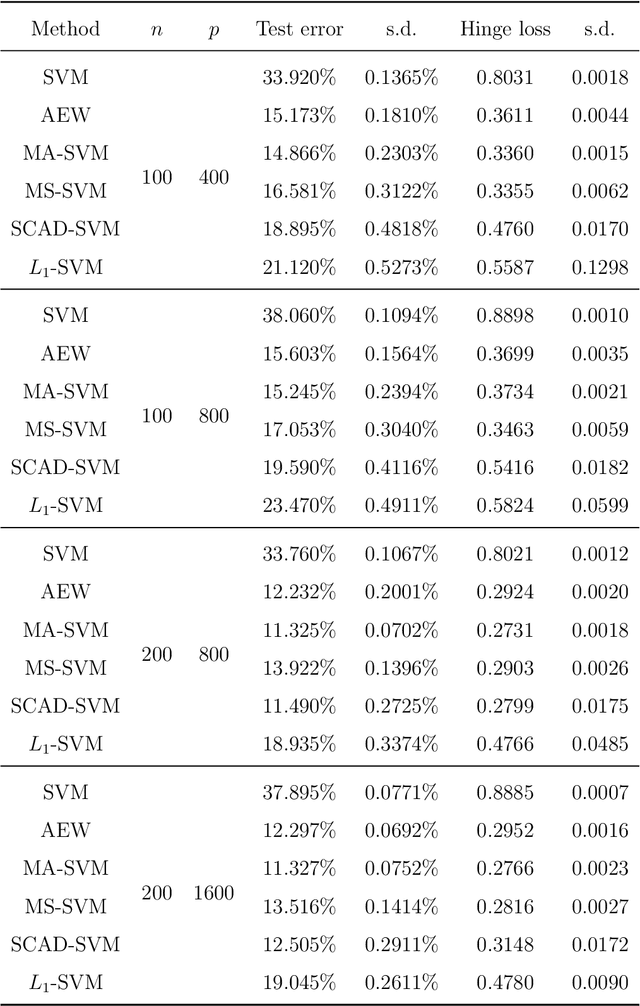
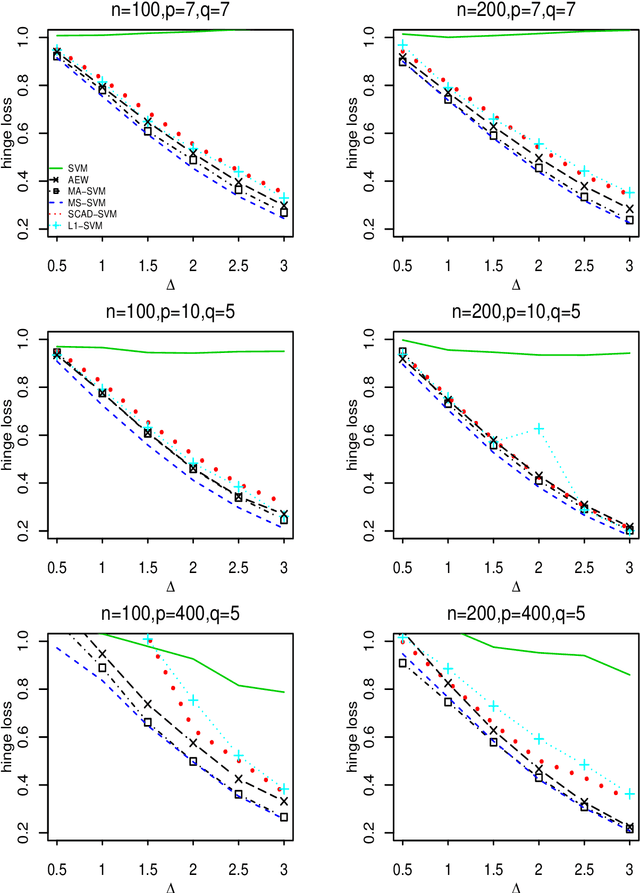

Support vector machine (SVM) is a powerful classification method that has achieved great success in many fields. Since its performance can be seriously impaired by redundant covariates, model selection techniques are widely used for SVM with high dimensional covariates. As an alternative to model selection, significant progress has been made in the area of model averaging in the past decades. Yet no frequentist model averaging method was considered for SVM. This work aims to fill the gap and to propose a frequentist model averaging procedure for SVM which selects the optimal weight by cross validation. Even when the number of covariates diverges at an exponential rate of the sample size, we show asymptotic optimality of the proposed method in the sense that the ratio of its hinge loss to the lowest possible loss converges to one. We also derive the convergence rate which provides more insights to model averaging. Compared to model selection methods of SVM which require a tedious but critical task of tuning parameter selection, the model averaging method avoids the task and shows promising performances in the empirical studies.