 Add to Chrome
 Add to Firefox
 Add to Edge
LLM Driven Design of Continuous Optimization Problems with Controllable High-level Properties
Jan 26, 2026
Benchmarking in continuous black-box optimisation is hindered by the limited structural diversity of existing test suites such as BBOB. We explore whether large language models embedded in an evolutionary loop can be used to design optimisation problems with clearly defined high-level landscape characteristics. Using the LLaMEA framework, we guide an LLM to generate problem code from natural-language descriptions of target properties, including multimodality, separability, basin-size homogeneity, search-space homogeneity and globallocal optima contrast. Inside the loop we score candidates through ELA-based property predictors. We introduce an ELA-space fitness-sharing mechanism that increases population diversity and steers the generator away from redundant landscapes. A complementary basin-of-attraction analysis, statistical testing and visual inspection, verifies that many of the generated functions indeed exhibit the intended structural traits. In addition, a t-SNE embedding shows that they expand the BBOB instance space rather than forming an unrelated cluster. The resulting library provides a broad, interpretable, and reproducible set of benchmark problems for landscape analysis and downstream tasks such as automated algorithm selection.

On the Effectiveness of Heterogeneous Ensemble Methods for Re-identification
Mar 19, 2024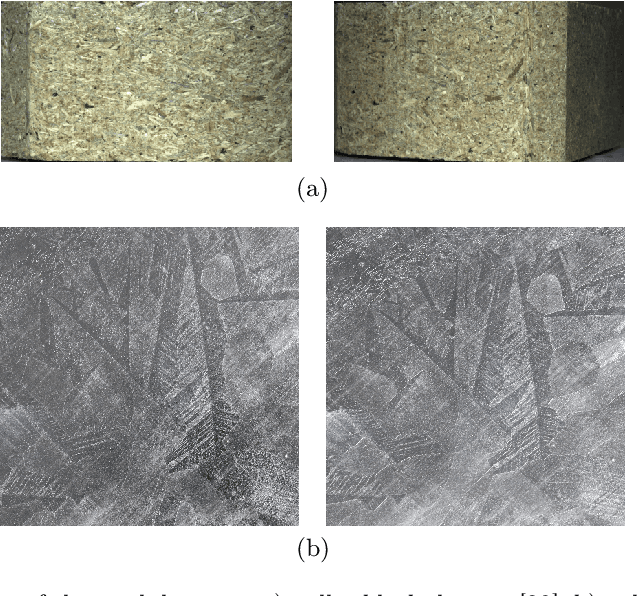
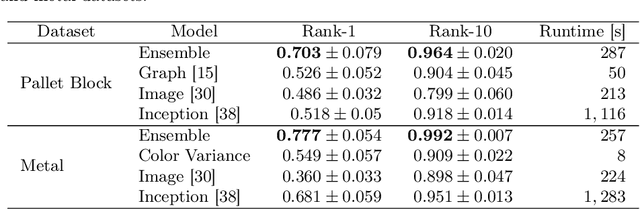
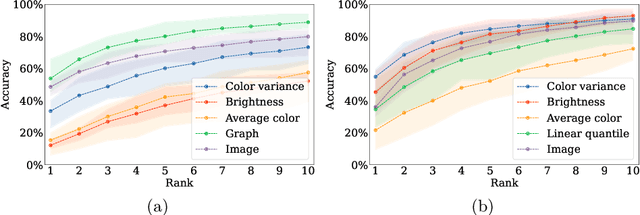
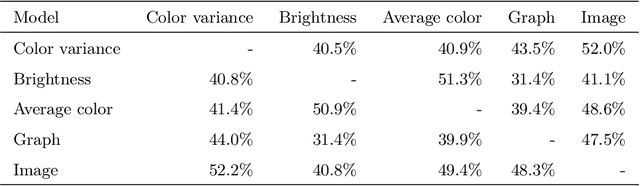
In this contribution, we introduce a novel ensemble method for the re-identification of industrial entities, using images of chipwood pallets and galvanized metal plates as dataset examples. Our algorithms replace commonly used, complex siamese neural networks with an ensemble of simplified, rudimentary models, providing wider applicability, especially in hardware-restricted scenarios. Each ensemble sub-model uses different types of extracted features of the given data as its input, allowing for the creation of effective ensembles in a fraction of the training duration needed for more complex state-of-the-art models. We reach state-of-the-art performance at our task, with a Rank-1 accuracy of over 77% and a Rank-10 accuracy of over 99%, and introduce five distinct feature extraction approaches, and study their combination using different ensemble methods.