 Add to Chrome
 Add to Firefox
 Add to Edge
AbductiveMLLM: Boosting Visual Abductive Reasoning Within MLLMs
Jan 06, 2026
Visual abductive reasoning (VAR) is a challenging task that requires AI systems to infer the most likely explanation for incomplete visual observations. While recent MLLMs develop strong general-purpose multimodal reasoning capabilities, they fall short in abductive inference, as compared to human beings. To bridge this gap, we draw inspiration from the interplay between verbal and pictorial abduction in human cognition, and propose to strengthen abduction of MLLMs by mimicking such dual-mode behavior. Concretely, we introduce AbductiveMLLM comprising of two synergistic components: REASONER and IMAGINER. The REASONER operates in the verbal domain. It first explores a broad space of possible explanations using a blind LLM and then prunes visually incongruent hypotheses based on cross-modal causal alignment. The remaining hypotheses are introduced into the MLLM as targeted priors, steering its reasoning toward causally coherent explanations. The IMAGINER, on the other hand, further guides MLLMs by emulating human-like pictorial thinking. It conditions a text-to-image diffusion model on both the input video and the REASONER's output embeddings to "imagine" plausible visual scenes that correspond to verbal explanation, thereby enriching MLLMs' contextual grounding. The two components are trained jointly in an end-to-end manner. Experiments on standard VAR benchmarks show that AbductiveMLLM achieves state-of-the-art performance, consistently outperforming traditional solutions and advanced MLLMs.

Image Segmentation in Foundation Model Era: A Survey
Aug 23, 2024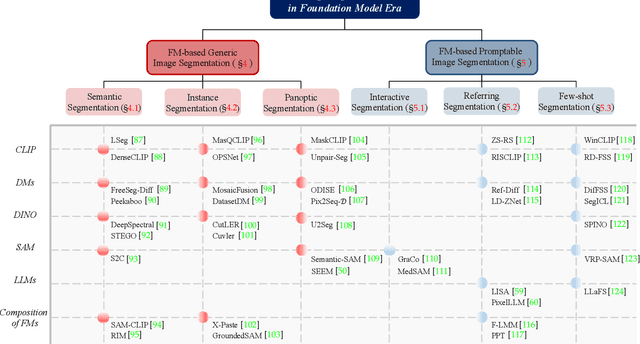
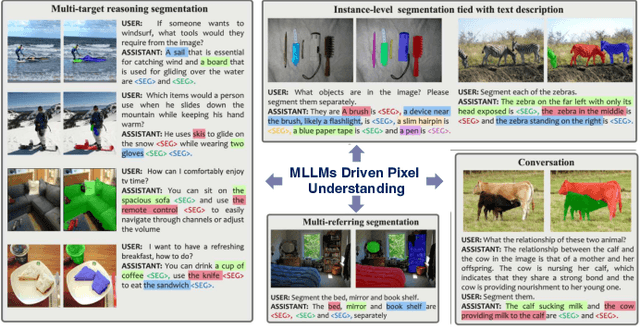
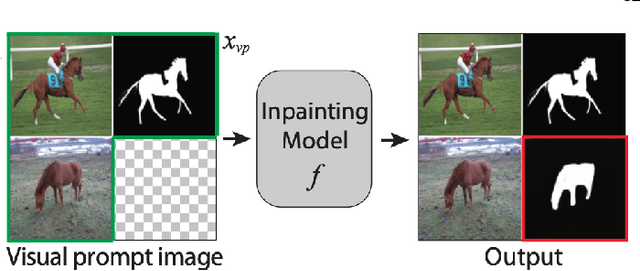
Image segmentation is a long-standing challenge in computer vision, studied continuously over several decades, as evidenced by seminal algorithms such as N-Cut, FCN, and MaskFormer. With the advent of foundation models (FMs), contemporary segmentation methodologies have embarked on a new epoch by either adapting FMs (e.g., CLIP, Stable Diffusion, DINO) for image segmentation or developing dedicated segmentation foundation models (e.g., SAM). These approaches not only deliver superior segmentation performance, but also herald newfound segmentation capabilities previously unseen in deep learning context. However, current research in image segmentation lacks a detailed analysis of distinct characteristics, challenges, and solutions associated with these advancements. This survey seeks to fill this gap by providing a thorough review of cutting-edge research centered around FM-driven image segmentation. We investigate two basic lines of research -- generic image segmentation (i.e., semantic segmentation, instance segmentation, panoptic segmentation), and promptable image segmentation (i.e., interactive segmentation, referring segmentation, few-shot segmentation) -- by delineating their respective task settings, background concepts, and key challenges. Furthermore, we provide insights into the emergence of segmentation knowledge from FMs like CLIP, Stable Diffusion, and DINO. An exhaustive overview of over 300 segmentation approaches is provided to encapsulate the breadth of current research efforts. Subsequently, we engage in a discussion of open issues and potential avenues for future research. We envisage that this fresh, comprehensive, and systematic survey catalyzes the evolution of advanced image segmentation systems.