 Add to Chrome
 Add to Firefox
 Add to Edge
Imagine-then-Plan: Agent Learning from Adaptive Lookahead with World Models
Jan 13, 2026
Recent advances in world models have shown promise for modeling future dynamics of environmental states, enabling agents to reason and act without accessing real environments. Current methods mainly perform single-step or fixed-horizon rollouts, leaving their potential for complex task planning under-exploited. We propose Imagine-then-Plan (\texttt{ITP}), a unified framework for agent learning via lookahead imagination, where an agent's policy model interacts with the learned world model, yielding multi-step ``imagined'' trajectories. Since the imagination horizon may vary by tasks and stages, we introduce a novel adaptive lookahead mechanism by trading off the ultimate goal and task progress. The resulting imagined trajectories provide rich signals about future consequences, such as achieved progress and potential conflicts, which are fused with current observations, formulating a partially \textit{observable} and \textit{imaginable} Markov decision process to guide policy learning. We instantiate \texttt{ITP} with both training-free and reinforcement-trained variants. Extensive experiments across representative agent benchmarks demonstrate that \texttt{ITP} significantly outperforms competitive baselines. Further analyses validate that our adaptive lookahead largely enhances agents' reasoning capability, providing valuable insights into addressing broader, complex tasks.

MegaFake: A Theory-Driven Dataset of Fake News Generated by Large Language Models
Aug 19, 2024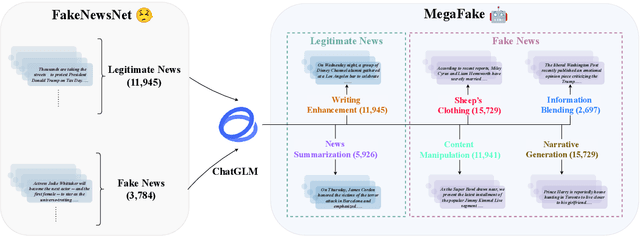
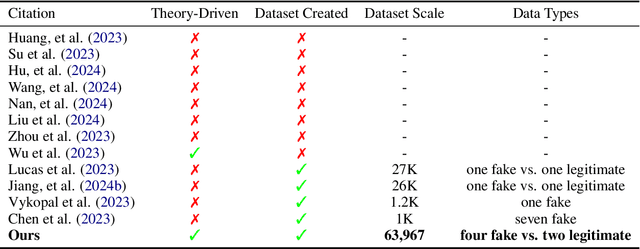
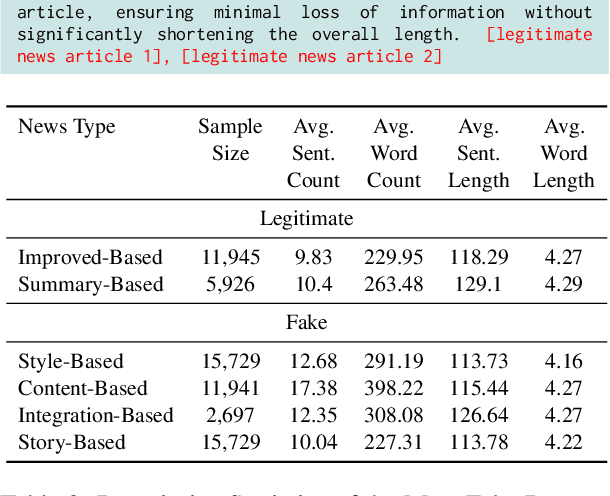
The advent of large language models (LLMs) has revolutionized online content creation, making it much easier to generate high-quality fake news. This misuse threatens the integrity of our digital environment and ethical standards. Therefore, understanding the motivations and mechanisms behind LLM-generated fake news is crucial. In this study, we analyze the creation of fake news from a social psychology perspective and develop a comprehensive LLM-based theoretical framework, LLM-Fake Theory. We introduce a novel pipeline that automates the generation of fake news using LLMs, thereby eliminating the need for manual annotation. Utilizing this pipeline, we create a theoretically informed Machine-generated Fake news dataset, MegaFake, derived from the GossipCop dataset. We conduct comprehensive analyses to evaluate our MegaFake dataset. We believe that our dataset and insights will provide valuable contributions to future research focused on the detection and governance of fake news in the era of LLMs.