 Add to Chrome
 Add to Firefox
 Add to Edge
Multilingual Amnesia: On the Transferability of Unlearning in Multilingual LLMs
Jan 09, 2026
As multilingual large language models become more widely used, ensuring their safety and fairness across diverse linguistic contexts presents unique challenges. While existing research on machine unlearning has primarily focused on monolingual settings, typically English, multilingual environments introduce additional complexities due to cross-lingual knowledge transfer and biases embedded in both pretraining and fine-tuning data. In this work, we study multilingual unlearning using the Aya-Expanse 8B model under two settings: (1) data unlearning and (2) concept unlearning. We extend benchmarks for factual knowledge and stereotypes to ten languages through translation: English, French, Arabic, Japanese, Russian, Farsi, Korean, Hindi, Hebrew, and Indonesian. These languages span five language families and a wide range of resource levels. Our experiments show that unlearning in high-resource languages is generally more stable, with asymmetric transfer effects observed between typologically related languages. Furthermore, our analysis of linguistic distances indicates that syntactic similarity is the strongest predictor of cross-lingual unlearning behavior.

Blacksmith: Fast Adversarial Training of Vision Transformers via a Mixture of Single-step and Multi-step Methods
Oct 29, 2023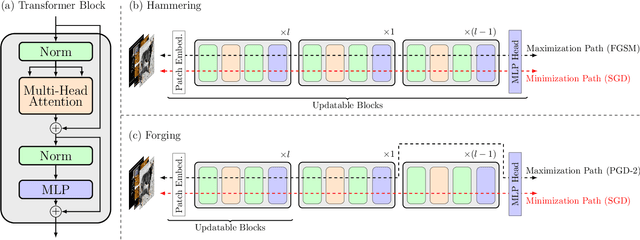
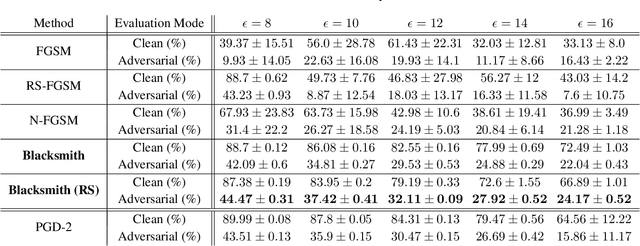
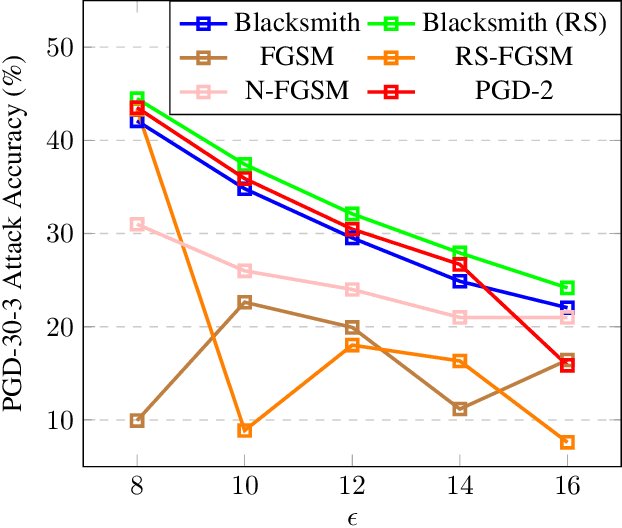
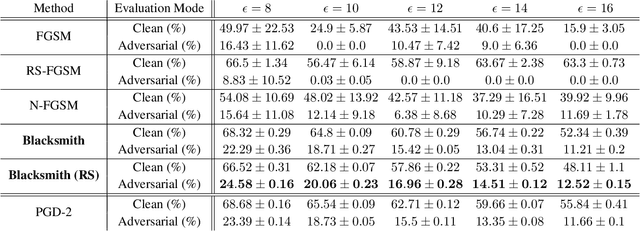
Despite the remarkable success achieved by deep learning algorithms in various domains, such as computer vision, they remain vulnerable to adversarial perturbations. Adversarial Training (AT) stands out as one of the most effective solutions to address this issue; however, single-step AT can lead to Catastrophic Overfitting (CO). This scenario occurs when the adversarially trained network suddenly loses robustness against multi-step attacks like Projected Gradient Descent (PGD). Although several approaches have been proposed to address this problem in Convolutional Neural Networks (CNNs), we found out that they do not perform well when applied to Vision Transformers (ViTs). In this paper, we propose Blacksmith, a novel training strategy to overcome the CO problem, specifically in ViTs. Our approach utilizes either of PGD-2 or Fast Gradient Sign Method (FGSM) randomly in a mini-batch during the adversarial training of the neural network. This will increase the diversity of our training attacks, which could potentially mitigate the CO issue. To manage the increased training time resulting from this combination, we craft the PGD-2 attack based on only the first half of the layers, while FGSM is applied end-to-end. Through our experiments, we demonstrate that our novel method effectively prevents CO, achieves PGD-2 level performance, and outperforms other existing techniques including N-FGSM, which is the state-of-the-art method in fast training for CNNs.