 Add to Chrome
 Add to Firefox
 Add to Edge
Explainable Admission-Level Predictive Modeling for Prolonged Hospital Stay in Elderly Populations: Challenges in Low- and Middle-Income Countries
Jan 07, 2026
Prolonged length of stay (pLoS) is a significant factor associated with the risk of adverse in-hospital events. We develop and explain a predictive model for pLos using admission-level patient and hospital administrative data. The approach includes a feature selection method by selecting non-correlated features with the highest information value. The method uses features weights of evidence to select a representative within cliques from graph theory. The prognosis study analyzed the records from 120,354 hospital admissions at the Hospital Alma Mater de Antioquia between January 2017 and March 2022. After a cleaning process the dataset was split into training (67%), test (22%), and validation (11%) cohorts. A logistic regression model was trained to predict the pLoS in two classes: less than or greater than 7 days. The performance of the model was evaluated using accuracy, precision, sensitivity, specificity, and AUC-ROC metrics. The feature selection method returns nine interpretable variables, enhancing the models' transparency. In the validation cohort, the pLoS model achieved a specificity of 0.83 (95% CI, 0.82-0.84), sensitivity of 0.64 (95% CI, 0.62-0.65), accuracy of 0.76 (95% CI, 0.76-0.77), precision of 0.67 (95% CI, 0.66-0.69), and AUC-ROC of 0.82 (95% CI, 0.81-0.83). The model exhibits strong predictive performance and offers insights into the factors that influence prolonged hospital stays. This makes it a valuable tool for hospital management and for developing future intervention studies aimed at reducing pLoS.

Alien Recombination: Exploring Concept Blends Beyond Human Cognitive Availability in Visual Art
Nov 18, 2024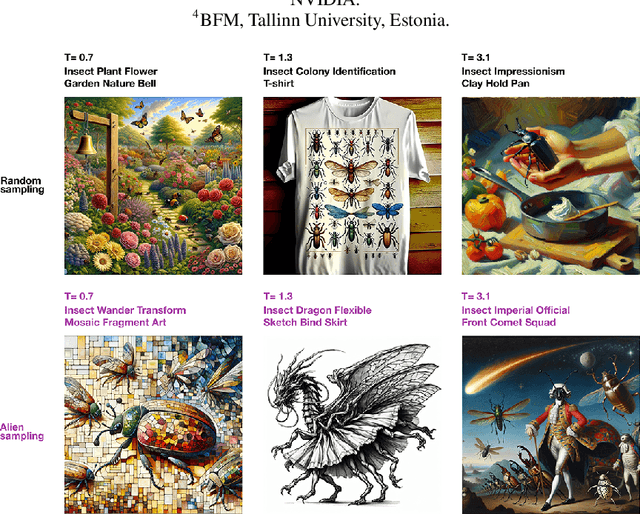
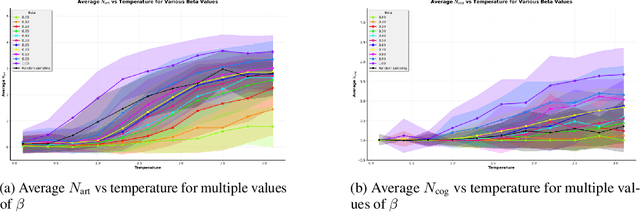
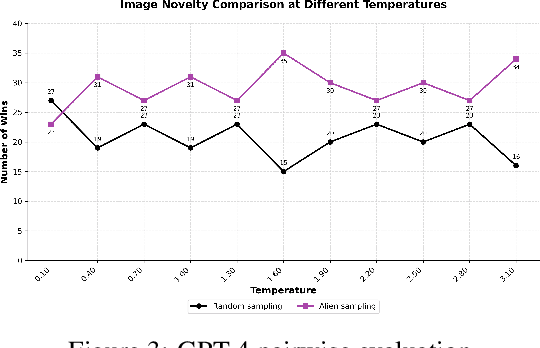
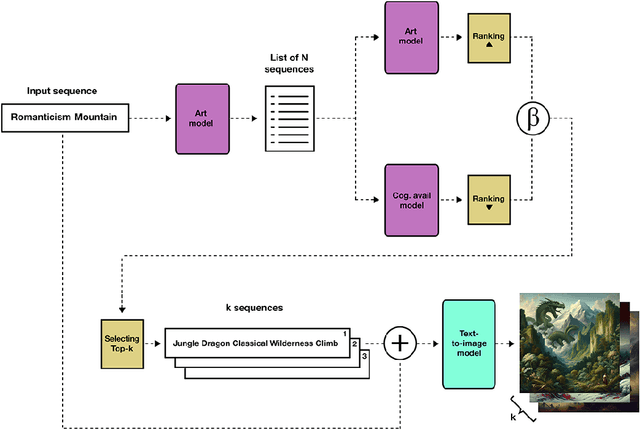
While AI models have demonstrated remarkable capabilities in constrained domains like game strategy, their potential for genuine creativity in open-ended domains like art remains debated. We explore this question by examining how AI can transcend human cognitive limitations in visual art creation. Our research hypothesizes that visual art contains a vast unexplored space of conceptual combinations, constrained not by inherent incompatibility, but by cognitive limitations imposed by artists' cultural, temporal, geographical and social contexts. To test this hypothesis, we present the Alien Recombination method, a novel approach utilizing fine-tuned large language models to identify and generate concept combinations that lie beyond human cognitive availability. The system models and deliberately counteracts human availability bias, the tendency to rely on immediately accessible examples, to discover novel artistic combinations. This system not only produces combinations that have never been attempted before within our dataset but also identifies and generates combinations that are cognitively unavailable to all artists in the domain. Furthermore, we translate these combinations into visual representations, enabling the exploration of subjective perceptions of novelty. Our findings suggest that cognitive unavailability is a promising metric for optimizing artistic novelty, outperforming merely temperature scaling without additional evaluation criteria. This approach uses generative models to connect previously unconnected ideas, providing new insight into the potential of framing AI-driven creativity as a combinatorial problem.