 Add to Chrome
 Add to Firefox
 Add to Edge
WAXAL: A Large-Scale Multilingual African Language Speech Corpus
Feb 02, 2026
The advancement of speech technology has predominantly favored high-resource languages, creating a significant digital divide for speakers of most Sub-Saharan African languages. To address this gap, we introduce WAXAL, a large-scale, openly accessible speech dataset for 21 languages representing over 100 million speakers. The collection consists of two main components: an Automated Speech Recognition (ASR) dataset containing approximately 1,250 hours of transcribed, natural speech from a diverse range of speakers, and a Text-to-Speech (TTS) dataset with over 180 hours of high-quality, single-speaker recordings reading phonetically balanced scripts. This paper details our methodology for data collection, annotation, and quality control, which involved partnerships with four African academic and community organizations. We provide a detailed statistical overview of the dataset and discuss its potential limitations and ethical considerations. The WAXAL datasets are released at https://huggingface.co/datasets/google/WaxalNLP under the permissive CC-BY-4.0 license to catalyze research, enable the development of inclusive technologies, and serve as a vital resource for the digital preservation of these languages.

LLM Augmented LLMs: Expanding Capabilities through Composition
Jan 04, 2024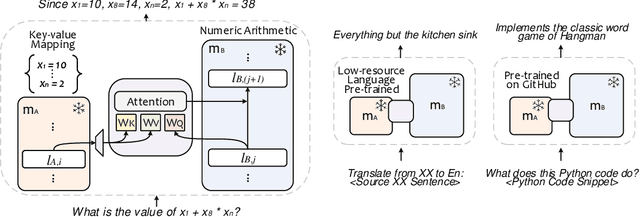
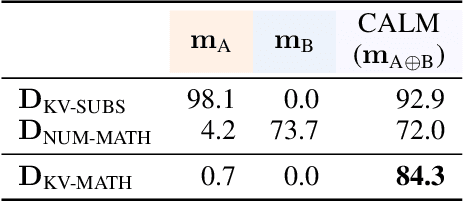
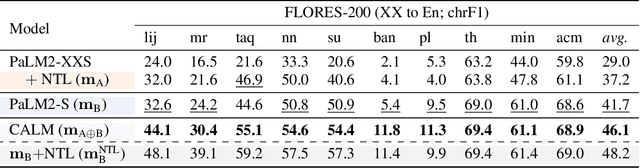
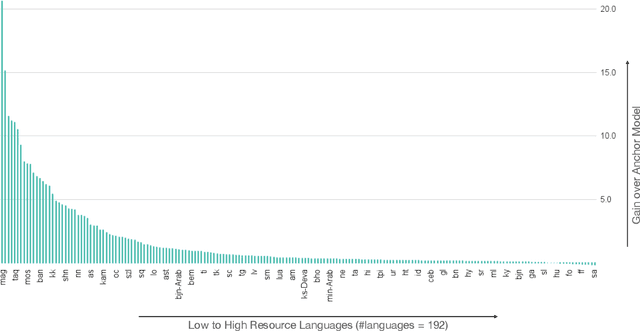
Foundational models with billions of parameters which have been trained on large corpora of data have demonstrated non-trivial skills in a variety of domains. However, due to their monolithic structure, it is challenging and expensive to augment them or impart new skills. On the other hand, due to their adaptation abilities, several new instances of these models are being trained towards new domains and tasks. In this work, we study the problem of efficient and practical composition of existing foundation models with more specific models to enable newer capabilities. To this end, we propose CALM -- Composition to Augment Language Models -- which introduces cross-attention between models to compose their representations and enable new capabilities. Salient features of CALM are: (i) Scales up LLMs on new tasks by 're-using' existing LLMs along with a few additional parameters and data, (ii) Existing model weights are kept intact, and hence preserves existing capabilities, and (iii) Applies to diverse domains and settings. We illustrate that augmenting PaLM2-S with a smaller model trained on low-resource languages results in an absolute improvement of up to 13\% on tasks like translation into English and arithmetic reasoning for low-resource languages. Similarly, when PaLM2-S is augmented with a code-specific model, we see a relative improvement of 40\% over the base model for code generation and explanation tasks -- on-par with fully fine-tuned counterparts.