 Add to Chrome
 Add to Firefox
 Add to Edge
End-to-end differentiable design of geometric waveguide displays
Jan 07, 2026
Geometric waveguides are a promising architecture for optical see-through augmented reality displays, but their performance is severely bottlenecked by the difficulty of jointly optimizing non-sequential light transport and polarization-dependent multilayer thin-film coatings. Here we present the first end-to-end differentiable optimization framework for geometric waveguide that couples non-sequential Monte Carlo polarization ray tracing with a differentiable transfer-matrix thin-film solver. A differentiable Monte Carlo ray tracer avoids the exponential growth of deterministic ray splitting while enabling gradients backpropagation from eyebox metrics to design parameters. With memory-saving strategies, we optimize more than one thousand layer-thickness parameters and billions of non-sequential ray-surface intersections on a single multi-GPU workstation. Automated layer pruning is achieved by starting from over-parameterized stacks and driving redundant layers to zero thickness under discrete manufacturability constraints, effectively performing topology optimization to discover optimal coating structures. On a representative design, starting from random initialization within thickness bounds, our method increases light efficiency from 4.1\% to 33.5\% and improves eyebox and FoV uniformity by $\sim$17$\times$ and $\sim$11$\times$, respectively. Furthermore, we jointly optimize the waveguide and an image preprocessing network to improve perceived image quality. Our framework not only enables system-level, high-dimensional coating optimization inside the waveguide, but also expands the scope of differentiable optics for next-generation optical design.

Confocal super-resolution microscopy based on a spatial mode sorter
Jan 11, 2021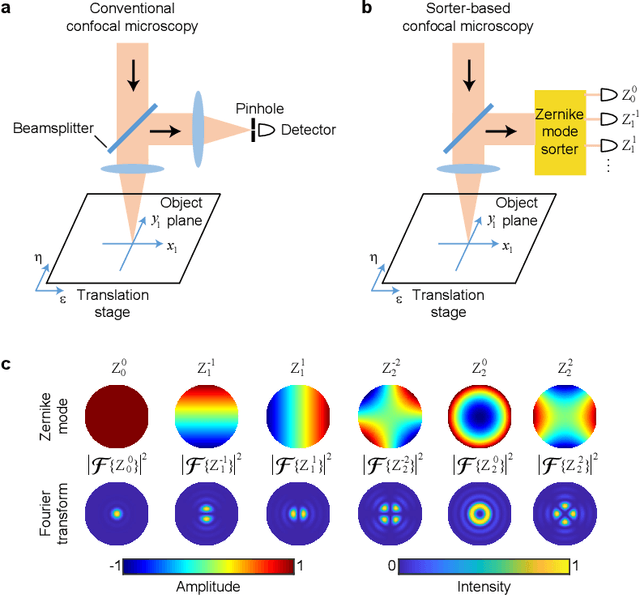
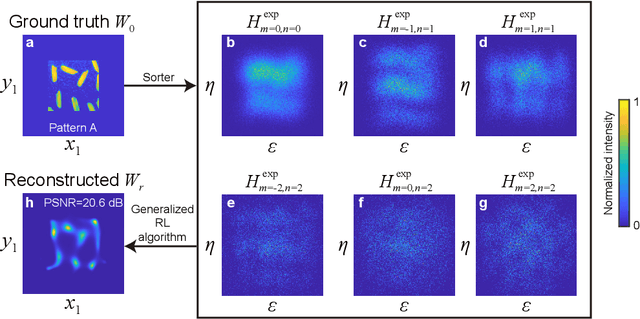
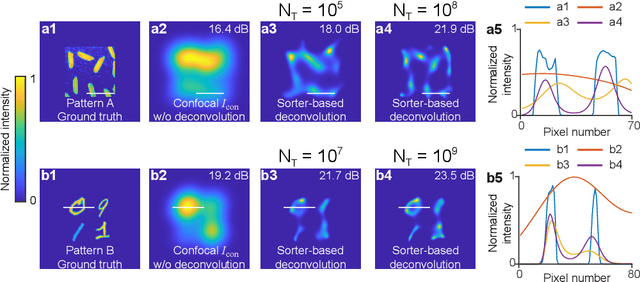
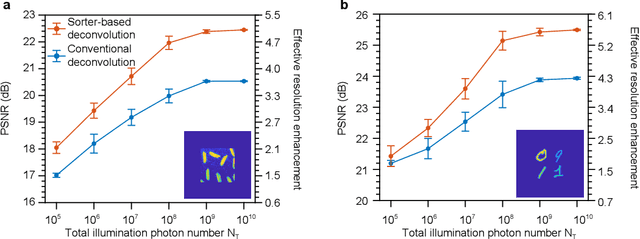
Spatial resolution is one of the most important specifications of an imaging system. Recent results in quantum parameter estimation theory reveal that an arbitrarily small distance between two incoherent point sources can always be efficiently determined through the use of a spatial mode sorter. However, extending this procedure to a general object consisting of many incoherent point sources remains challenging, due to the intrinsic complexity of multi-parameter estimation problems. Here, we generalize the Richardson-Lucy (RL) deconvolution algorithm to address this challenge. We simulate its application to an incoherent confocal microscope, with a Zernike spatial mode sorter replacing the pinhole used in a conventional confocal microscope. We test different spatially incoherent objects of arbitrary geometry, and we find that sorter-based microscopy can achieve more than 5-fold resolution enhancement over a diffraction-limited image. In addition, the resolution enhancement of sorter-based microscopy is on average over 30% higher than that of a conventional confocal microscope using the standard RL deconvolution algorithm. Our method could potentially be used in diverse applications such as fluorescent microscopy and astronomical imaging.