 Add to Chrome
 Add to Firefox
 Add to Edge
Reasoning Over Space: Enabling Geographic Reasoning for LLM-Based Generative Next POI Recommendation
Jan 08, 2026
Generative recommendation with large language models (LLMs) reframes prediction as sequence generation, yet existing LLM-based recommenders remain limited in leveraging geographic signals that are crucial in mobility and local-services scenarios. Here, we present Reasoning Over Space (ROS), a framework that utilizes geography as a vital decision variable within the reasoning process. ROS introduces a Hierarchical Spatial Semantic ID (SID) that discretizes coarse-to-fine locality and POI semantics into compositional tokens, and endows LLM with a three-stage Mobility Chain-of-Thought (CoT) paradigm that models user personality, constructs an intent-aligned candidate space, and performs locality informed pruning. We further align the model with real world geography via spatial-guided Reinforcement Learning (RL). Experiments on three widely used location-based social network (LBSN) datasets show that ROS achieves over 10% relative gains in hit rate over strongest LLM-based baselines and improves cross-city transfer, despite using a smaller backbone model.

MVPainter: Accurate and Detailed 3D Texture Generation via Multi-View Diffusion with Geometric Control
May 19, 2025Recently, significant advances have been made in 3D object generation. Building upon the generated geometry, current pipelines typically employ image diffusion models to generate multi-view RGB images, followed by UV texture reconstruction through texture baking. While 3D geometry generation has improved significantly, supported by multiple open-source frameworks, 3D texture generation remains underexplored. In this work, we systematically investigate 3D texture generation through the lens of three core dimensions: reference-texture alignment, geometry-texture consistency, and local texture quality. To tackle these issues, we propose MVPainter, which employs data filtering and augmentation strategies to enhance texture fidelity and detail, and introduces ControlNet-based geometric conditioning to improve texture-geometry alignment. Furthermore, we extract physically-based rendering (PBR) attributes from the generated views to produce PBR meshes suitable for real-world rendering applications. MVPainter achieves state-of-the-art results across all three dimensions, as demonstrated by human-aligned evaluations. To facilitate further research and reproducibility, we also release our full pipeline as an open-source system, including data construction, model architecture, and evaluation tools.
HumanRig: Learning Automatic Rigging for Humanoid Character in a Large Scale Dataset
Dec 03, 2024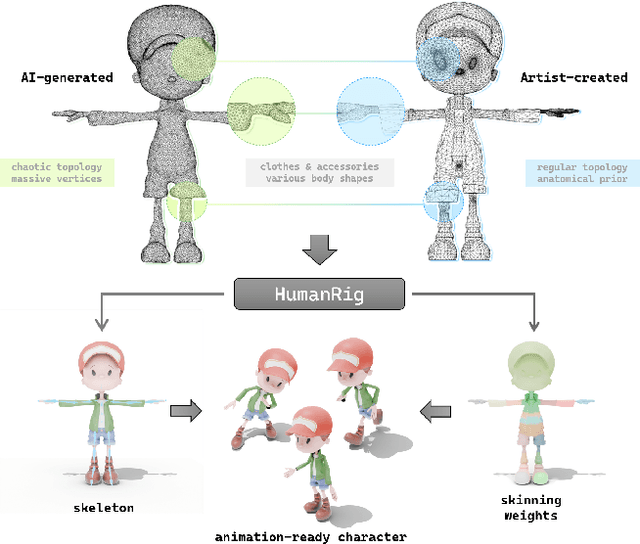

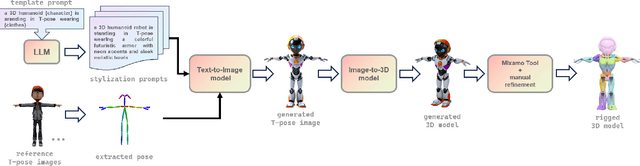

With the rapid evolution of 3D generation algorithms, the cost of producing 3D humanoid character models has plummeted, yet the field is impeded by the lack of a comprehensive dataset for automatic rigging, which is a pivotal step in character animation. Addressing this gap, we present HumanRig, the first large-scale dataset specifically designed for 3D humanoid character rigging, encompassing 11,434 meticulously curated T-posed meshes adhered to a uniform skeleton topology. Capitalizing on this dataset, we introduce an innovative, data-driven automatic rigging framework, which overcomes the limitations of GNN-based methods in handling complex AI-generated meshes. Our approach integrates a Prior-Guided Skeleton Estimator (PGSE) module, which uses 2D skeleton joints to provide a preliminary 3D skeleton, and a Mesh-Skeleton Mutual Attention Network (MSMAN) that fuses skeleton features with 3D mesh features extracted by a U-shaped point transformer. This enables a coarse-to-fine 3D skeleton joint regression and a robust skinning estimation, surpassing previous methods in quality and versatility. This work not only remedies the dataset deficiency in rigging research but also propels the animation industry towards more efficient and automated character rigging pipelines.