 Add to Chrome
 Add to Firefox
 Add to Edge
PATS: Personality-Aware Teaching Strategies with Large Language Model Tutors
Jan 13, 2026
Recent advances in large language models (LLMs) demonstrate their potential as educational tutors. However, different tutoring strategies benefit different student personalities, and mismatches can be counterproductive to student outcomes. Despite this, current LLM tutoring systems do not take into account student personality traits. To address this problem, we first construct a taxonomy that links pedagogical methods to personality profiles, based on pedagogical literature. We simulate student-teacher conversations and use our framework to let the LLM tutor adjust its strategy to the simulated student personality. We evaluate the scenario with human teachers and find that they consistently prefer our approach over two baselines. Our method also increases the use of less common, high-impact strategies such as role-playing, which human and LLM annotators prefer significantly. Our findings pave the way for developing more personalized and effective LLM use in educational applications.

Robust Anomaly Detection for Time-series Data
Feb 06, 2022
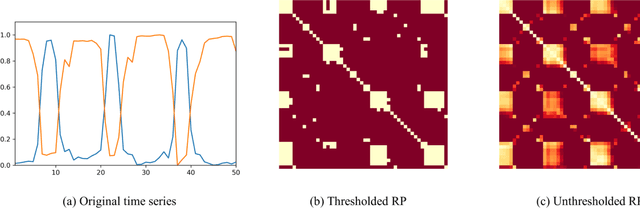
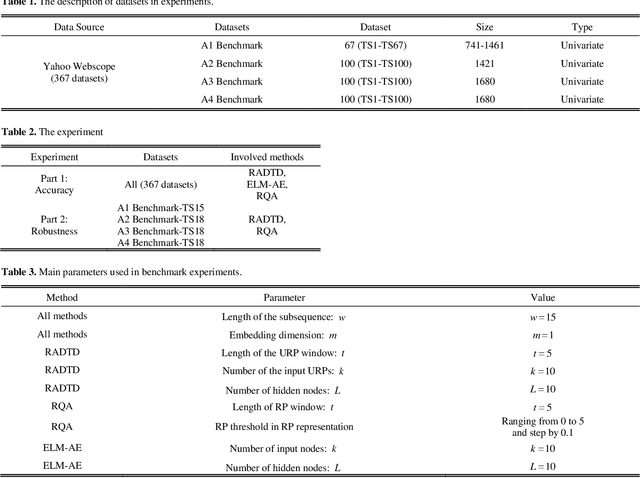
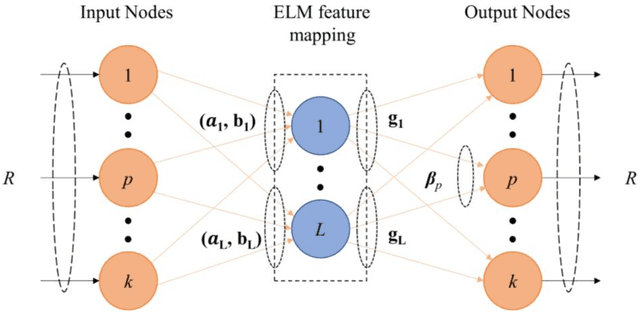
Time-series anomaly detection plays a vital role in monitoring complex operation conditions. However, the detection accuracy of existing approaches is heavily influenced by pattern distribution, existence of multiple normal patterns, dynamical features representation, and parameter settings. For the purpose of improving the robustness and guaranteeing the accuracy, this research combined the strengths of negative selection, unthresholded recurrence plots, and an extreme learning machine autoencoder and then proposed robust anomaly detection for time-series data (RADTD), which can automatically learn dynamical features in time series and recognize anomalies with low label dependency and high robustness. Yahoo benchmark datasets and three tunneling engineering simulation experiments were used to evaluate the performance of RADTD. The experiments showed that in benchmark datasets RADTD possessed higher accuracy and robustness than recurrence qualification analysis and extreme learning machine autoencoder, respectively, and that RADTD accurately detected the occurrence of tunneling settlement accidents, indicating its remarkable performance in accuracy and robustness.