 Add to Chrome
 Add to Firefox
 Add to Edge
SkyReels-V3 Technique Report
Jan 24, 2026
Video generation serves as a cornerstone for building world models, where multimodal contextual inference stands as the defining test of capability. In this end, we present SkyReels-V3, a conditional video generation model, built upon a unified multimodal in-context learning framework with diffusion Transformers. SkyReels-V3 model supports three core generative paradigms within a single architecture: reference images-to-video synthesis, video-to-video extension and audio-guided video generation. (i) reference images-to-video model is designed to produce high-fidelity videos with strong subject identity preservation, temporal coherence, and narrative consistency. To enhance reference adherence and compositional stability, we design a comprehensive data processing pipeline that leverages cross frame pairing, image editing, and semantic rewriting, effectively mitigating copy paste artifacts. During training, an image video hybrid strategy combined with multi-resolution joint optimization is employed to improve generalization and robustness across diverse scenarios. (ii) video extension model integrates spatio-temporal consistency modeling with large-scale video understanding, enabling both seamless single-shot continuation and intelligent multi-shot switching with professional cinematographic patterns. (iii) Talking avatar model supports minute-level audio-conditioned video generation by training first-and-last frame insertion patterns and reconstructing key-frame inference paradigms. On the basis of ensuring visual quality, synchronization of audio and videos has been optimized. Extensive evaluations demonstrate that SkyReels-V3 achieves state-of-the-art or near state-of-the-art performance on key metrics including visual quality, instruction following, and specific aspect metrics, approaching leading closed-source systems. Github: https://github.com/SkyworkAI/SkyReels-V3.

Dimba: Transformer-Mamba Diffusion Models
Jun 03, 2024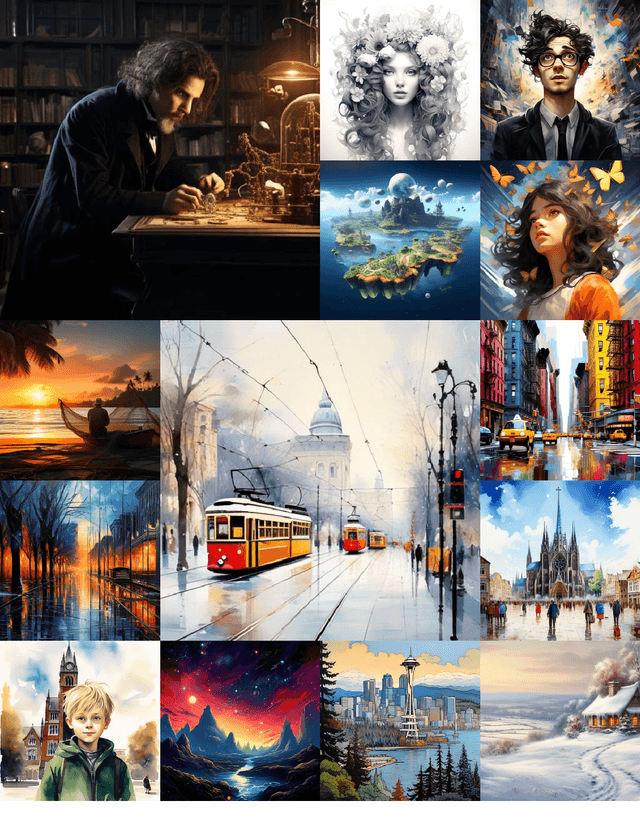
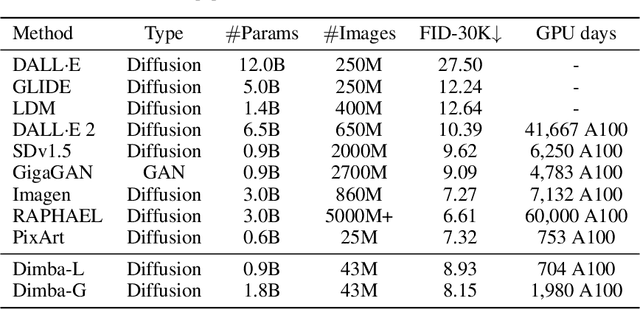
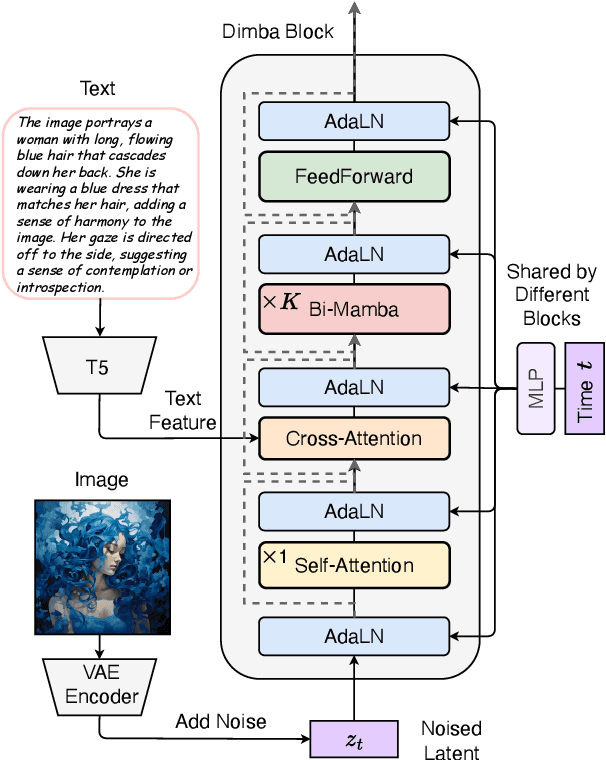
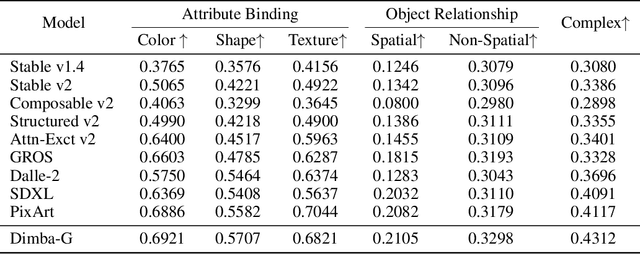
This paper unveils Dimba, a new text-to-image diffusion model that employs a distinctive hybrid architecture combining Transformer and Mamba elements. Specifically, Dimba sequentially stacked blocks alternate between Transformer and Mamba layers, and integrate conditional information through the cross-attention layer, thus capitalizing on the advantages of both architectural paradigms. We investigate several optimization strategies, including quality tuning, resolution adaption, and identify critical configurations necessary for large-scale image generation. The model's flexible design supports scenarios that cater to specific resource constraints and objectives. When scaled appropriately, Dimba offers substantial throughput and a reduced memory footprint relative to conventional pure Transformers-based benchmarks. Extensive experiments indicate that Dimba achieves comparable performance compared with benchmarks in terms of image quality, artistic rendering, and semantic control. We also report several intriguing properties of architecture discovered during evaluation and release checkpoints in experiments. Our findings emphasize the promise of large-scale hybrid Transformer-Mamba architectures in the foundational stage of diffusion models, suggesting a bright future for text-to-image generation.