 Add to Chrome
 Add to Firefox
 Add to Edge
Exploring Syn-to-Real Domain Adaptation for Military Target Detection
Dec 29, 2025
Object detection is one of the key target tasks of interest in the context of civil and military applications. In particular, the real-world deployment of target detection methods is pivotal in the decision-making process during military command and reconnaissance. However, current domain adaptive object detection algorithms consider adapting one domain to another similar one only within the scope of natural or autonomous driving scenes. Since military domains often deal with a mixed variety of environments, detecting objects from multiple varying target domains poses a greater challenge. Several studies for armored military target detection have made use of synthetic aperture radar (SAR) data due to its robustness to all weather, long range, and high-resolution characteristics. Nevertheless, the costs of SAR data acquisition and processing are still much higher than those of the conventional RGB camera, which is a more affordable alternative with significantly lower data processing time. Furthermore, the lack of military target detection datasets limits the use of such a low-cost approach. To mitigate these issues, we propose to generate RGB-based synthetic data using a photorealistic visual tool, Unreal Engine, for military target detection in a cross-domain setting. To this end, we conducted synthetic-to-real transfer experiments by training our synthetic dataset and validating on our web-collected real military target datasets. We benchmark the state-of-the-art domain adaptation methods distinguished by the degree of supervision on our proposed train-val dataset pair, and find that current methods using minimal hints on the image (e.g., object class) achieve a substantial improvement over unsupervised or semi-supervised DA methods. From these observations, we recognize the current challenges that remain to be overcome.

Towards Controllable Real Image Denoising with Camera Parameters
Jul 02, 2025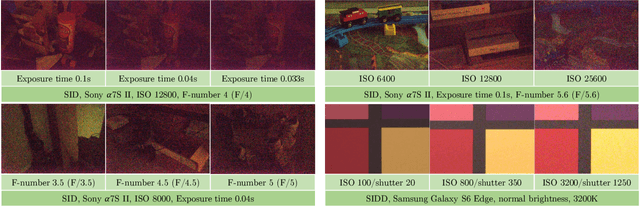

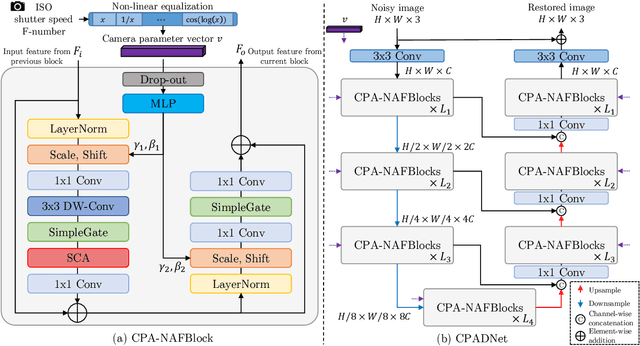
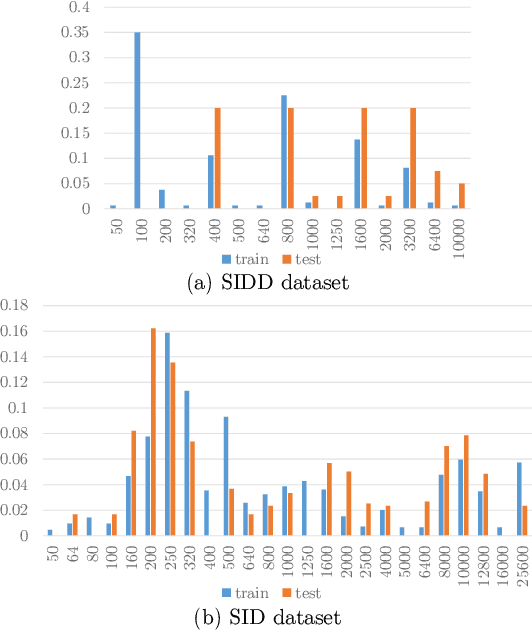
Recent deep learning-based image denoising methods have shown impressive performance; however, many lack the flexibility to adjust the denoising strength based on the noise levels, camera settings, and user preferences. In this paper, we introduce a new controllable denoising framework that adaptively removes noise from images by utilizing information from camera parameters. Specifically, we focus on ISO, shutter speed, and F-number, which are closely related to noise levels. We convert these selected parameters into a vector to control and enhance the performance of the denoising network. Experimental results show that our method seamlessly adds controllability to standard denoising neural networks and improves their performance. Code is available at https://github.com/OBAKSA/CPADNet.
Domain Generalization Emerges from Dreaming
Feb 02, 2023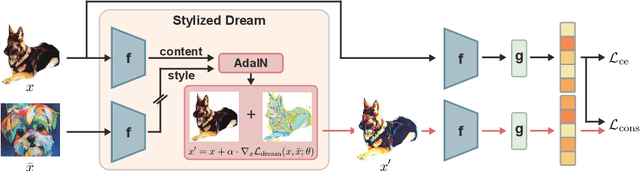
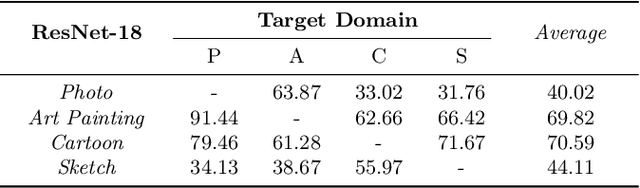
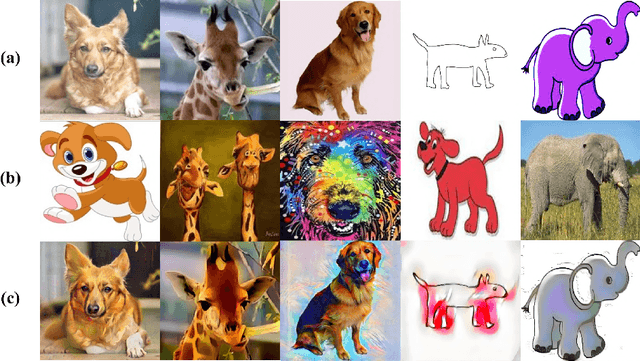
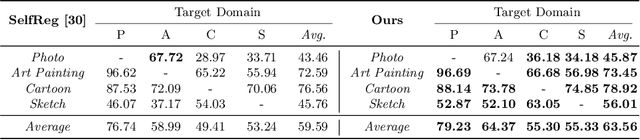
Recent studies have proven that DNNs, unlike human vision, tend to exploit texture information rather than shape. Such texture bias is one of the factors for the poor generalization performance of DNNs. We observe that the texture bias negatively affects not only in-domain generalization but also out-of-distribution generalization, i.e., Domain Generalization. Motivated by the observation, we propose a new framework to reduce the texture bias of a model by a novel optimization-based data augmentation, dubbed Stylized Dream. Our framework utilizes adaptive instance normalization (AdaIN) to augment the style of an original image yet preserve the content. We then adopt a regularization loss to predict consistent outputs between Stylized Dream and original images, which encourages the model to learn shape-based representations. Extensive experiments show that the proposed method achieves state-of-the-art performance in out-of-distribution settings on public benchmark datasets: PACS, VLCS, OfficeHome, TerraIncognita, and DomainNet.