 Add to Chrome
 Add to Firefox
 Add to Edge
The Llama 4 Herd: Architecture, Training, Evaluation, and Deployment Notes
Jan 15, 2026
This document consolidates publicly reported technical details about Metas Llama 4 model family. It summarizes (i) released variants (Scout and Maverick) and the broader herd context including the previewed Behemoth teacher model, (ii) architectural characteristics beyond a high-level MoE description covering routed/shared-expert structure, early-fusion multimodality, and long-context design elements reported for Scout (iRoPE and length generalization strategies), (iii) training disclosures spanning pre-training, mid-training for long-context extension, and post-training methodology (lightweight SFT, online RL, and lightweight DPO) as described in release materials, (iv) developer-reported benchmark results for both base and instruction-tuned checkpoints, and (v) practical deployment constraints observed across major serving environments, including provider-specific context limits and quantization packaging. The manuscript also summarizes licensing obligations relevant to redistribution and derivative naming, and reviews publicly described safeguards and evaluation practices. The goal is to provide a compact technical reference for researchers and practitioners who need precise, source-backed facts about Llama 4.

Open Sesame: Getting Inside BERT's Linguistic Knowledge
Jun 04, 2019
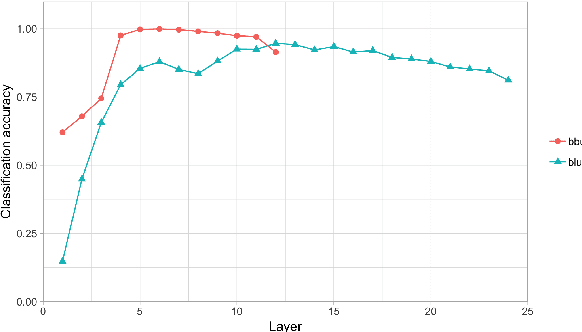
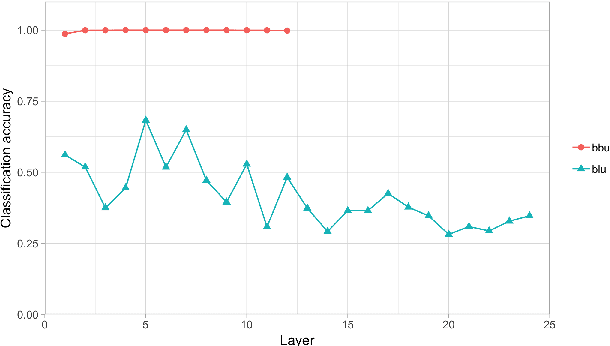
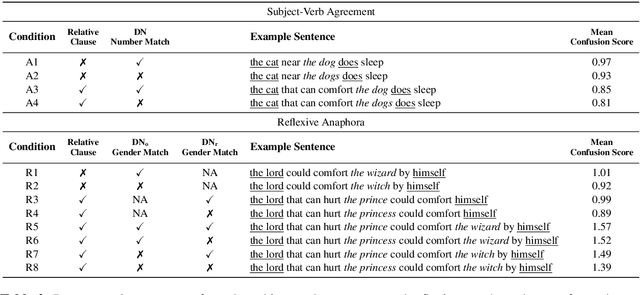
How and to what extent does BERT encode syntactically-sensitive hierarchical information or positionally-sensitive linear information? Recent work has shown that contextual representations like BERT perform well on tasks that require sensitivity to linguistic structure. We present here two studies which aim to provide a better understanding of the nature of BERT's representations. The first of these focuses on the identification of structurally-defined elements using diagnostic classifiers, while the second explores BERT's representation of subject-verb agreement and anaphor-antecedent dependencies through a quantitative assessment of self-attention vectors. In both cases, we find that BERT encodes positional information about word tokens well on its lower layers, but switches to a hierarchically-oriented encoding on higher layers. We conclude then that BERT's representations do indeed model linguistically relevant aspects of hierarchical structure, though they do not appear to show the sharp sensitivity to hierarchical structure that is found in human processing of reflexive anaphora.