 Add to Chrome
 Add to Firefox
 Add to Edge
Towards Agentic Intelligence for Materials Science
Jan 29, 2026
The convergence of artificial intelligence and materials science presents a transformative opportunity, but achieving true acceleration in discovery requires moving beyond task-isolated, fine-tuned models toward agentic systems that plan, act, and learn across the full discovery loop. This survey advances a unique pipeline-centric view that spans from corpus curation and pretraining, through domain adaptation and instruction tuning, to goal-conditioned agents interfacing with simulation and experimental platforms. Unlike prior reviews, we treat the entire process as an end-to-end system to be optimized for tangible discovery outcomes rather than proxy benchmarks. This perspective allows us to trace how upstream design choices-such as data curation and training objectives-can be aligned with downstream experimental success through effective credit assignment. To bridge communities and establish a shared frame of reference, we first present an integrated lens that aligns terminology, evaluation, and workflow stages across AI and materials science. We then analyze the field through two focused lenses: From the AI perspective, the survey details LLM strengths in pattern recognition, predictive analytics, and natural language processing for literature mining, materials characterization, and property prediction; from the materials science perspective, it highlights applications in materials design, process optimization, and the acceleration of computational workflows via integration with external tools (e.g., DFT, robotic labs). Finally, we contrast passive, reactive approaches with agentic design, cataloging current contributions while motivating systems that pursue long-horizon goals with autonomy, memory, and tool use. This survey charts a practical roadmap towards autonomous, safety-aware LLM agents aimed at discovering novel and useful materials.

M^4olGen: Multi-Agent, Multi-Stage Molecular Generation under Precise Multi-Property Constraints
Jan 16, 2026Generating molecules that satisfy precise numeric constraints over multiple physicochemical properties is critical and challenging. Although large language models (LLMs) are expressive, they struggle with precise multi-objective control and numeric reasoning without external structure and feedback. We introduce \textbf{M olGen}, a fragment-level, retrieval-augmented, two-stage framework for molecule generation under multi-property constraints. Stage I : Prototype generation: a multi-agent reasoner performs retrieval-anchored, fragment-level edits to produce a candidate near the feasible region. Stage II : RL-based fine-grained optimization: a fragment-level optimizer trained with Group Relative Policy Optimization (GRPO) applies one- or multi-hop refinements to explicitly minimize the property errors toward our target while regulating edit complexity and deviation from the prototype. A large, automatically curated dataset with reasoning chains of fragment edits and measured property deltas underpins both stages, enabling deterministic, reproducible supervision and controllable multi-hop reasoning. Unlike prior work, our framework better reasons about molecules by leveraging fragments and supports controllable refinement toward numeric targets. Experiments on generation under two sets of property constraints (QED, LogP, Molecular Weight and HOMO, LUMO) show consistent gains in validity and precise satisfaction of multi-property targets, outperforming strong LLMs and graph-based algorithms.
Improving Clinical Note Generation from Complex Doctor-Patient Conversation
Aug 26, 2024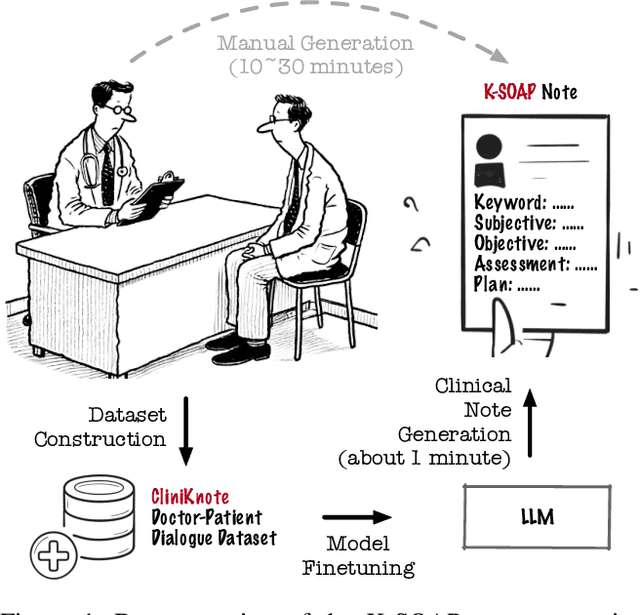

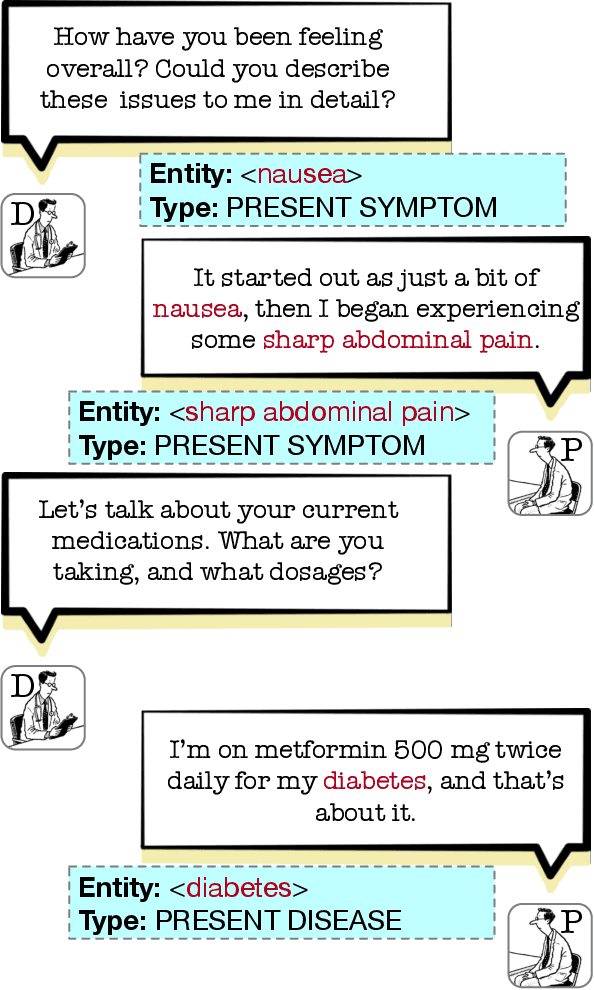
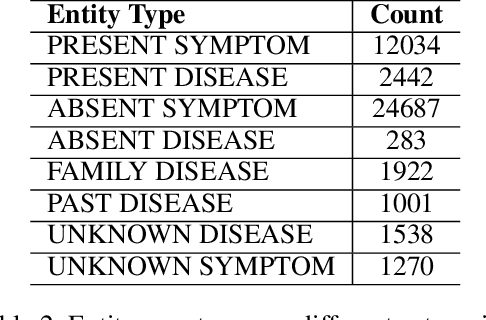
Writing clinical notes and documenting medical exams is a critical task for healthcare professionals, serving as a vital component of patient care documentation. However, manually writing these notes is time-consuming and can impact the amount of time clinicians can spend on direct patient interaction and other tasks. Consequently, the development of automated clinical note generation systems has emerged as a clinically meaningful area of research within AI for health. In this paper, we present three key contributions to the field of clinical note generation using large language models (LLMs). First, we introduce CliniKnote, a comprehensive dataset consisting of 1,200 complex doctor-patient conversations paired with their full clinical notes. This dataset, created and curated by medical experts with the help of modern neural networks, provides a valuable resource for training and evaluating models in clinical note generation tasks. Second, we propose the K-SOAP (Keyword, Subjective, Objective, Assessment, and Plan) note format, which enhances traditional SOAP~\cite{podder2023soap} (Subjective, Objective, Assessment, and Plan) notes by adding a keyword section at the top, allowing for quick identification of essential information. Third, we develop an automatic pipeline to generate K-SOAP notes from doctor-patient conversations and benchmark various modern LLMs using various metrics. Our results demonstrate significant improvements in efficiency and performance compared to standard LLM finetuning methods.