 Add to Chrome
 Add to Firefox
 Add to Edge
OUTLINEFORGE: Hierarchical Reinforcement Learning with Explicit States for Scientific Writing
Jan 14, 2026
Scientific paper generation requires document-level planning and factual grounding, but current large language models, despite their strong local fluency, often fail in global structure, input coverage, and citation consistency. We present a reinforcement learning framework that casts scientific outline construction as a long-horizon planning problem over hierarchical document structures. Our approach models edit evolving outlines through structured actions, enabling the system to incrementally build a complete scientific manuscript. To support effective and stabilize learning,we introduce a two-stage optimization procedure consisting of (i) backward outline reconstruction from partial plans to enforce global structural consistency, and (ii) forward value-guided reinforcement learning with rewards explicitly modeling scientific correctness, discourse coherence, and citation fidelity. In addition, We further introduce a benchmark for scientific paper generation that evaluates document planning, input utilization, reference faithfulness, outline organization, and content-level factual accuracy. Our results show consistent improvements over strong neural and LLM baselines, particularly in long-range structural coherence and citation reliability.

Offline Reinforcement Learning for LLM Multi-Step Reasoning
Dec 20, 2024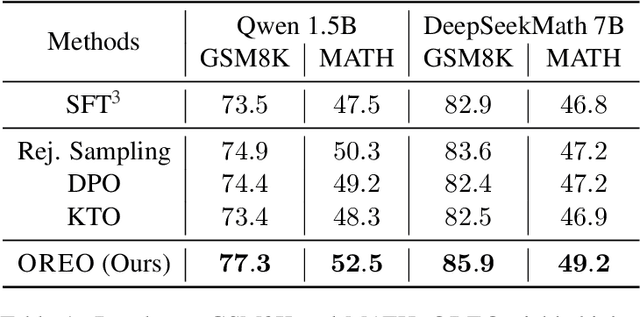
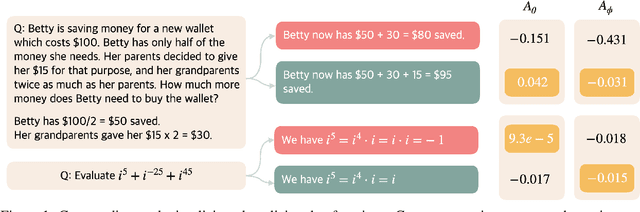
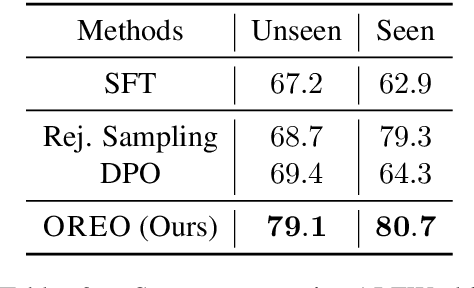
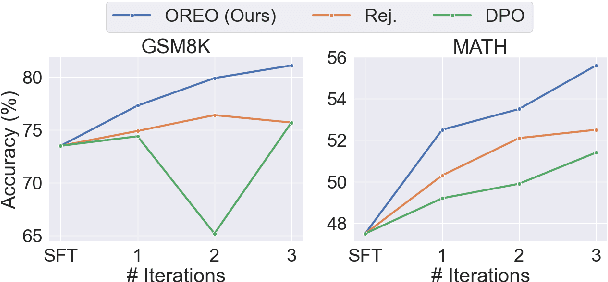
Improving the multi-step reasoning ability of large language models (LLMs) with offline reinforcement learning (RL) is essential for quickly adapting them to complex tasks. While Direct Preference Optimization (DPO) has shown promise in aligning LLMs with human preferences, it is less suitable for multi-step reasoning tasks because (1) DPO relies on paired preference data, which is not readily available for multi-step reasoning tasks, and (2) it treats all tokens uniformly, making it ineffective for credit assignment in multi-step reasoning tasks, which often come with sparse reward. In this work, we propose OREO (Offline Reasoning Optimization), an offline RL method for enhancing LLM multi-step reasoning. Building on insights from previous works of maximum entropy reinforcement learning, it jointly learns a policy model and value function by optimizing the soft Bellman Equation. We show in principle that it reduces the need to collect pairwise data and enables better credit assignment. Empirically, OREO surpasses existing offline learning methods on multi-step reasoning benchmarks, including mathematical reasoning tasks (GSM8K, MATH) and embodied agent control (ALFWorld). The approach can be extended to a multi-iteration framework when additional resources are available. Furthermore, the learned value function can be leveraged to guide the tree search for free, which can further boost performance during test time.