 Add to Chrome
 Add to Firefox
 Add to Edge
OUTLINEFORGE: Hierarchical Reinforcement Learning with Explicit States for Scientific Writing
Jan 14, 2026
Scientific paper generation requires document-level planning and factual grounding, but current large language models, despite their strong local fluency, often fail in global structure, input coverage, and citation consistency. We present a reinforcement learning framework that casts scientific outline construction as a long-horizon planning problem over hierarchical document structures. Our approach models edit evolving outlines through structured actions, enabling the system to incrementally build a complete scientific manuscript. To support effective and stabilize learning,we introduce a two-stage optimization procedure consisting of (i) backward outline reconstruction from partial plans to enforce global structural consistency, and (ii) forward value-guided reinforcement learning with rewards explicitly modeling scientific correctness, discourse coherence, and citation fidelity. In addition, We further introduce a benchmark for scientific paper generation that evaluates document planning, input utilization, reference faithfulness, outline organization, and content-level factual accuracy. Our results show consistent improvements over strong neural and LLM baselines, particularly in long-range structural coherence and citation reliability.

Hyperbolic Contrastive Learning for Hierarchical 3D Point Cloud Embedding
Jan 07, 2025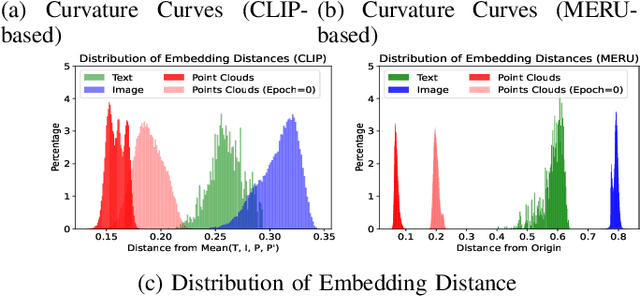
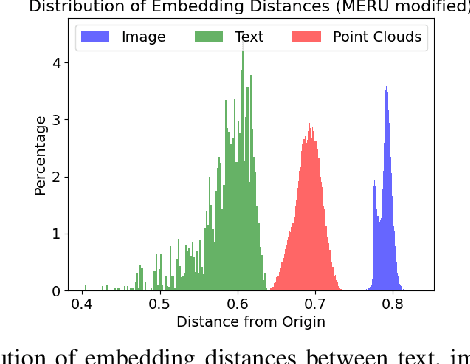
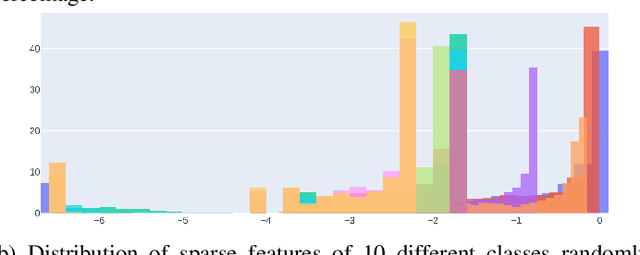
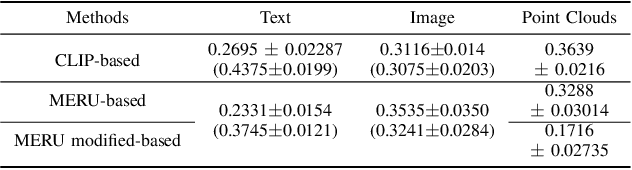
Hyperbolic spaces allow for more efficient modeling of complex, hierarchical structures, which is particularly beneficial in tasks involving multi-modal data. Although hyperbolic geometries have been proven effective for language-image pre-training, their capabilities to unify language, image, and 3D Point Cloud modalities are under-explored. We extend the 3D Point Cloud modality in hyperbolic multi-modal contrastive pre-training. Additionally, we explore the entailment, modality gap, and alignment regularizers for learning hierarchical 3D embeddings and facilitating the transfer of knowledge from both Text and Image modalities. These regularizers enable the learning of intra-modal hierarchy within each modality and inter-modal hierarchy across text, 2D images, and 3D Point Clouds. Experimental results demonstrate that our proposed training strategy yields an outstanding 3D Point Cloud encoder, and the obtained 3D Point Cloud hierarchical embeddings significantly improve performance on various downstream tasks.