 Add to Chrome
 Add to Firefox
 Add to Edge
Antenna Coding Optimization for Pixel Antenna Empowered MIMO Wireless Power Transfer
Jan 12, 2026
We investigate antenna coding utilizing pixel antennas as a new degree of freedom for enhancing multiple-input multiple-output (MIMO) wireless power transfer (WPT) systems. The objective is to enhance the output direct current (DC) power under RF combining and DC combining schemes by jointly exploiting gains from antenna coding, beamforming, and rectenna nonlinearity. We first propose the MIMO WPT system model with binary and continuous antenna coding using the beamspace channel model and formulate the joint antenna coding and beamforming optimization using a nonlinear rectenna model. We propose two efficient closed-form successive convex approximation algorithms to efficiently optimize the beamforming. To further reduce the computational complexity, we propose codebook-based antenna coding designs for output DC power maximization based on K-means clustering. Results show that the proposed pixel antenna empowered MIMO WPT system with binary antenna coding increases output DC power by more than 15 dB compared with conventional systems with fixed antenna configuration. With continuous antenna coding, the performance improves another 6 dB. Moreover, the proposed codebook design outperforms previous designs by up to 40% and shows good performance with reduced computational complexity. Overall, the significant improvement in output DC power verifies the potential of leveraging antenna coding utilizing pixel antennas to enhance WPT systems.

Antenna Coding Optimization Based on Pixel Antennas for MIMO Wireless Power Transfer with DC Combining
Dec 16, 2025This paper investigates antenna coding based on pixel antennas as a new degree of freedom for enhancing multiple-input multiple-output (MIMO) wireless power transfer (WPT) systems. Antenna coding is closely related to the Fluid Antenna System (FAS) concept and further generalizes the radiation pattern reconfigurability. We first introduce a beamspace channel model to demonstrate reconfigurable radiation patterns enabled by antenna coders. By jointly optimizing the antenna coding and transmit beamforming with perfect channel state information (CSI), we exploit gains from antenna coding, transmit beamforming, and rectenna nonlinearity to maximize the output DC power. We adopt an alternating optimization approach with the quasi-Newton method and Successive Exhaustive Boolean Optimization (SEBO) method with warm-start to handle the transmit beamforming design and antenna coding design respectively. Finally, simulation results show that the proposed MIMO WPT system with pixel antennas achieves up to 15 dB gain in average output DC power compared with a conventional system with fixed antenna configuration, highlighting the potential of pixel antennas for boosting the WPT efficiency.
Automatically Planning Optimal Parallel Strategy for Large Language Models
Dec 31, 2024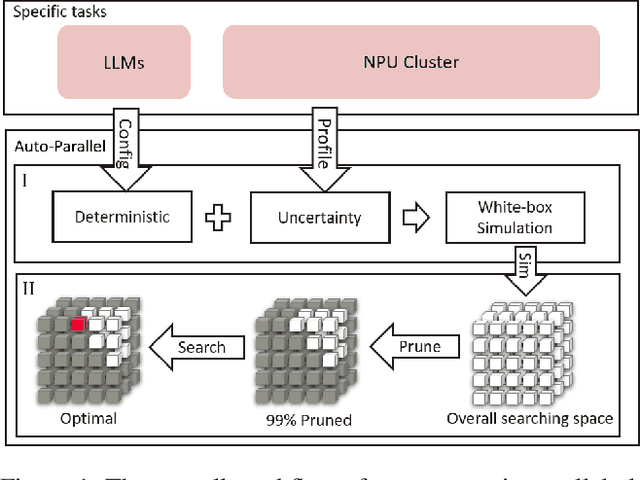
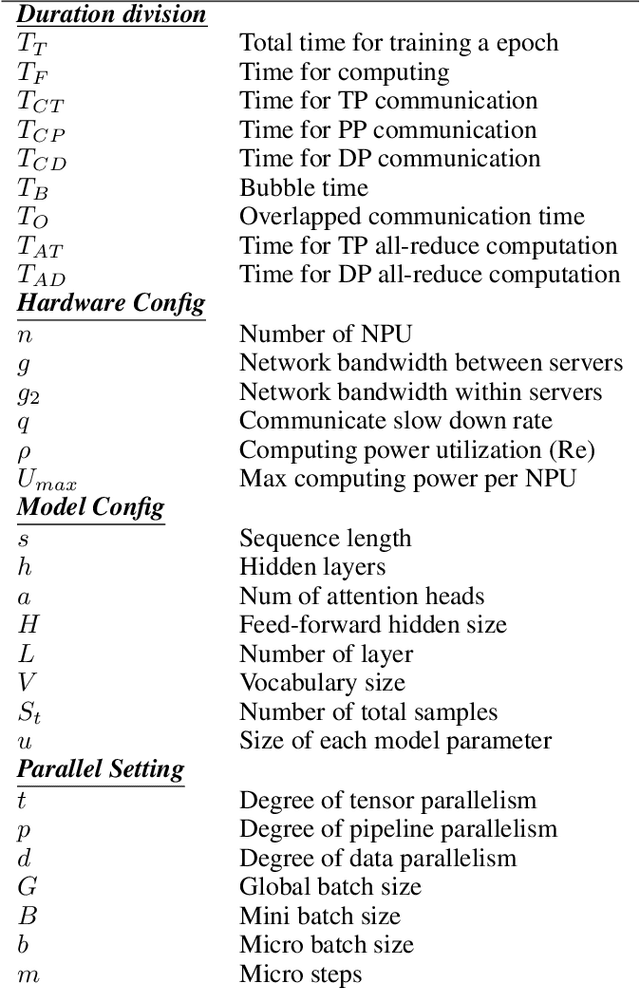
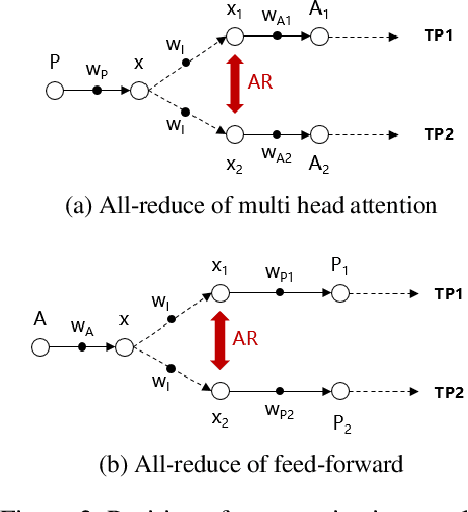
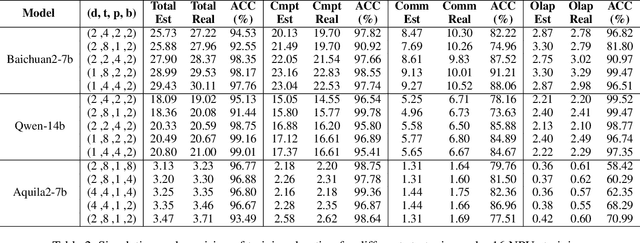
The number of parameters in large-scale language models based on transformers is gradually increasing, and the scale of computing clusters is also growing. The technology of quickly mobilizing large amounts of computing resources for parallel computing is becoming increasingly important. In this paper, we propose an automatic parallel algorithm that automatically plans the parallel strategy with maximum throughput based on model and hardware information. By decoupling the training time into computation, communication, and overlap, we established a training duration simulation model. Based on this simulation model, we prune the parallel solution space to shorten the search time required. The multi-node experiment results show that the algorithm can estimate the parallel training duration in real time with an average accuracy of 96%. In our test, the recommendation strategy provided by the algorithm is always globally optimal.