 Add to Chrome
 Add to Firefox
 Add to Edge
PsychēChat: An Empathic Framework Focused on Emotion Shift Tracking and Safety Risk Analysis in Psychological Counseling
Jan 18, 2026
Large language models (LLMs) have demonstrated notable advancements in psychological counseling. However, existing models generally do not explicitly model seekers' emotion shifts across counseling sessions, a core focus in classical psychological schools. Moreover, how to align counselor models' responses with these emotion shifts while proactively mitigating safety risks remains underexplored. To bridge these gaps, we propose PsychēChat, which explicitly integrates emotion shift tracking and safety risk analysis for psychological counseling. Specifically, we employ interactive role-playing to synthesize counselor--seeker dialogues, incorporating two modules: Emotion Management Module, to capture seekers' current emotions and emotion shifts; and Risk Control Module, to anticipate seekers' subsequent reactions and identify potential risks. Furthermore, we introduce two modeling paradigms. The Agent Mode structures emotion management, risk control, and counselor responses into a collaborative multi-agent pipeline. The LLM Mode integrates these stages into a unified chain-of-thought for end-to-end inference, balancing efficiency and performance. Extensive experiments, including interactive scoring, dialogue-level evaluation, and human assessment, demonstrate that PsychēChat outperforms existing methods for emotional insight and safety control.

PatientEG Dataset: Bringing Event Graph Model with Temporal Relations to Electronic Medical Records
Dec 24, 2018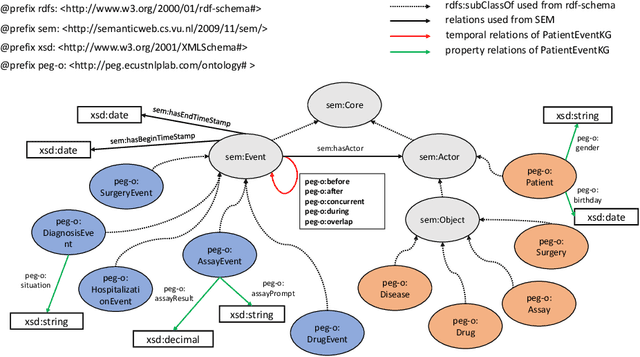
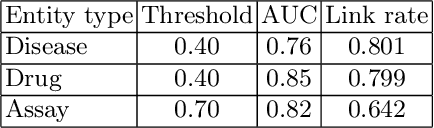
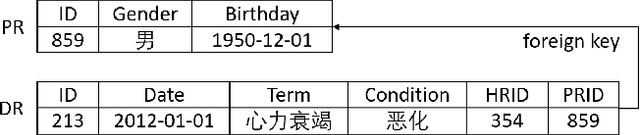
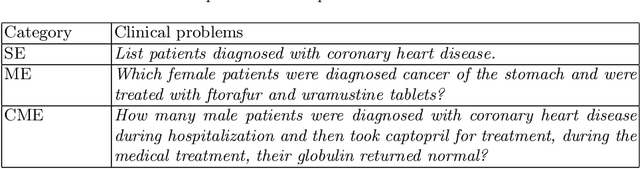
Medical activities, such as diagnoses, medicine treatments, and laboratory tests, as well as temporal relations between these activities are the basic concepts in clinical research. However, existing relational data model on electronic medical records (EMRs) lacks explicit and accurate semantic definitions of these concepts. It leads to the inconvenience of query construction and the inefficiency of query execution where multi-table join queries are frequently required. In this paper, we propose a patient event graph (PatientEG) model to capture the characteristics of EMRs. We respectively define five types of medical entities, five types of medical events and five types of temporal relations. Based on the proposed model, we also construct a PatientEG dataset with 191,294 events, 3,429 distinct entities, and 545,993 temporal relations using EMRs from Shanghai Shuguang hospital. To help to normalize entity values which contain synonyms, hyponymies, and abbreviations, we link them with the Chinese biomedical knowledge graph. With the help of PatientEG dataset, we are able to conveniently perform complex queries for clinical research such as auxiliary diagnosis and therapeutic effectiveness analysis. In addition, we provide a SPARQL endpoint to access PatientEG dataset and the dataset is also publicly available online. Also, we list several illustrative SPARQL queries on our website.