 Add to Chrome
 Add to Firefox
 Add to Edge
Real-Time Lane Detection via Efficient Feature Alignment and Covariance Optimization for Low-Power Embedded Systems
Jan 05, 2026
Real-time lane detection in embedded systems encounters significant challenges due to subtle and sparse visual signals in RGB images, often constrained by limited computational resources and power consumption. Although deep learning models for lane detection categorized into segmentation-based, anchor-based, and curve-based methods there remains a scarcity of universally applicable optimization techniques tailored for low-power embedded environments. To overcome this, we propose an innovative Covariance Distribution Optimization (CDO) module specifically designed for efficient, real-time applications. The CDO module aligns lane feature distributions closely with ground-truth labels, significantly enhancing detection accuracy without increasing computational complexity. Evaluations were conducted on six diverse models across all three method categories, including two optimized for real-time applications and four state-of-the-art (SOTA) models, tested comprehensively on three major datasets: CULane, TuSimple, and LLAMAS. Experimental results demonstrate accuracy improvements ranging from 0.01% to 1.5%. The proposed CDO module is characterized by ease of integration into existing systems without structural modifications and utilizes existing model parameters to facilitate ongoing training, thus offering substantial benefits in performance, power efficiency, and operational flexibility in embedded systems.

A&B BNN: Add&Bit-Operation-Only Hardware-Friendly Binary Neural Network
Mar 06, 2024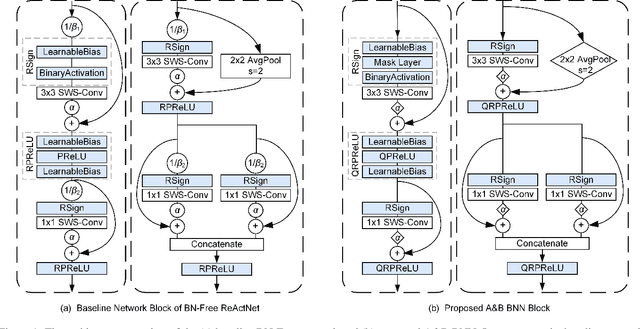
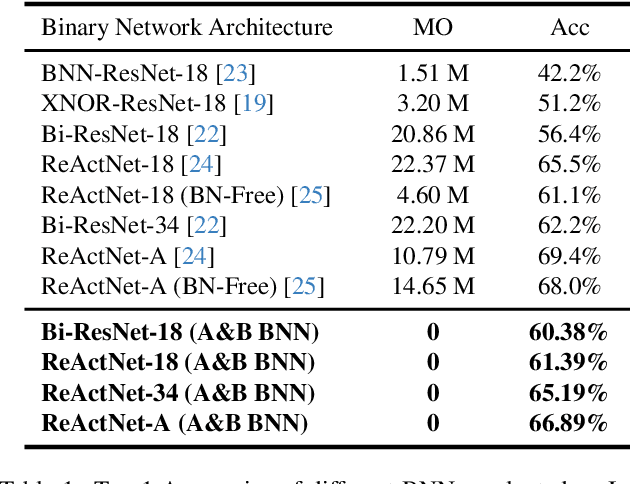
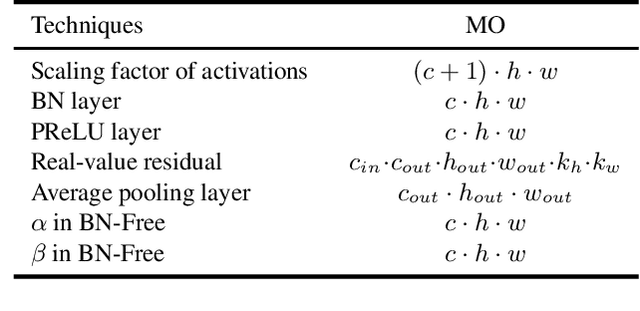
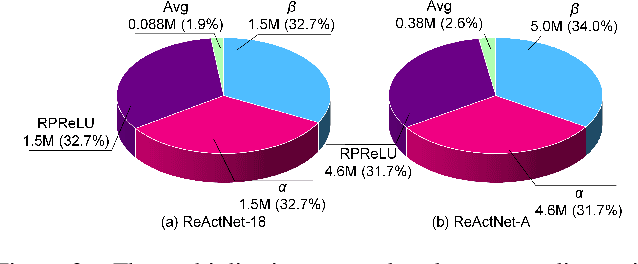
Binary neural networks utilize 1-bit quantized weights and activations to reduce both the model's storage demands and computational burden. However, advanced binary architectures still incorporate millions of inefficient and nonhardware-friendly full-precision multiplication operations. A&B BNN is proposed to directly remove part of the multiplication operations in a traditional BNN and replace the rest with an equal number of bit operations, introducing the mask layer and the quantized RPReLU structure based on the normalizer-free network architecture. The mask layer can be removed during inference by leveraging the intrinsic characteristics of BNN with straightforward mathematical transformations to avoid the associated multiplication operations. The quantized RPReLU structure enables more efficient bit operations by constraining its slope to be integer powers of 2. Experimental results achieved 92.30%, 69.35%, and 66.89% on the CIFAR-10, CIFAR-100, and ImageNet datasets, respectively, which are competitive with the state-of-the-art. Ablation studies have verified the efficacy of the quantized RPReLU structure, leading to a 1.14% enhancement on the ImageNet compared to using a fixed slope RLeakyReLU. The proposed add&bit-operation-only BNN offers an innovative approach for hardware-friendly network architecture.