 Add to Chrome
 Add to Firefox
 Add to Edge
Edit3r: Instant 3D Scene Editing from Sparse Unposed Images
Dec 31, 2025
We present Edit3r, a feed-forward framework that reconstructs and edits 3D scenes in a single pass from unposed, view-inconsistent, instruction-edited images. Unlike prior methods requiring per-scene optimization, Edit3r directly predicts instruction-aligned 3D edits, enabling fast and photorealistic rendering without optimization or pose estimation. A key challenge in training such a model lies in the absence of multi-view consistent edited images for supervision. We address this with (i) a SAM2-based recoloring strategy that generates reliable, cross-view-consistent supervision, and (ii) an asymmetric input strategy that pairs a recolored reference view with raw auxiliary views, encouraging the network to fuse and align disparate observations. At inference, our model effectively handles images edited by 2D methods such as InstructPix2Pix, despite not being exposed to such edits during training. For large-scale quantitative evaluation, we introduce DL3DV-Edit-Bench, a benchmark built on the DL3DV test split, featuring 20 diverse scenes, 4 edit types and 100 edits in total. Comprehensive quantitative and qualitative results show that Edit3r achieves superior semantic alignment and enhanced 3D consistency compared to recent baselines, while operating at significantly higher inference speed, making it promising for real-time 3D editing applications.

M$^3$-VOS: Multi-Phase, Multi-Transition, and Multi-Scenery Video Object Segmentation
Dec 19, 2024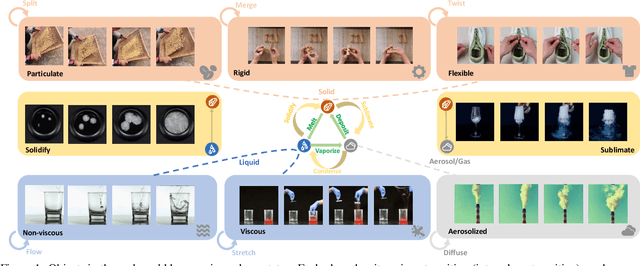
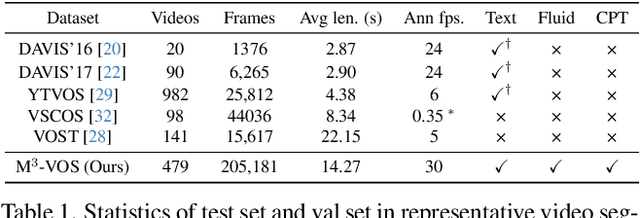
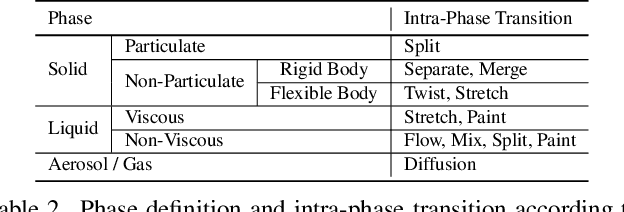
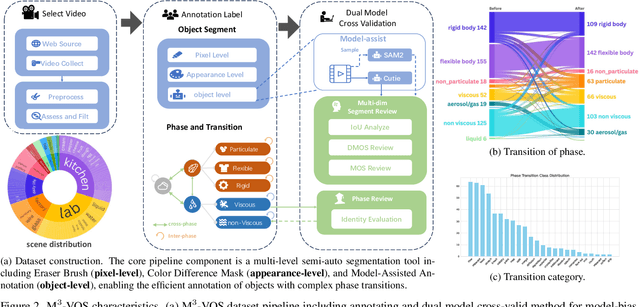
Intelligent robots need to interact with diverse objects across various environments. The appearance and state of objects frequently undergo complex transformations depending on the object properties, e.g., phase transitions. However, in the vision community, segmenting dynamic objects with phase transitions is overlooked. In light of this, we introduce the concept of phase in segmentation, which categorizes real-world objects based on their visual characteristics and potential morphological and appearance changes. Then, we present a new benchmark, Multi-Phase, Multi-Transition, and Multi-Scenery Video Object Segmentation (M$^3$-VOS), to verify the ability of models to understand object phases, which consists of 479 high-resolution videos spanning over 10 distinct everyday scenarios. It provides dense instance mask annotations that capture both object phases and their transitions. We evaluate state-of-the-art methods on M$^3$-VOS, yielding several key insights. Notably, current appearancebased approaches show significant room for improvement when handling objects with phase transitions. The inherent changes in disorder suggest that the predictive performance of the forward entropy-increasing process can be improved through a reverse entropy-reducing process. These findings lead us to propose ReVOS, a new plug-andplay model that improves its performance by reversal refinement. Our data and code will be publicly available at https://zixuan-chen.github.io/M-cubeVOS.github.io/.