 Add to Chrome
 Add to Firefox
 Add to Edge
Bridging Distance and Spectral Positional Encodings via Anchor-Based Diffusion Geometry Approximation
Jan 08, 2026
Molecular graph learning benefits from positional signals that capture both local neighborhoods and global topology. Two widely used families are spectral encodings derived from Laplacian or diffusion operators and anchor-based distance encodings built from shortest-path information, yet their precise relationship is poorly understood. We interpret distance encodings as a low-rank surrogate of diffusion geometry and derive an explicit trilateration map that reconstructs truncated diffusion coordinates from transformed anchor distances and anchor spectral positions, with pointwise and Frobenius-gap guarantees on random regular graphs. On DrugBank molecular graphs using a shared GNP-based DDI prediction backbone, a distance-driven Nyström scheme closely recovers diffusion geometry, and both Laplacian and distance encodings substantially outperform a no-encoding baseline.

Group Distributionally Robust Optimization can Suppress Class Imbalance Effect in Network Traffic Classification
Sep 28, 2024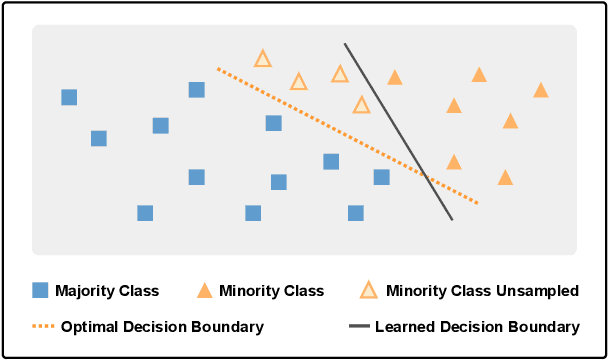
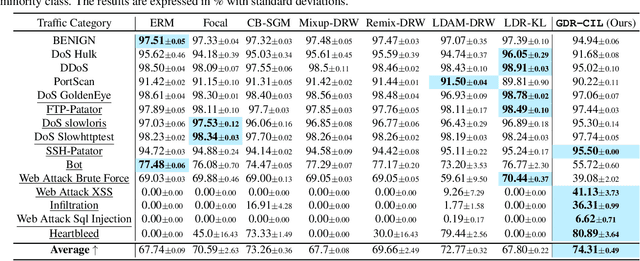
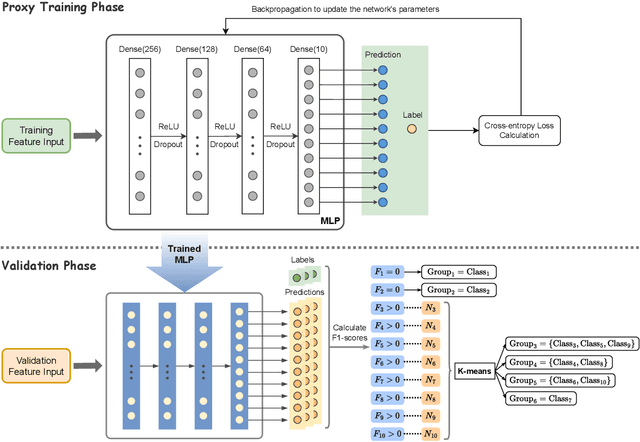

Internet services have led to the eruption of traffic, and machine learning on these Internet data has become an indispensable tool, especially when the application is risk-sensitive. This paper focuses on network traffic classification in the presence of class imbalance, which fundamentally and ubiquitously exists in Internet data analysis. This existence of class imbalance mostly drifts the optimal decision boundary, resulting in a less optimal solution for machine learning models. To alleviate the effect, we propose to design strategies for alleviating the class imbalance through the lens of group distributionally robust optimization. Our approach iteratively updates the non-parametric weights for separate classes and optimizes the learning model by minimizing reweighted losses. We interpret the optimization steps from a Stackelberg game and perform extensive experiments on typical benchmarks. Results show that our approach can not only suppress the negative effect of class imbalance but also improve the comprehensive performance in prediction.