 Add to Chrome
 Add to Firefox
 Add to Edge
A universal linearized subspace refinement framework for neural networks
Jan 20, 2026
Neural networks are predominantly trained using gradient-based methods, yet in many applications their final predictions remain far from the accuracy attainable within the model's expressive capacity. We introduce Linearized Subspace Refinement (LSR), a general and architecture-agnostic framework that exploits the Jacobian-induced linear residual model at a fixed trained network state. By solving a reduced direct least-squares problem within this subspace, LSR computes a subspace-optimal solution of the linearized residual model, yielding a refined linear predictor with substantially improved accuracy over standard gradient-trained solutions, without modifying network architectures, loss formulations, or training procedures. Across supervised function approximation, data-driven operator learning, and physics-informed operator fine-tuning, we show that gradient-based training often fails to access this attainable accuracy, even when local linearization yields a convex problem. This observation indicates that loss-induced numerical ill-conditioning, rather than nonconvexity or model expressivity, can constitute a dominant practical bottleneck. In contrast, one-shot LSR systematically exposes accuracy levels not fully exploited by gradient-based training, frequently achieving order-of-magnitude error reductions. For operator-constrained problems with composite loss structures, we further introduce Iterative LSR, which alternates one-shot LSR with supervised nonlinear alignment, transforming ill-conditioned residual minimization into numerically benign fitting steps and yielding accelerated convergence and improved accuracy. By bridging nonlinear neural representations with reduced-order linear solvers at fixed linearization points, LSR provides a numerically grounded and broadly applicable refinement framework for supervised learning, operator learning, and scientific computing.

Probing Scientific General Intelligence of LLMs with Scientist-Aligned Workflows
Dec 18, 2025Despite advances in scientific AI, a coherent framework for Scientific General Intelligence (SGI)-the ability to autonomously conceive, investigate, and reason across scientific domains-remains lacking. We present an operational SGI definition grounded in the Practical Inquiry Model (PIM: Deliberation, Conception, Action, Perception) and operationalize it via four scientist-aligned tasks: deep research, idea generation, dry/wet experiments, and experimental reasoning. SGI-Bench comprises over 1,000 expert-curated, cross-disciplinary samples inspired by Science's 125 Big Questions, enabling systematic evaluation of state-of-the-art LLMs. Results reveal gaps: low exact match (10--20%) in deep research despite step-level alignment; ideas lacking feasibility and detail; high code executability but low execution result accuracy in dry experiments; low sequence fidelity in wet protocols; and persistent multimodal comparative-reasoning challenges. We further introduce Test-Time Reinforcement Learning (TTRL), which optimizes retrieval-augmented novelty rewards at inference, enhancing hypothesis novelty without reference answer. Together, our PIM-grounded definition, workflow-centric benchmark, and empirical insights establish a foundation for AI systems that genuinely participate in scientific discovery.
TSONN: Time-stepping-oriented neural network for solving partial differential equations
Oct 25, 2023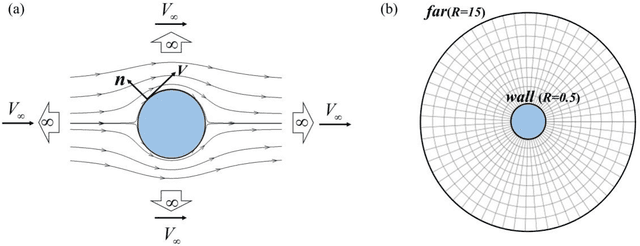
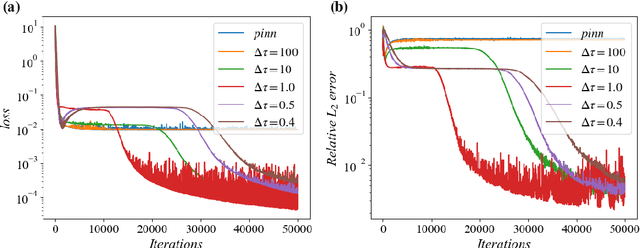
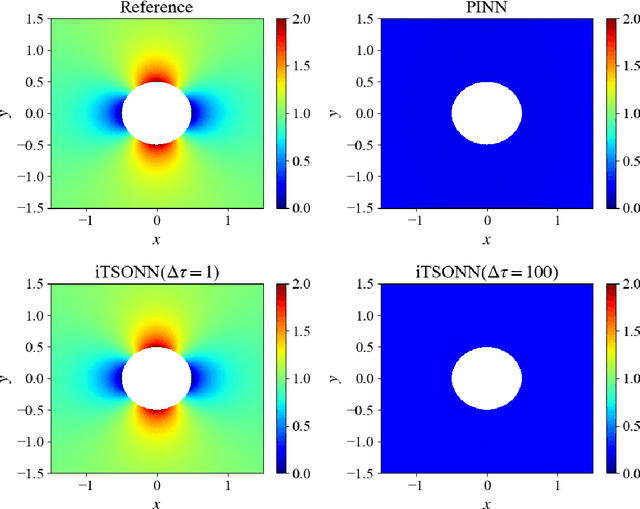
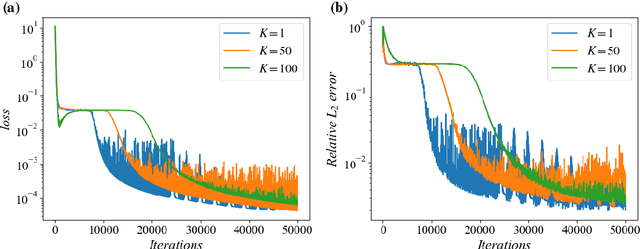
Deep neural networks (DNNs), especially physics-informed neural networks (PINNs), have recently become a new popular method for solving forward and inverse problems governed by partial differential equations (PDEs). However, these methods still face challenges in achieving stable training and obtaining correct results in many problems, since minimizing PDE residuals with PDE-based soft constraint make the problem ill-conditioned. Different from all existing methods that directly minimize PDE residuals, this work integrates time-stepping method with deep learning, and transforms the original ill-conditioned optimization problem into a series of well-conditioned sub-problems over given pseudo time intervals. The convergence of model training is significantly improved by following the trajectory of the pseudo time-stepping process, yielding a robust optimization-based PDE solver. Our results show that the proposed method achieves stable training and correct results in many problems that standard PINNs fail to solve, requiring only a simple modification on the loss function. In addition, we demonstrate several novel properties and advantages of time-stepping methods within the framework of neural network-based optimization approach, in comparison to traditional grid-based numerical method. Specifically, explicit scheme allows significantly larger time step, while implicit scheme can be implemented as straightforwardly as explicit scheme.