 Add to Chrome
 Add to Firefox
 Add to Edge
User Mobility Demands Near-Field Communications in Terahertz Band Wireless Networks Beyond 6G
Apr 20, 2026
Near-field propagation is often unavoidable at terahertz (THz) frequencies due to the large apertures needed for sufficient array gain, yet near-field operation complicates practical system design, especially under user mobility. This paper asks whether a mobile THz link can remain broadband, achieve the desired high rates and coverage, while operating exclusively in the radiative far field. To answer this question, we develop a proof-by-contradiction feasibility framework that jointly enforces (i) a far-field requirement based on the Fraunhofer distance and (ii) a reliability requirement specified by a target SNR at the worst-case link distance. We derive closed-form upper bounds on the far-field-feasible bandwidth for stationary and mobile links. We further incorporate practical misalignment through several UE rotation and mobility scenarios. Numerical results show that stationary THz links can remain far-field-only with physically realizable apertures while supporting extremely large bandwidths, whereas practical mobile THz systems cannot. In practically relevant mobile THz access settings, the far-field-feasible bandwidth becomes a severe limiting factor: achieving tens-of-GHz targets would require unrealistically high UE transmit power. A cross-band comparison further shows that far-field-only operation is largely attainable at sub-6~GHz and, to a significant extent, at mmWave for moderate bandwidths, while near-field-aware designs become essential for mobile THz access.

Performance Evaluation of Movable Antenna Arrays in Wideband Multi-User MIMO Systems
Mar 23, 2026Future wireless networks are expected to support increasingly high data rates and user densities, motivating advanced multi-antenna architectures capable of adapting to dynamic propagation environments. Movable antenna (MA) arrays have recently emerged as an extension of massive MIMO, enabling physical repositioning of antenna elements to better exploit spatial diversity and mitigate inter-user interference. While prior studies report promising gains under idealized assumptions, their performance under realistic wideband multi-user operation remains insufficiently understood. This paper presents a comprehensive evaluation of MA-enabled systems in practical uplink and downlink scenarios. A wideband OFDM system model is developed, and novel closed-form sum-rate expressions are derived for both uplink and downlink under linear and nonlinear processing. Hardware impairments are incorporated via an EVM-based model, from which a distortion-aware UL/DL duality is established and the resulting high-SNR sum rate ceiling is analytically characterized. In addition, the interactions between antenna position optimization, receiver processing, and user loading are examined, and performance is evaluated under both time-division duplexing (TDD) and frequency-division duplexing (FDD). The results show that movable antennas can provide noticeable gains in low-impairment regimes with strong multi-user interference, but these benefits are highly scenario-dependent and diminish under hardware-impairment-limited conditions or in rich-scattering environments. These findings highlight the importance of carefully assessing deployment conditions when considering antenna mobility as an alternative to conventional fixed array configurations.
Near-field Boundary Distance in mmWave and THz Communications with Misaligned Antenna Arrays
Mar 16, 2026Wireless communications in the millimeter wave (mmWave) and terahertz (THz) spectrum allow harnessing large frequency bands, thus achieving ultra-high data rates. However, the inherently short wavelengths of mmWave and THz signals lead to an extended radiative near-field region, where certain canonical far-field assumptions fail. Most prior works aimed to characterize this radiative near-field region either do not consider antenna arrays on both communicating nodes or, if they do, assume perfect alignment between the arrays. However, such assumptions break down in many realistic deployments, where both sides must employ large-scale mmWave/THz antenna arrays to maintain the desired communication range, while perfect antenna alignment cannot be guaranteed particularly under nodes mobility. In this work, a generalized mathematical framework is presented to characterize the radiative near-field distance in directional mmWave and THz communication systems under various realistic array rotations and misalignments. With the use of the developed framework, compact closed-form expressions are derived for the near-field boundary distance in a wide range of antenna configurations, including array-to-array and array-to-point setups, considering both linear and planar arrays. Our numerical study reveals that the presence of antenna misalignment may significantly adjust the boundaries of the near-field region in mmWave and THz communication systems.
Statistics Approximation-Enabled Distributed Beamforming for Cell-Free Massive MIMO
Feb 03, 2026We study a distributed beamforming approach for cell-free massive multiple-input multiple-output networks, referred to as Global Statistics \& Local Instantaneous information-based minimum mean-square error (GSLI-MMSE). The scenario with multi-antenna access points (APs) is considered over three different channel models: correlated Rician fading with fixed or random line-of-sight (LoS) phase-shifts, and correlated Rayleigh fading. With the aid of matrix inversion derivations, we can construct the conventional MMSE combining from the perspective of each AP, where global instantaneous information is involved. Then, for an arbitrary AP, we apply the statistics approximation methodology to approximate instantaneous terms related to other APs by channel statistics to construct the distributed combining scheme at each AP with local instantaneous information and global statistics. With the aid of uplink-downlink duality, we derive the respective GSLI-MMSE precoding schemes. Numerical results showcase that the proposed GSLI-MMSE scheme demonstrates performance comparable to the optimal centralized MMSE scheme, under the stable LoS conditions, e.g., with static users having Rician fading with a fixed LoS path.
From Antenna Abundance to Antenna Intelligence in 6G Gigantic MIMO Systems
Jan 13, 2026Current cellular systems achieve high spectral efficiency through Massive MIMO, which leverages an abundance of antennas to create favorable propagation conditions for multiuser spatial multiplexing. Looking towards future networks, the extrapolation of this paradigm leads to systems with many hundreds of antennas per base station, raising concerns regarding hardware complexity, cost, and power consumption. This article suggests more intelligent array designs that reduce the need for excessive antenna numbers. We revisit classical uniform array design principles and explain how their uniform spatial sampling leads to unnecessary redundancies in practical deployment scenarios. By exploiting non-uniform sparse arrays with site-specific antenna placements -- based on either pre-optimized irregular arrays or real-time movable antennas -- we demonstrate how superior multiuser MIMO performance can be achieved with far fewer antennas. These principles are inspired by previous works on wireless localization. We explain and demonstrate numerically how these concepts can be adapted for communications to improve the average sum rate and similar metrics. The results suggest a paradigm shift for future antenna array design, where antenna intelligence replaces sheer antenna count. This opens new opportunities for efficient, adaptable, and sustainable Gigantic MIMO systems.
Optimizing Movable Antennas in Wideband Multi-User MIMO With Hardware Impairments
Apr 17, 2025Movable antennas represent an emerging field in telecommunication research and a potential approach to achieving higher data rates in multiple-input multiple-output (MIMO) communications when the total number of antennas is limited. Most solutions and analyses to date have been limited to \emph{narrowband} setups. This work complements the prior studies by quantifying the benefit of using movable antennas in \emph{wideband} MIMO communication systems. First, we derive a novel uplink wideband system model that also accounts for distortion from transceiver hardware impairments. We then formulate and solve an optimization task to maximize the average sum rate by adjusting the antenna positions using particle swarm optimization. Finally, the performance with movable antennas is compared with fixed uniform arrays and the derived theoretical upper bound. The numerical study concludes that the data rate improvement from movable antennas over other arrays heavily depends on the level of hardware impairments, the richness of the multi-path environments, and the number of subcarriers. The present study provides vital insights into the most suitable use cases for movable antennas in future wideband systems.
Pre-Optimized Irregular Arrays versus Moveable Antennas in Multi-User MIMO Systems
Feb 06, 2025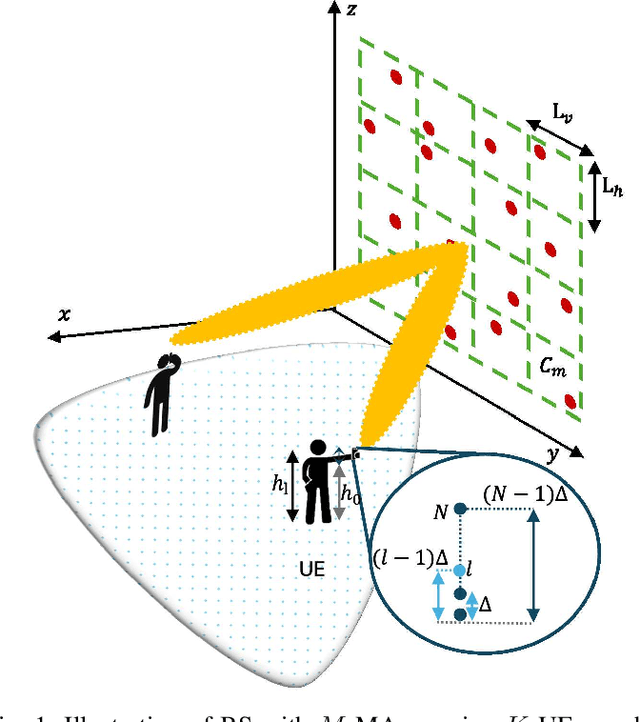
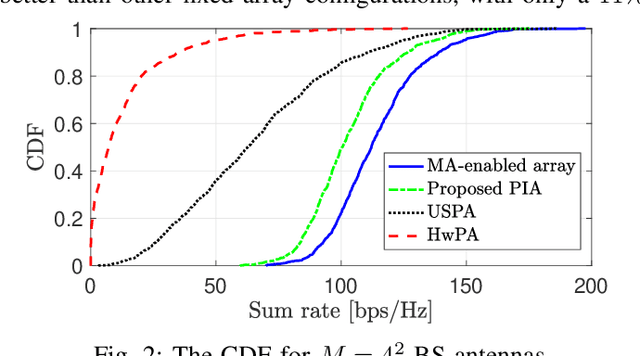
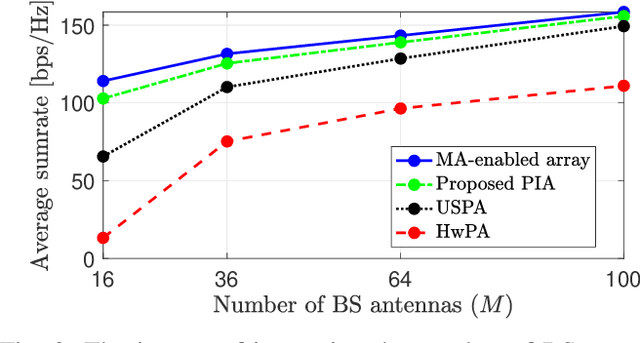
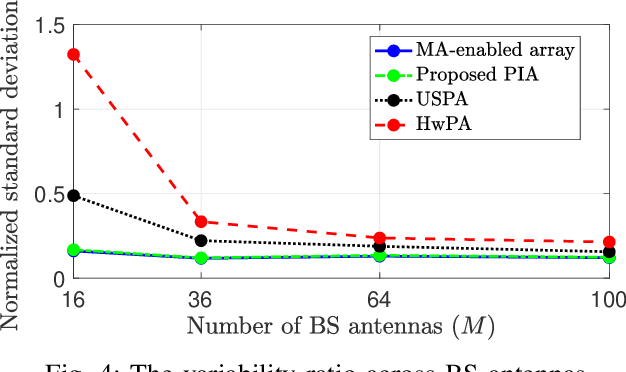
Massive multiple-input multiple-output (MIMO) systems exploit the spatial diversity achieved with an array of many antennas to perform spatial multiplexing of many users. Similar performance can be achieved using fewer antennas if movable antenna (MA) elements are used instead. MA-enabled arrays can dynamically change the antenna locations, mechanically or electrically, to achieve maximum spatial diversity for the current propagation conditions. However, optimizing the antenna locations for each channel realization is computationally excessive, requires channel knowledge for all conceivable locations, and requires rapid antenna movements, thus making real-time implementation cumbersome. To overcome these challenges, we propose a pre-optimized irregular array (PIA) concept, where the antenna locations at the base station are optimized a priori for a given coverage area. The objective is to maximize the average sum rate and we take a particle swarm optimization approach to solve it. Simulation results show that PIA achieves performance comparable to MA-enabled arrays while outperforming traditional uniform arrays. Hence, PIA offers a fixed yet efficient array deployment approach without the complexities associated with MA-enabled arrays.
Impact of the Antenna on the Sub-Terahertz Indoor Channel Characteristics: An Experimental Approach
Mar 07, 2024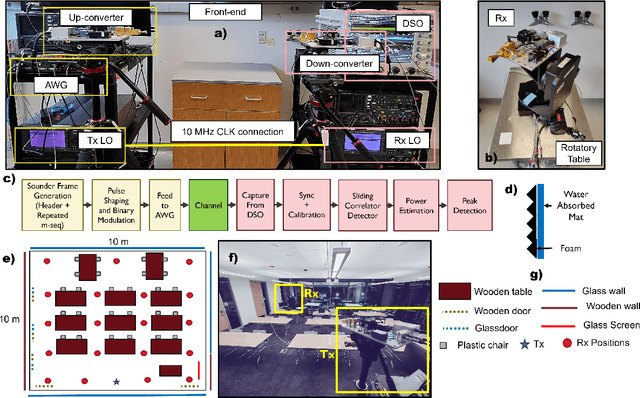
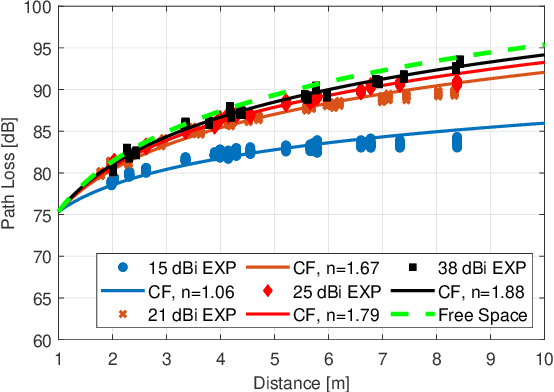
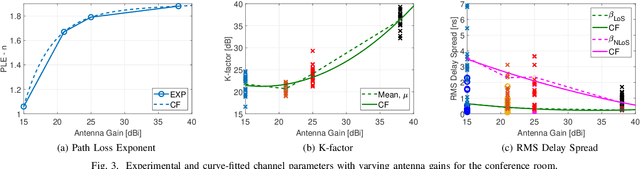
Terahertz-band (100 GHz-10 THz) communication is a promising radio technology envisioned to enable ultra-high data rate, reliable and low-latency wireless connectivity in next-generation wireless systems. However, the low transmission power of THz transmitters, the need for high gain directional antennas, and the complex interaction of THz radiation with common objects along the propagation path make crucial the understanding of the THz channel. In this paper, we conduct an extensive channel measurement campaign in an indoor setting (i.e., a conference room) through a channel sounder with 0.1 ns time resolution and 20 GHz bandwidth at 140 GHz. Particularly, the impact of different antenna directivities (and, thus, beam widths) on the channel characteristics is extensively studied. The experimentally obtained dataset is processed to develop the path loss model and, subsequently, derive key channel metrics such as the path loss exponent, delay spread, and K-factor. The results highlight the multi-faceted impact of the antenna gain on the channel and, by extension, the wireless system and, thus, show that an antenna-agnostic channel model cannot capture the propagation characteristics of the THz channel.
Terahertz Communications Can Work in Rain and Snow: Impact of Adverse Weather Conditions on Channels at 140 GHz
Aug 29, 2022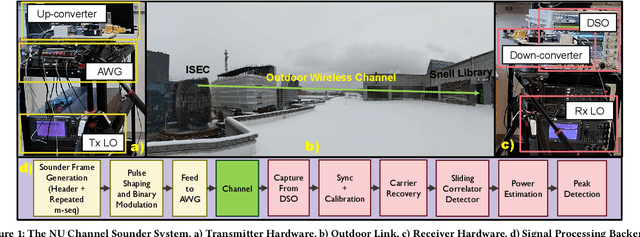
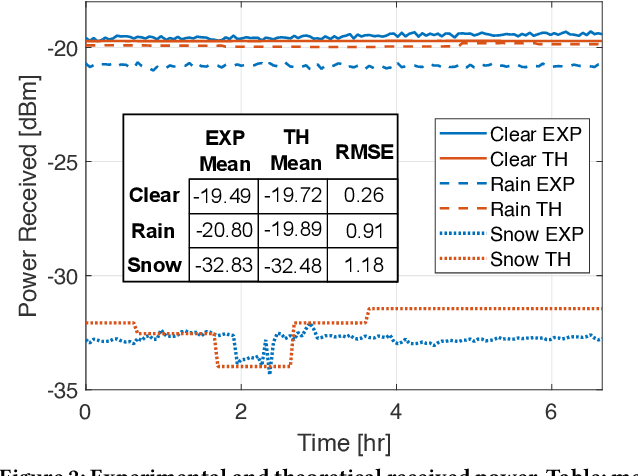
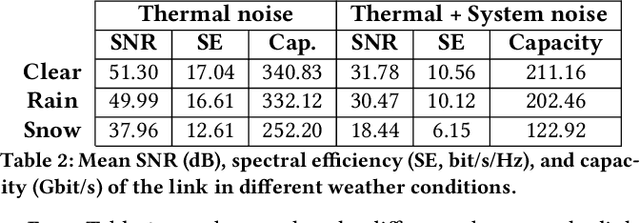
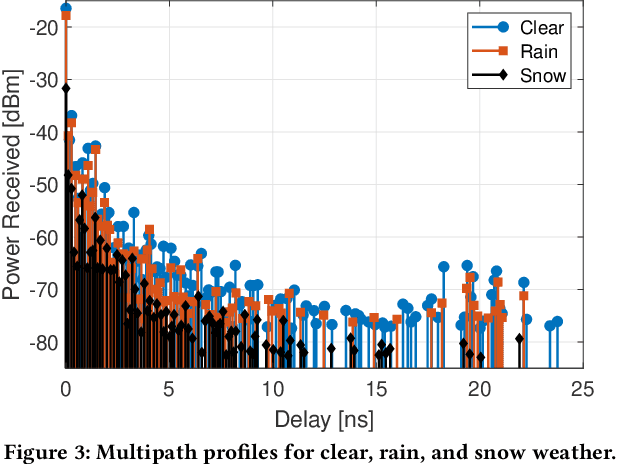
Next-generation wireless networks will leverage the spectrum above 100 GHz to enable ultra-high data rate communications over multi-GHz-wide bandwidths. The propagation environment at such high frequencies, however, introduces challenges throughout the whole protocol stack design, from physical layer signal processing to application design. Therefore, it is fundamental to develop a holistic understanding of the channel propagation and fading characteristics over realistic deployment scenarios and ultra-wide bands. In this paper, we conduct an extensive measurement campaign to evaluate the impact of weather conditions on a wireless link in the 130-150 GHz band through a channel sounding campaign with clear weather, rain, and snow in a typical urban backhaul scenario. We present a novel channel sounder design that captures signals with -82 dBm sensitivity and 20 GHz of bandwidth. We analyze link budget, capacity, as well as channel parameters such as the delay spread and the K-factor. Our experimental results indicate that in the considered context the adverse weather does not interrupt the link, but introduces some additional constraints (e.g., high delay spread and increase in path loss in snow conditions) that need to be accounted for in the design of reliable Sixth Generation (6G) communication links above 100 GHz.