 Add to Chrome
 Add to Firefox
 Add to Edge
Event Tensor: A Unified Abstraction for Compiling Dynamic Megakernel
Apr 14, 2026
Modern GPU workloads, especially large language model (LLM) inference, suffer from kernel launch overheads and coarse synchronization that limit inter-kernel parallelism. Recent megakernel techniques fuse multiple operators into a single persistent kernel to eliminate launch gaps and expose inter-kernel parallelism, but struggle to handle dynamic shapes and data-dependent computation in real workloads. We present Event Tensor, a unified compiler abstraction for dynamic megakernels. Event Tensor encodes dependencies between tiled tasks, and enables first-class support for both shape and data-dependent dynamism. Built atop this abstraction, our Event Tensor Compiler (ETC) applies static and dynamic scheduling transformations to generate high-performance persistent kernels. Evaluations show that ETC achieves state-of-the-art LLM serving latency while significantly reducing system warmup overhead.

AVO: Agentic Variation Operators for Autonomous Evolutionary Search
Mar 25, 2026Agentic Variation Operators (AVO) are a new family of evolutionary variation operators that replace the fixed mutation, crossover, and hand-designed heuristics of classical evolutionary search with autonomous coding agents. Rather than confining a language model to candidate generation within a prescribed pipeline, AVO instantiates variation as a self-directed agent loop that can consult the current lineage, a domain-specific knowledge base, and execution feedback to propose, repair, critique, and verify implementation edits. We evaluate AVO on attention, among the most aggressively optimized kernel targets in AI, on NVIDIA Blackwell (B200) GPUs. Over 7 days of continuous autonomous evolution on multi-head attention, AVO discovers kernels that outperform cuDNN by up to 3.5% and FlashAttention-4 by up to 10.5% across the evaluated configurations. The discovered optimizations transfer readily to grouped-query attention, requiring only 30 minutes of additional autonomous adaptation and yielding gains of up to 7.0% over cuDNN and 9.3% over FlashAttention-4. Together, these results show that agentic variation operators move beyond prior LLM-in-the-loop evolutionary pipelines by elevating the agent from candidate generator to variation operator, and can discover performance-critical micro-architectural optimizations that produce kernels surpassing state-of-the-art expert-engineered attention implementations on today's most advanced GPU hardware.
SOL-ExecBench: Speed-of-Light Benchmarking for Real-World GPU Kernels Against Hardware Limits
Mar 19, 2026As agentic AI systems become increasingly capable of generating and optimizing GPU kernels, progress is constrained by benchmarks that reward speedup over software baselines rather than proximity to hardware-efficient execution. We present SOL-ExecBench, a benchmark of 235 CUDA kernel optimization problems extracted from 124 production and emerging AI models spanning language, diffusion, vision, audio, video, and hybrid architectures, targeting NVIDIA Blackwell GPUs. The benchmark covers forward and backward workloads across BF16, FP8, and NVFP4, including kernels whose best performance is expected to rely on Blackwell-specific capabilities. Unlike prior benchmarks that evaluate kernels primarily relative to software implementations, SOL-ExecBench measures performance against analytically derived Speed-of-Light (SOL) bounds computed by SOLAR, our pipeline for deriving hardware-grounded SOL bounds, yielding a fixed target for hardware-efficient optimization. We report a SOL Score that quantifies how much of the gap between a release-defined scoring baseline and the hardware SOL bound a candidate kernel closes. To support robust evaluation of agentic optimizers, we additionally provide a sandboxed harness with GPU clock locking, L2 cache clearing, isolated subprocess execution, and static analysis based checks against common reward-hacking strategies. SOL-ExecBench reframes GPU kernel benchmarking from beating a mutable software baseline to closing the remaining gap to hardware Speed-of-Light.
VibeTensor: System Software for Deep Learning, Fully Generated by AI Agents
Jan 21, 2026VIBETENSOR is an open-source research system software stack for deep learning, generated by LLM-powered coding agents under high-level human guidance. In this paper, "fully generated" refers to code provenance: implementation changes were produced and applied as agent-proposed diffs; validation relied on agent-run builds, tests, and differential checks, without per-change manual diff review. It implements a PyTorch-style eager tensor library with a C++20 core (CPU+CUDA), a torch-like Python overlay via nanobind, and an experimental Node.js/TypeScript interface. Unlike thin bindings, VIBETENSOR includes its own tensor/storage system, schema-lite dispatcher, reverse-mode autograd, CUDA runtime (streams/events/graphs), a stream-ordered caching allocator with diagnostics, and a stable C ABI for dynamically loaded operator plugins. We view this release as a milestone for AI-assisted software engineering: it shows coding agents can generate a coherent deep learning runtime spanning language bindings down to CUDA memory management, validated primarily by builds and tests. We describe the architecture, summarize the workflow used to produce and validate the system, and evaluate the artifact. We report repository scale and test-suite composition, and summarize reproducible microbenchmarks from an accompanying AI-generated kernel suite, including fused attention versus PyTorch SDPA/FlashAttention. We also report end-to-end training sanity checks on 3 small workloads (sequence reversal, ViT, miniGPT) on NVIDIA H100 (Hopper, SM90) and Blackwell-class GPUs; multi-GPU results are Blackwell-only and use an optional CUTLASS-based ring-allreduce plugin gated on CUDA 13+ and sm103a toolchain support. Finally, we discuss failure modes in generated system software, including a "Frankenstein" composition effect where locally correct subsystems interact to yield globally suboptimal performance.
FlashInfer: Efficient and Customizable Attention Engine for LLM Inference Serving
Jan 02, 2025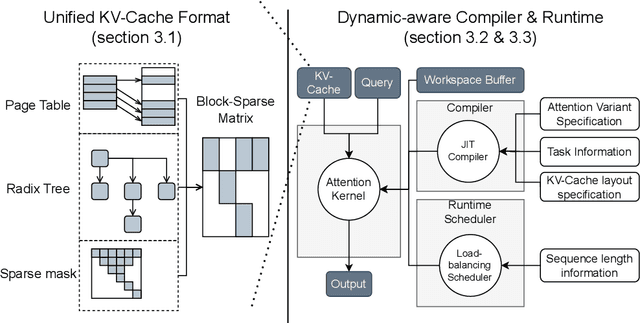
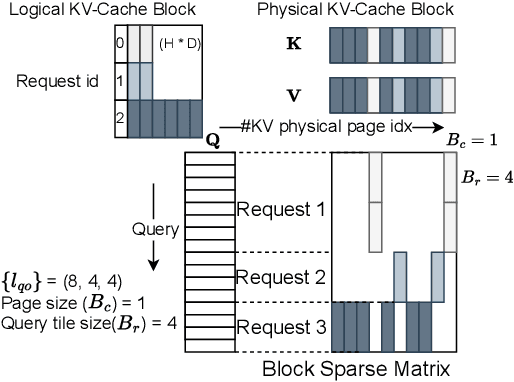
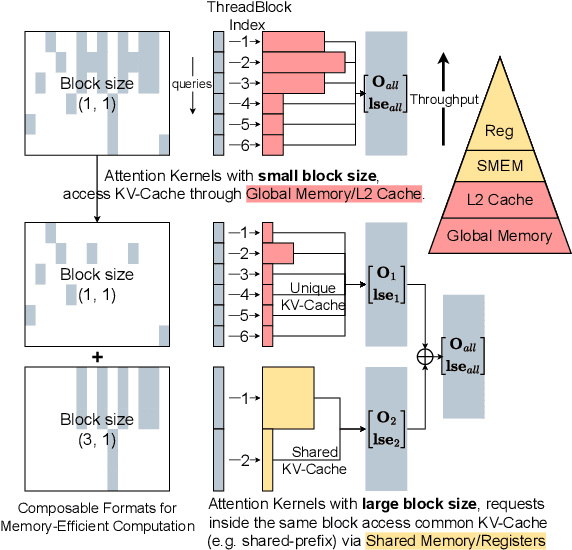
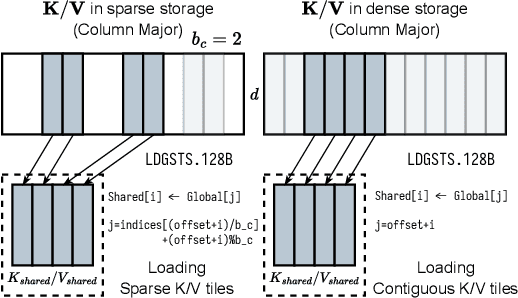
Transformers, driven by attention mechanisms, form the foundation of large language models (LLMs). As these models scale up, efficient GPU attention kernels become essential for high-throughput and low-latency inference. Diverse LLM applications demand flexible and high-performance attention solutions. We present FlashInfer: a customizable and efficient attention engine for LLM serving. FlashInfer tackles KV-cache storage heterogeneity using block-sparse format and composable formats to optimize memory access and reduce redundancy. It also offers a customizable attention template, enabling adaptation to various settings through Just-In-Time (JIT) compilation. Additionally, FlashInfer's load-balanced scheduling algorithm adjusts to dynamism of user requests while maintaining compatibility with CUDAGraph which requires static configuration. FlashInfer have been integrated into leading LLM serving frameworks like SGLang, vLLM and MLC-Engine. Comprehensive kernel-level and end-to-end evaluations demonstrate FlashInfer's ability to significantly boost kernel performance across diverse inference scenarios: compared to state-of-the-art LLM serving solutions, FlashInfer achieve 29-69% inter-token-latency reduction compared to compiler backends for LLM serving benchmark, 28-30% latency reduction for long-context inference, and 13-17% speedup for LLM serving with parallel generation.
Pattern Matching in AI Compilers and its Formalization (Extended Version)
Dec 18, 2024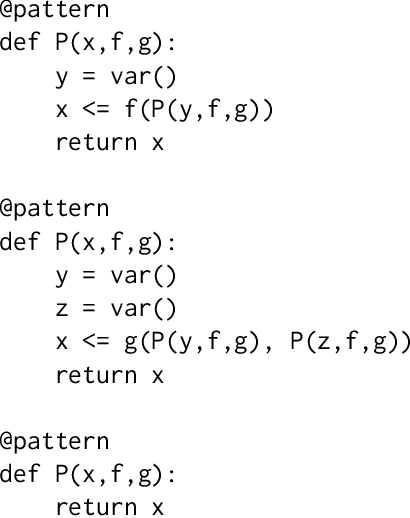
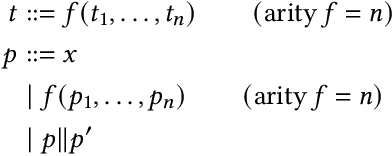
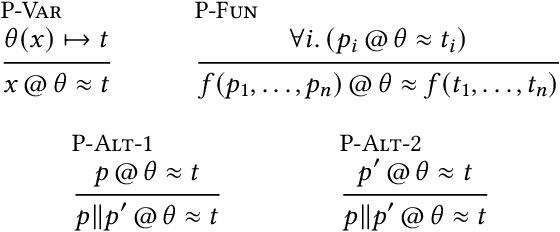
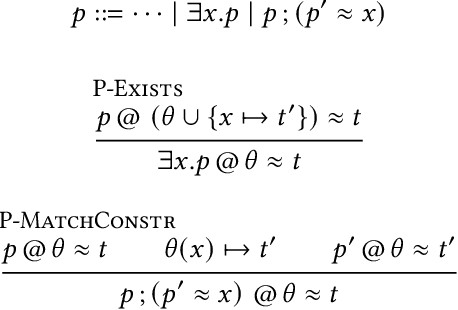
PyPM is a Python-based domain specific language (DSL) for building rewrite-based optimization passes on machine learning computation graphs. Users define individual optimizations by writing (a) patterns that match subgraphs of a computation graph and (b) corresponding rules which replace a matched subgraph with an optimized kernel. PyPM is distinguished from the many other DSLs for defining rewriting passes by its complex and novel pattern language which borrows concepts from logic programming. PyPM patterns can be recursive, nondeterminstic, and can require checking domain-specific constraints such as the shapes of tensors. The PyPM implementation is thus similarly complicated, consisting of thousands of lines of C++ code. In this paper, we present our work on building PyPM, as well as formalizing and distilling and this complexity to an understandable mathematical core. We have developed a formal core calculus expressing the main operations of the PyPM pattern language. We define both a declarative semantics - describing which patterns match which terms - and an algorithmic semantics - an idealized version of the PyPM pattern interpreter - and prove their equivalence. The development is fully mechanized in the Coq proof assistant.
Scaling Deep Learning Training with MPMD Pipeline Parallelism
Dec 18, 2024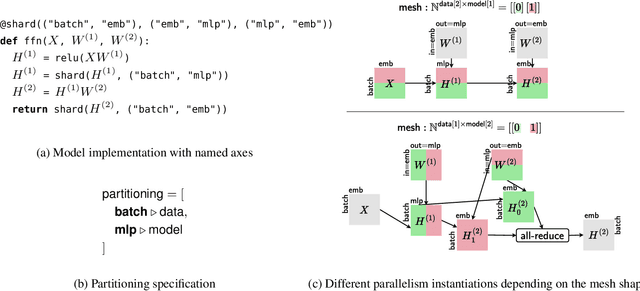
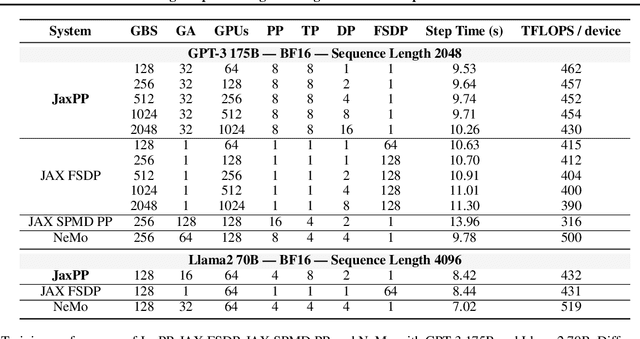
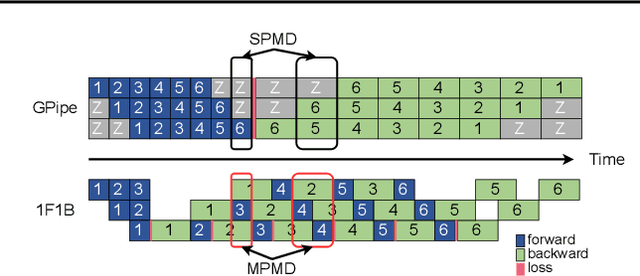
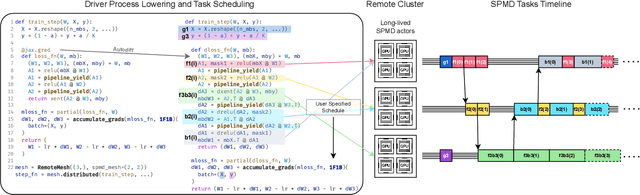
We present JaxPP, a system for efficiently scaling the training of large deep learning models with flexible pipeline parallelism. We introduce a seamless programming model that allows implementing user-defined pipeline schedules for gradient accumulation. JaxPP automatically distributes tasks, corresponding to pipeline stages, over a cluster of nodes and automatically infers the communication among them. We implement a MPMD runtime for asynchronous execution of SPMD tasks. The pipeline parallelism implementation of JaxPP improves hardware utilization by up to $1.11\times$ with respect to the best performing SPMD configuration.