 Add to Chrome
 Add to Firefox
 Add to Edge
Rethinking Multinomial Logistic Mixture of Experts with Sigmoid Gating Function
Feb 01, 2026
The sigmoid gate in mixture-of-experts (MoE) models has been empirically shown to outperform the softmax gate across several tasks, ranging from approximating feed-forward networks to language modeling. Additionally, recent efforts have demonstrated that the sigmoid gate is provably more sample-efficient than its softmax counterpart under regression settings. Nevertheless, there are three notable concerns that have not been addressed in the literature, namely (i) the benefits of the sigmoid gate have not been established under classification settings; (ii) existing sigmoid-gated MoE models may not converge to their ground-truth; and (iii) the effects of a temperature parameter in the sigmoid gate remain theoretically underexplored. To tackle these open problems, we perform a comprehensive analysis of multinomial logistic MoE equipped with a modified sigmoid gate to ensure model convergence. Our results indicate that the sigmoid gate exhibits a lower sample complexity than the softmax gate for both parameter and expert estimation. Furthermore, we find that incorporating a temperature into the sigmoid gate leads to a sample complexity of exponential order due to an intrinsic interaction between the temperature and gating parameters. To overcome this issue, we propose replacing the vanilla inner product score in the gating function with a Euclidean score that effectively removes that interaction, thereby substantially improving the sample complexity to a polynomial order.

A Statistical Theory of Gated Attention through the Lens of Hierarchical Mixture of Experts
Feb 01, 2026Self-attention has greatly contributed to the success of the widely used Transformer architecture by enabling learning from data with long-range dependencies. In an effort to improve performance, a gated attention model that leverages a gating mechanism within the multi-head self-attention has recently been proposed as a promising alternative. Gated attention has been empirically demonstrated to increase the expressiveness of low-rank mapping in standard attention and even to eliminate the attention sink phenomenon. Despite its efficacy, a clear theoretical understanding of gated attention's benefits remains lacking in the literature. To close this gap, we rigorously show that each entry in a gated attention matrix or a multi-head self-attention matrix can be written as a hierarchical mixture of experts. By recasting learning as an expert estimation problem, we demonstrate that gated attention is more sample-efficient than multi-head self-attention. In particular, while the former needs only a polynomial number of data points to estimate an expert, the latter requires exponentially many data points to achieve the same estimation error. Furthermore, our analysis also provides a theoretical justification for why gated attention yields higher performance when a gate is placed at the output of the scaled dot product attention or the value map rather than at other positions in the multi-head self-attention architecture.
Hierarchical Graph Neural Networks for Particle Track Reconstruction
Mar 03, 2023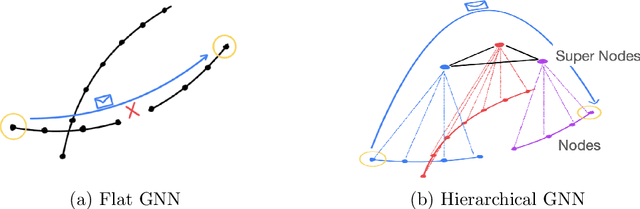
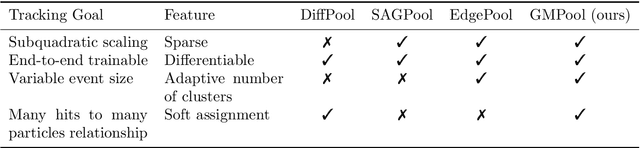
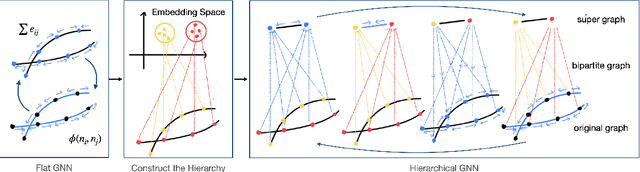

We introduce a novel variant of GNN for particle tracking called Hierarchical Graph Neural Network (HGNN). The architecture creates a set of higher-level representations which correspond to tracks and assigns spacepoints to these tracks, allowing disconnected spacepoints to be assigned to the same track, as well as multiple tracks to share the same spacepoint. We propose a novel learnable pooling algorithm called GMPool to generate these higher-level representations called "super-nodes", as well as a new loss function designed for tracking problems and HGNN specifically. On a standard tracking problem, we show that, compared with previous ML-based tracking algorithms, the HGNN has better tracking efficiency performance, better robustness against inefficient input graphs, and better convergence compared with traditional GNNs.