 Add to Chrome
 Add to Firefox
 Add to Edge
Protean Compiler: An Agile Framework to Drive Fine-grain Phase Ordering
Feb 05, 2026
The phase ordering problem has been a long-standing challenge since the late 1970s, yet it remains an open problem due to having a vast optimization space and an unbounded nature, making it an open-ended problem without a finite solution, one can limit the scope by reducing the number and the length of optimizations. Traditionally, such locally optimized decisions are made by hand-coded algorithms tuned for a small number of benchmarks, often requiring significant effort to be retuned when the benchmark suite changes. In the past 20 years, Machine Learning has been employed to construct performance models to improve the selection and ordering of compiler optimizations, however, the approaches are not baked into the compiler seamlessly and never materialized to be leveraged at a fine-grained scope of code segments. This paper presents Protean Compiler: An agile framework to enable LLVM with built-in phase-ordering capabilities at a fine-grained scope. The framework also comprises a complete library of more than 140 handcrafted static feature collection methods at varying scopes, and the experimental results showcase speedup gains of up to 4.1% on average and up to 15.7% on select Cbench applications wrt LLVM's O3 by just incurring a few extra seconds of build time on Cbench. Additionally, Protean compiler allows for an easy integration with third-party ML frameworks and other Large Language Models, and this two-step optimization shows a gain of 10.1% and 8.5% speedup wrt O3 on Cbench's Susan and Jpeg applications. Protean compiler is seamlessly integrated into LLVM and can be used as a new, enhanced, full-fledged compiler. We plan to release the project to the open-source community in the near future.

ACPO: AI-Enabled Compiler-Driven Program Optimization
Dec 15, 2023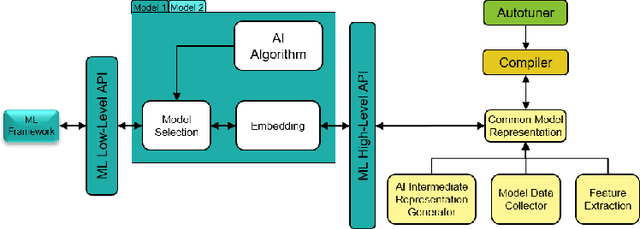
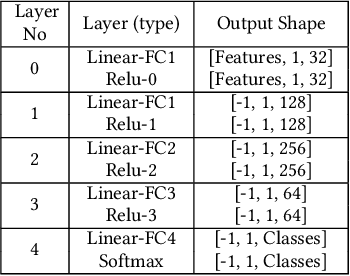
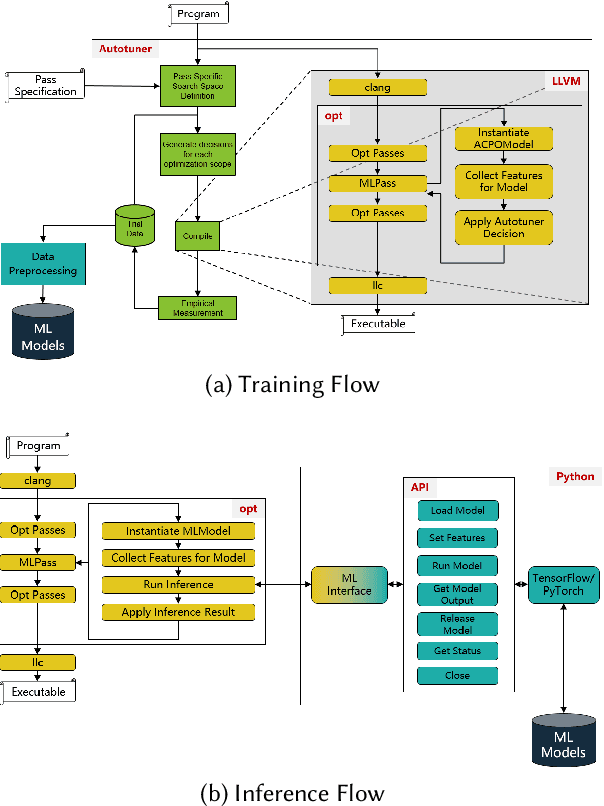
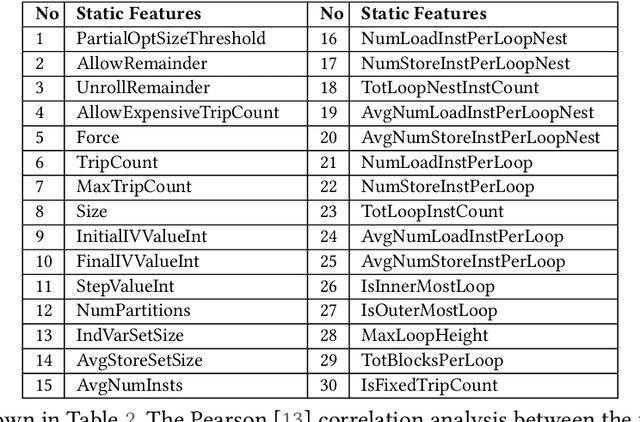
The key to performance optimization of a program is to decide correctly when a certain transformation should be applied by a compiler. Traditionally, such profitability decisions are made by hand-coded algorithms tuned for a very small number of benchmarks, usually requiring a great deal of effort to be retuned when the benchmark suite changes. This is an ideal opportunity to apply machine-learning models to speed up the tuning process; while this realization has been around since the late 90s, only recent advancements in ML enabled a practical application of ML to compilers as an end-to-end framework. Even so, seamless integration of ML into the compiler would require constant rebuilding of the compiler when models are updated. This paper presents ACPO: \textbf{\underline{A}}I-Enabled \textbf{\underline{C}}ompiler-driven \textbf{\underline{P}}rogram \textbf{\underline{O}}ptimization; a novel framework to provide LLVM with simple and comprehensive tools to benefit from employing ML models for different optimization passes. We first showcase the high-level view, class hierarchy, and functionalities of ACPO and subsequently, demonstrate \taco{a couple of use cases of ACPO by ML-enabling the Loop Unroll and Function Inlining passes and describe how ACPO can be leveraged to optimize other passes. Experimental results reveal that ACPO model for Loop Unroll is able to gain on average 4\% and 3\%, 5.4\%, 0.2\% compared to LLVM's O3 optimization when deployed on Polybench, Coral-2, CoreMark, and Graph-500, respectively. Furthermore, by adding the Inliner model as well, ACPO is able to provide up to 4.5\% and 2.4\% on Polybench and Cbench compared with LLVM's O3 optimization, respectively.