 Add to Chrome
 Add to Firefox
 Add to Edge
When Single Answer Is Not Enough: Rethinking Single-Step Retrosynthesis Benchmarks for LLMs
Feb 03, 2026
Recent progress has expanded the use of large language models (LLMs) in drug discovery, including synthesis planning. However, objective evaluation of retrosynthesis performance remains limited. Existing benchmarks and metrics typically rely on published synthetic procedures and Top-K accuracy based on single ground-truth, which does not capture the open-ended nature of real-world synthesis planning. We propose a new benchmarking framework for single-step retrosynthesis that evaluates both general-purpose and chemistry-specialized LLMs using ChemCensor, a novel metric for chemical plausibility. By emphasizing plausibility over exact match, this approach better aligns with human synthesis planning practices. We also introduce CREED, a novel dataset comprising millions of ChemCensor-validated reaction records for LLM training, and use it to train a model that improves over the LLM baselines under this benchmark.

TruthLens:A Training-Free Paradigm for DeepFake Detection
Mar 19, 2025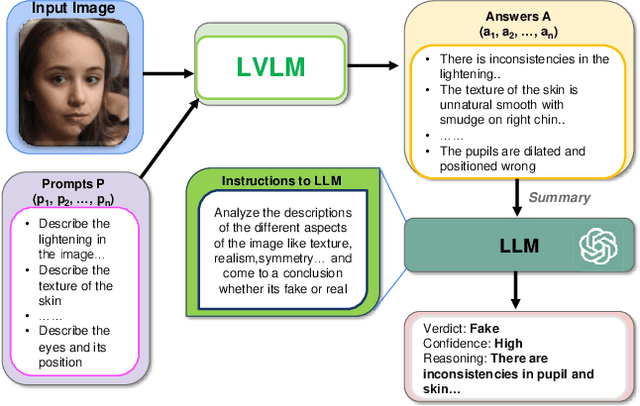
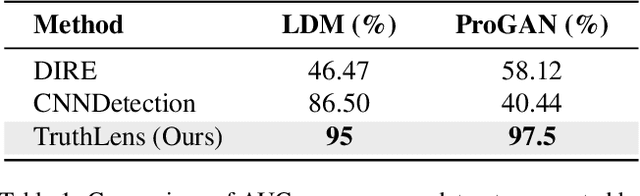
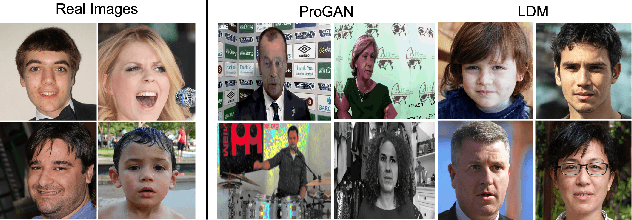
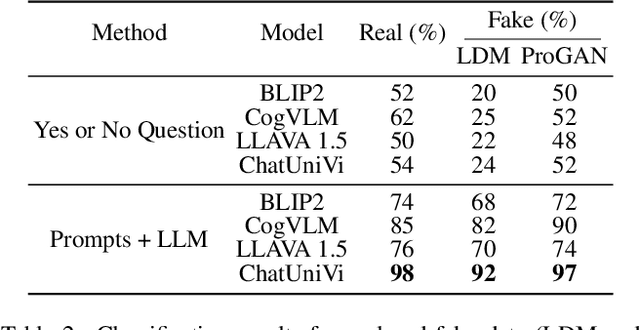
The proliferation of synthetic images generated by advanced AI models poses significant challenges in identifying and understanding manipulated visual content. Current fake image detection methods predominantly rely on binary classification models that focus on accuracy while often neglecting interpretability, leaving users without clear insights into why an image is deemed real or fake. To bridge this gap, we introduce TruthLens, a novel training-free framework that reimagines deepfake detection as a visual question-answering (VQA) task. TruthLens utilizes state-of-the-art large vision-language models (LVLMs) to observe and describe visual artifacts and combines this with the reasoning capabilities of large language models (LLMs) like GPT-4 to analyze and aggregate evidence into informed decisions. By adopting a multimodal approach, TruthLens seamlessly integrates visual and semantic reasoning to not only classify images as real or fake but also provide interpretable explanations for its decisions. This transparency enhances trust and provides valuable insights into the artifacts that signal synthetic content. Extensive evaluations demonstrate that TruthLens outperforms conventional methods, achieving high accuracy on challenging datasets while maintaining a strong emphasis on explainability. By reframing deepfake detection as a reasoning-driven process, TruthLens establishes a new paradigm in combating synthetic media, combining cutting-edge performance with interpretability to address the growing threats of visual disinformation.