 Add to Chrome
 Add to Firefox
 Add to Edge
HSSBench: Benchmarking Humanities and Social Sciences Ability for Multimodal Large Language Models
Jun 04, 2025
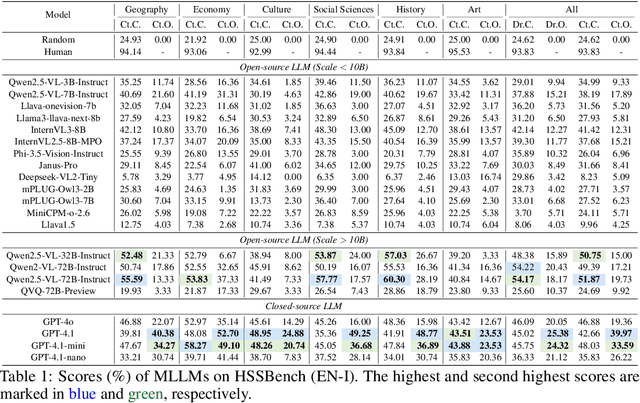
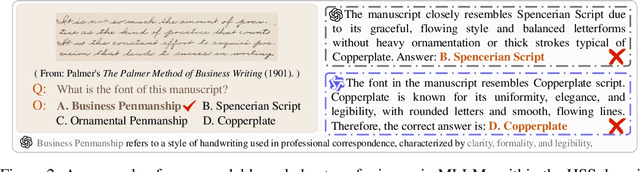
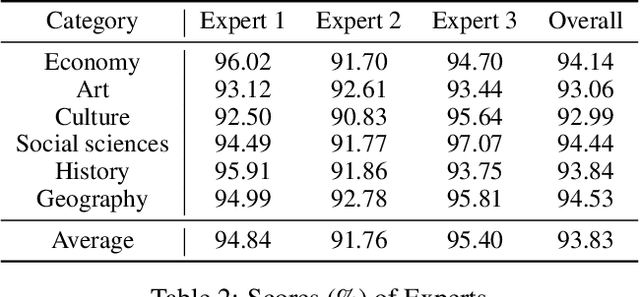
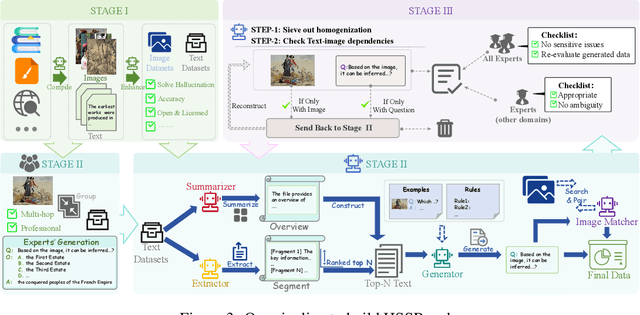
Multimodal Large Language Models (MLLMs) have demonstrated significant potential to advance a broad range of domains. However, current benchmarks for evaluating MLLMs primarily emphasize general knowledge and vertical step-by-step reasoning typical of STEM disciplines, while overlooking the distinct needs and potential of the Humanities and Social Sciences (HSS). Tasks in the HSS domain require more horizontal, interdisciplinary thinking and a deep integration of knowledge across related fields, which presents unique challenges for MLLMs, particularly in linking abstract concepts with corresponding visual representations. Addressing this gap, we present HSSBench, a dedicated benchmark designed to assess the capabilities of MLLMs on HSS tasks in multiple languages, including the six official languages of the United Nations. We also introduce a novel data generation pipeline tailored for HSS scenarios, in which multiple domain experts and automated agents collaborate to generate and iteratively refine each sample. HSSBench contains over 13,000 meticulously designed samples, covering six key categories. We benchmark more than 20 mainstream MLLMs on HSSBench and demonstrate that it poses significant challenges even for state-of-the-art models. We hope that this benchmark will inspire further research into enhancing the cross-disciplinary reasoning abilities of MLLMs, especially their capacity to internalize and connect knowledge across fields.

Exploring Sound Change Over Time: A Review of Computational and Human Perception
Jul 06, 2024Computational and human perception are often considered separate approaches for studying sound changes over time; few works have touched on the intersection of both. To fill this research gap, we provide a pioneering review contrasting computational with human perception from the perspectives of methods and tasks. Overall, computational approaches rely on computer-driven models to perceive historical sound changes on etymological datasets, while human approaches use listener-driven models to perceive ongoing sound changes on recording corpora. Despite their differences, both approaches complement each other on phonetic and acoustic levels, showing the potential to achieve a more comprehensive perception of sound change. Moreover, we call for a comparative study on the datasets used by both approaches to investigate the influence of historical sound changes on ongoing changes. Lastly, we discuss the applications of sound change in computational linguistics, and point out that perceiving sound change alone is insufficient, as many processes of language change are complex, with entangled changes at syntactic, semantic, and phonetic levels.