 Add to Chrome
 Add to Firefox
 Add to Edge
VideoWeave: A Data-Centric Approach for Efficient Video Understanding
Jan 09, 2026
Training video-language models is often prohibitively expensive due to the high cost of processing long frame sequences and the limited availability of annotated long videos. We present VideoWeave, a simple yet effective approach to improve data efficiency by constructing synthetic long-context training samples that splice together short, captioned videos from existing datasets. Rather than modifying model architectures or optimization objectives, VideoWeave reorganizes available video-text pairs to expand temporal diversity within fixed compute. We systematically study how different data composition strategies like random versus visually clustered splicing and caption enrichment affect downstream performance on downstream video question answering. Under identical compute constraints, models trained with VideoWeave achieve higher accuracy than conventional video finetuning. Our results highlight that reorganizing training data, rather than altering architectures, may offer a simple and scalable path for training video-language models. We link our code for all experiments here.

Representing visual classification as a linear combination of words
Nov 18, 2023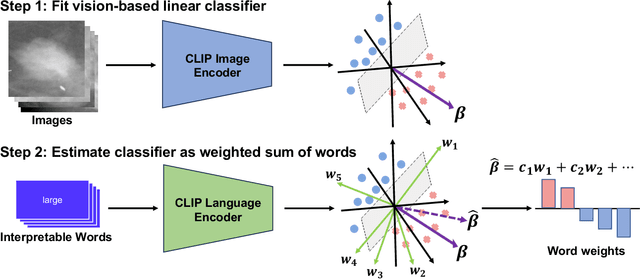
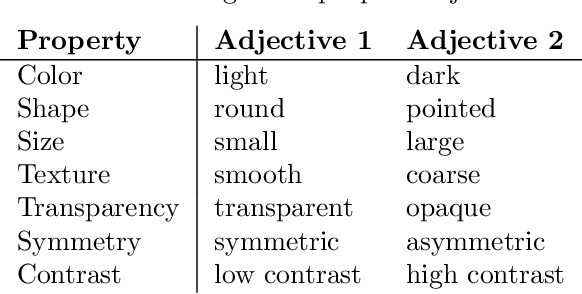
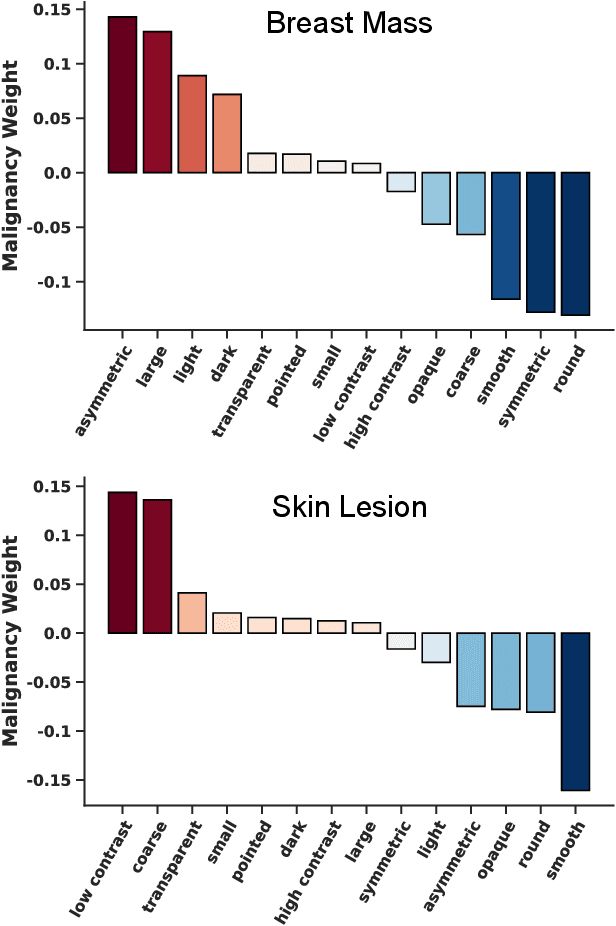
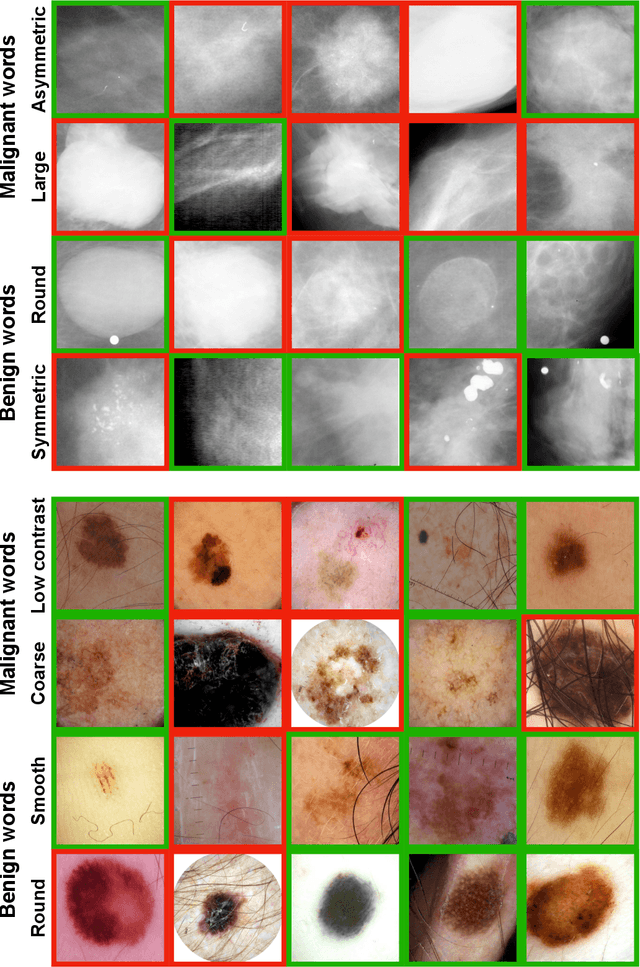
Explainability is a longstanding challenge in deep learning, especially in high-stakes domains like healthcare. Common explainability methods highlight image regions that drive an AI model's decision. Humans, however, heavily rely on language to convey explanations of not only "where" but "what". Additionally, most explainability approaches focus on explaining individual AI predictions, rather than describing the features used by an AI model in general. The latter would be especially useful for model and dataset auditing, and potentially even knowledge generation as AI is increasingly being used in novel tasks. Here, we present an explainability strategy that uses a vision-language model to identify language-based descriptors of a visual classification task. By leveraging a pre-trained joint embedding space between images and text, our approach estimates a new classification task as a linear combination of words, resulting in a weight for each word that indicates its alignment with the vision-based classifier. We assess our approach using two medical imaging classification tasks, where we find that the resulting descriptors largely align with clinical knowledge despite a lack of domain-specific language training. However, our approach also identifies the potential for 'shortcut connections' in the public datasets used. Towards a functional measure of explainability, we perform a pilot reader study where we find that the AI-identified words can enable non-expert humans to perform a specialized medical task at a non-trivial level. Altogether, our results emphasize the potential of using multimodal foundational models to deliver intuitive, language-based explanations of visual tasks.