 Add to Chrome
 Add to Firefox
 Add to Edge
Cold-Starting Podcast Ads and Promotions with Multi-Task Learning on Spotify
Jan 05, 2026
We present a unified multi-objective model for targeting both advertisements and promotions within the Spotify podcast ecosystem. Our approach addresses key challenges in personalization and cold-start initialization, particularly for new advertising objectives. By leveraging transfer learning from large-scale ad and content interactions within a multi-task learning (MTL) framework, a single joint model can be fine-tuned or directly applied to new or low-data targeting tasks, including in-app promotions. This multi-objective design jointly optimizes podcast outcomes such as streams, clicks, and follows for both ads and promotions using a shared representation over user, content, context, and creative features, effectively supporting diverse business goals while improving user experience. Online A/B tests show up to a 22% reduction in effective Cost-Per-Stream (eCPS), particularly for less-streamed podcasts, and an 18-24% increase in podcast stream rates. Offline experiments and ablations highlight the contribution of ancillary objectives and feature groups to cold-start performance. Our experience shows that a unified modeling strategy improves maintainability, cold-start performance, and coverage, while breaking down historically siloed targeting pipelines. We discuss practical trade-offs of such joint models in a real-world advertising system.

Lessons Learned Addressing Dataset Bias in Model-Based Candidate Generation at Twitter
May 13, 2021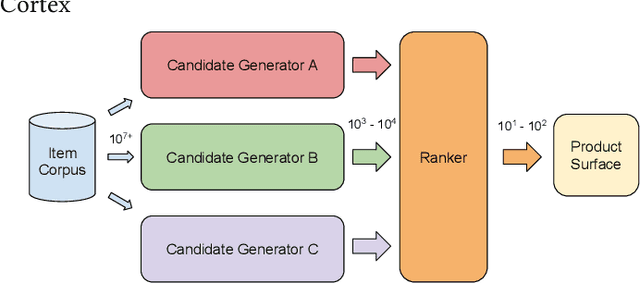
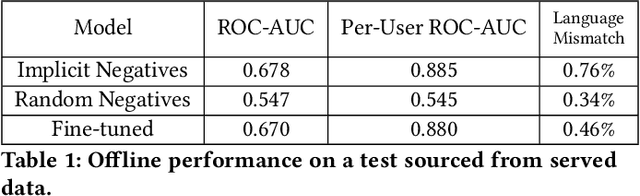
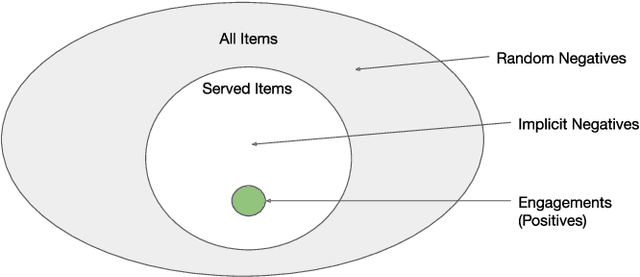
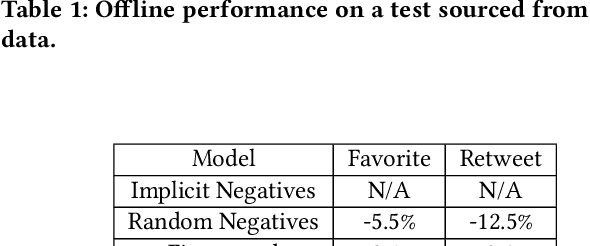
Traditionally, heuristic methods are used to generate candidates for large scale recommender systems. Model-based candidate generation promises multiple potential advantages, primarily that we can explicitly optimize the same objective as the downstream ranking model. However, large scale model-based candidate generation approaches suffer from dataset bias problems caused by the infeasibility of obtaining representative data on very irrelevant candidates. Popular techniques to correct dataset bias, such as inverse propensity scoring, do not work well in the context of candidate generation. We first explore the dynamics of the dataset bias problem and then demonstrate how to use random sampling techniques to mitigate it. Finally, in a novel application of fine-tuning, we show performance gains when applying our candidate generation system to Twitter's home timeline.