 Add to Chrome
 Add to Firefox
 Add to Edge
Succeeding at Scale: Automated Multi-Retriever Fusion and Query-Side Adaptation for Multi-Tenant Search
Jan 08, 2026
Large-scale multi-tenant retrieval systems amass vast user query logs yet critically lack the curated relevance labels required for effective domain adaptation. This "dark data" problem is exacerbated by the operational cost of model updates: jointly fine-tuning query and document encoders requires re-indexing the entire corpus, which is prohibitive in multi-tenant environments with thousands of isolated indices. To address these dual challenges, we introduce \textbf{DevRev Search}, a passage retrieval benchmark for technical customer support constructed through a fully automatic pipeline. We employ a \textbf{fusion-based candidate generation} strategy, pooling results from diverse sparse and dense retrievers, and utilize an LLM-as-a-Judge to perform rigorous \textbf{consistency filtering} and relevance assignment. We further propose a practical \textbf{Index-Preserving Adaptation} strategy: by fine-tuning only the query encoder via Low-Rank Adaptation (LoRA), we achieve competitive performance improvements while keeping the document index frozen. Our experiments on DevRev Search and SciFact demonstrate that targeting specific transformer layers in the query encoder yields optimal quality-efficiency trade-offs, offering a scalable path for personalized enterprise search.

Adopting Whisper for Confidence Estimation
Feb 19, 2025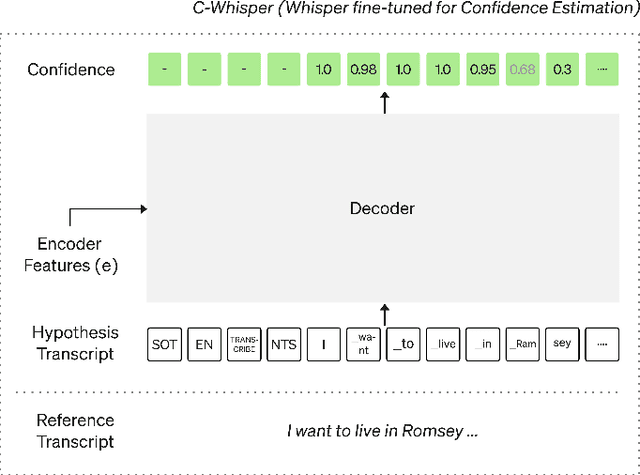
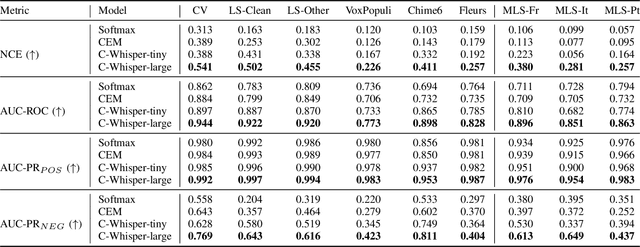
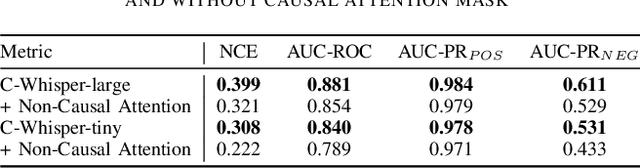
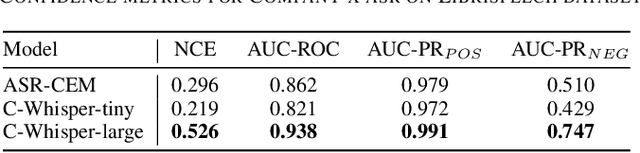
Recent research on word-level confidence estimation for speech recognition systems has primarily focused on lightweight models known as Confidence Estimation Modules (CEMs), which rely on hand-engineered features derived from Automatic Speech Recognition (ASR) outputs. In contrast, we propose a novel end-to-end approach that leverages the ASR model itself (Whisper) to generate word-level confidence scores. Specifically, we introduce a method in which the Whisper model is fine-tuned to produce scalar confidence scores given an audio input and its corresponding hypothesis transcript. Our experiments demonstrate that the fine-tuned Whisper-tiny model, comparable in size to a strong CEM baseline, achieves similar performance on the in-domain dataset and surpasses the CEM baseline on eight out-of-domain datasets, whereas the fine-tuned Whisper-large model consistently outperforms the CEM baseline by a substantial margin across all datasets.
Improving Rare-Word Recognition of Whisper in Zero-Shot Settings
Feb 18, 2025Whisper, despite being trained on 680K hours of web-scaled audio data, faces difficulty in recognising rare words like domain-specific terms, with a solution being contextual biasing through prompting. To improve upon this method, in this paper, we propose a supervised learning strategy to fine-tune Whisper for contextual biasing instruction. We demonstrate that by using only 670 hours of Common Voice English set for fine-tuning, our model generalises to 11 diverse open-source English datasets, achieving a 45.6% improvement in recognition of rare words and 60.8% improvement in recognition of words unseen during fine-tuning over the baseline method. Surprisingly, our model's contextual biasing ability generalises even to languages unseen during fine-tuning.