 Add to Chrome
 Add to Firefox
 Add to Edge
Probabilistic Transformers for Joint Modeling of Global Weather Dynamics and Decision-Centric Variables
Jan 07, 2026
Weather forecasts sit upstream of high-stakes decisions in domains such as grid operations, aviation, agriculture, and emergency response. Yet forecast users often face a difficult trade-off. Many decision-relevant targets are functionals of the atmospheric state variables, such as extrema, accumulations, and threshold exceedances, rather than state variables themselves. As a result, users must estimate these targets via post-processing, which can be suboptimal and can introduce structural bias. The core issue is that decisions depend on distributions over these functionals that the model is not trained to learn directly. In this work, we introduce GEM-2, a probabilistic transformer that jointly learns global atmospheric dynamics alongside a suite of variables that users directly act upon. Using this training recipe, we show that a lightweight (~275M params) and computationally efficient (~20-100x training speedup relative to state-of-the-art) transformer trained on the CRPS objective can directly outperform operational numerical weather prediction (NWP) models and be competitive with ML models that rely on expensive multi-step diffusion processes or require bespoke multi-stage fine-tuning strategies. We further demonstrate state-of-the-art economic value metrics under decision-theoretic evaluation, stable convergence to climatology at S2S and seasonal timescales, and a surprising insensitivity to many commonly assumed architectural and training design choices.

Learned Benchmarks for Subseasonal Forecasting
Sep 21, 2021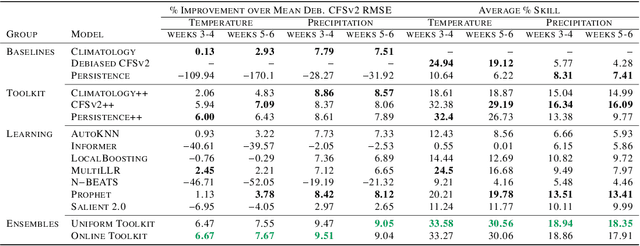
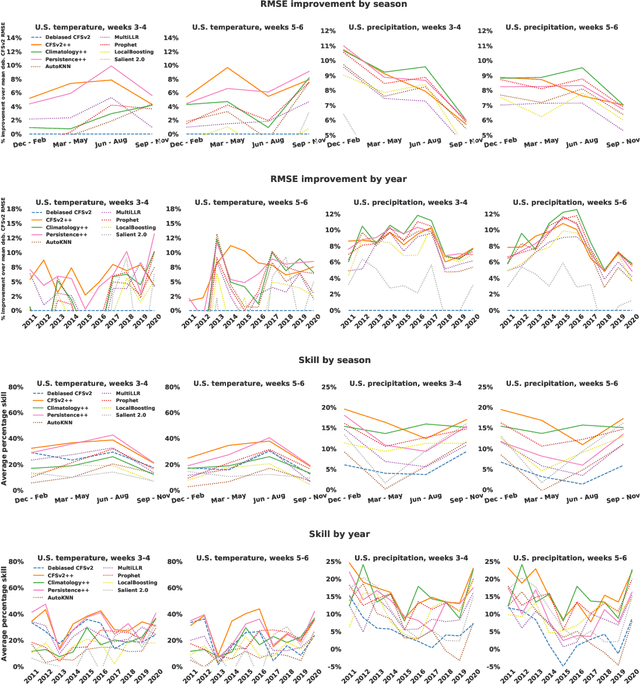
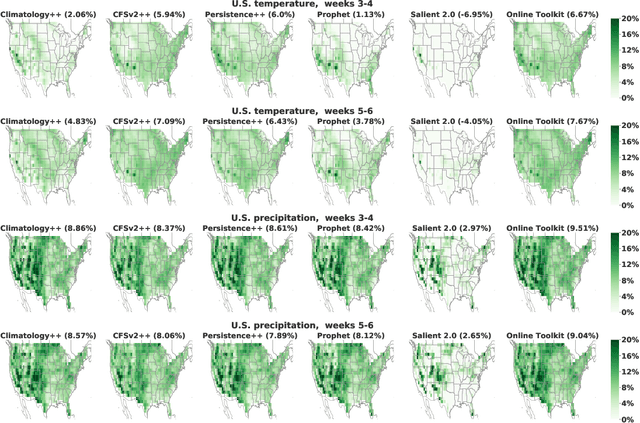
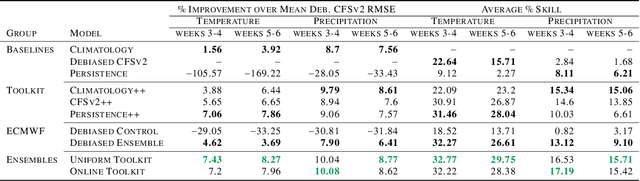
We develop a subseasonal forecasting toolkit of simple learned benchmark models that outperform both operational practice and state-of-the-art machine learning and deep learning methods. Our new models include (a) Climatology++, an adaptive alternative to climatology that, for precipitation, is 9% more accurate and 250% more skillful than the United States operational Climate Forecasting System (CFSv2); (b) CFSv2++, a learned CFSv2 correction that improves temperature and precipitation accuracy by 7-8% and skill by 50-275%; and (c) Persistence++, an augmented persistence model that combines CFSv2 forecasts with lagged measurements to improve temperature and precipitation accuracy by 6-9% and skill by 40-130%. Across the contiguous U.S., our Climatology++, CFSv2++, and Persistence++ toolkit consistently outperforms standard meteorological baselines, state-of-the-art machine and deep learning methods, and the European Centre for Medium-Range Weather Forecasts ensemble. Overall, we find that augmenting traditional forecasting approaches with learned enhancements yields an effective and computationally inexpensive strategy for building the next generation of subseasonal forecasting benchmarks.