 Add to Chrome
 Add to Firefox
 Add to Edge
High-Fidelity 3D Tooth Reconstruction by Fusing Intraoral Scans and CBCT Data via a Deep Implicit Representation
Jan 21, 2026
High-fidelity 3D tooth models are essential for digital dentistry, but must capture both the detailed crown and the complete root. Clinical imaging modalities are limited: Cone-Beam Computed Tomography (CBCT) captures the root but has a noisy, low-resolution crown, while Intraoral Scanners (IOS) provide a high-fidelity crown but no root information. A naive fusion of these sources results in unnatural seams and artifacts. We propose a novel, fully-automated pipeline that fuses CBCT and IOS data using a deep implicit representation. Our method first segments and robustly registers the tooth instances, then creates a hybrid proxy mesh combining the IOS crown and the CBCT root. The core of our approach is to use this noisy proxy to guide a class-specific DeepSDF network. This optimization process projects the input onto a learned manifold of ideal tooth shapes, generating a seamless, watertight, and anatomically coherent model. Qualitative and quantitative evaluations show our method uniquely preserves both the high-fidelity crown from IOS and the patient-specific root morphology from CBCT, overcoming the limitations of each modality and naive stitching.

4D Facial Expression Diffusion Model
Mar 29, 2023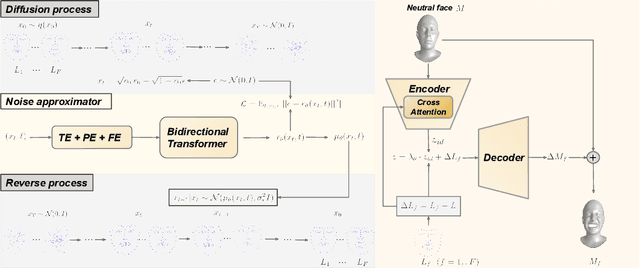
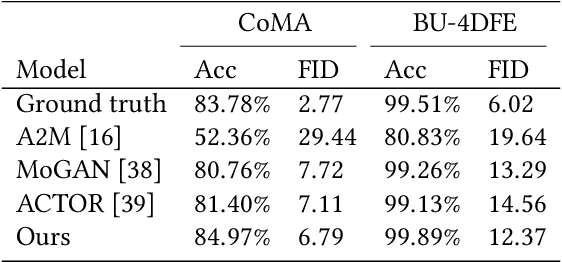
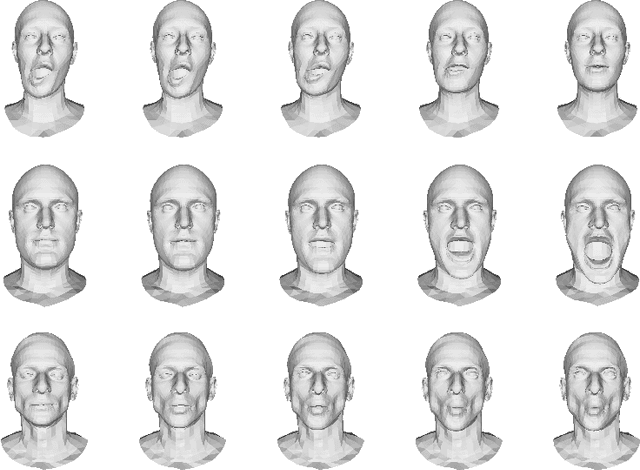
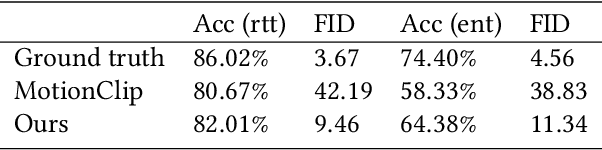
Facial expression generation is one of the most challenging and long-sought aspects of character animation, with many interesting applications. The challenging task, traditionally having relied heavily on digital craftspersons, remains yet to be explored. In this paper, we introduce a generative framework for generating 3D facial expression sequences (i.e. 4D faces) that can be conditioned on different inputs to animate an arbitrary 3D face mesh. It is composed of two tasks: (1) Learning the generative model that is trained over a set of 3D landmark sequences, and (2) Generating 3D mesh sequences of an input facial mesh driven by the generated landmark sequences. The generative model is based on a Denoising Diffusion Probabilistic Model (DDPM), which has achieved remarkable success in generative tasks of other domains. While it can be trained unconditionally, its reverse process can still be conditioned by various condition signals. This allows us to efficiently develop several downstream tasks involving various conditional generation, by using expression labels, text, partial sequences, or simply a facial geometry. To obtain the full mesh deformation, we then develop a landmark-guided encoder-decoder to apply the geometrical deformation embedded in landmarks on a given facial mesh. Experiments show that our model has learned to generate realistic, quality expressions solely from the dataset of relatively small size, improving over the state-of-the-art methods. Videos and qualitative comparisons with other methods can be found at https://github.com/ZOUKaifeng/4DFM. Code and models will be made available upon acceptance.
Disentangled representations: towards interpretation of sex determination from hip bone
Dec 17, 2021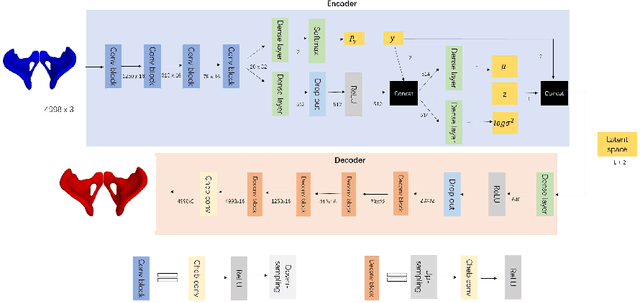


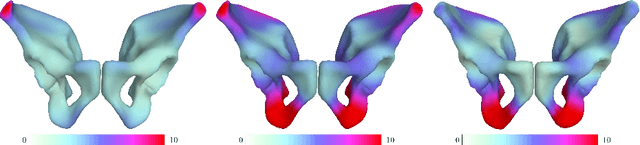
By highlighting the regions of the input image that contribute the most to the decision, saliency maps have become a popular method to make neural networks interpretable. In medical imaging, they are particularly well-suited to explain neural networks in the context of abnormality localization. However, from our experiments, they are less suited to classification problems where the features that allow to distinguish between the different classes are spatially correlated, scattered and definitely non-trivial. In this paper we thus propose a new paradigm for better interpretability. To this end we provide the user with relevant and easily interpretable information so that he can form his own opinion. We use Disentangled Variational Auto-Encoders which latent representation is divided into two components: the non-interpretable part and the disentangled part. The latter accounts for the categorical variables explicitly representing the different classes of interest. In addition to providing the class of a given input sample, such a model offers the possibility to transform the sample from a given class to a sample of another class, by modifying the value of the categorical variables in the latent representation. This paves the way to easier interpretation of class differences. We illustrate the relevance of this approach in the context of automatic sex determination from hip bones in forensic medicine. The features encoded by the model, that distinguish the different classes were found to be consistent with expert knowledge.
Hubless keypoint-based 3D deformable groupwise registration
Sep 11, 2018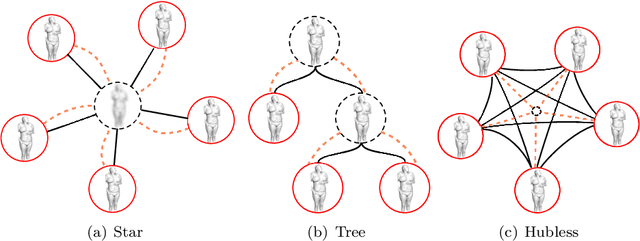
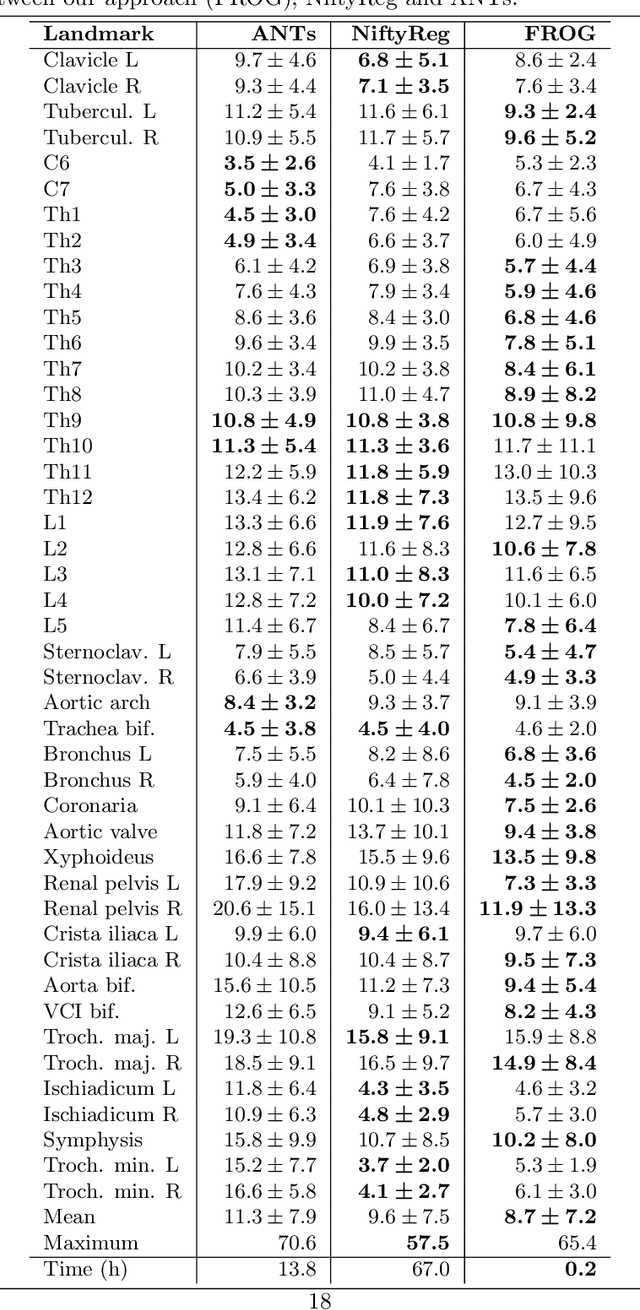
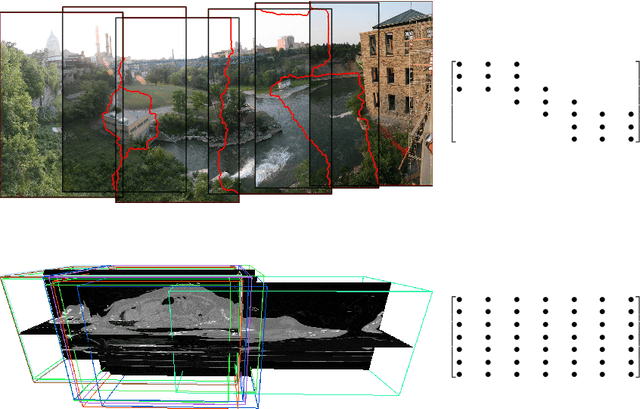
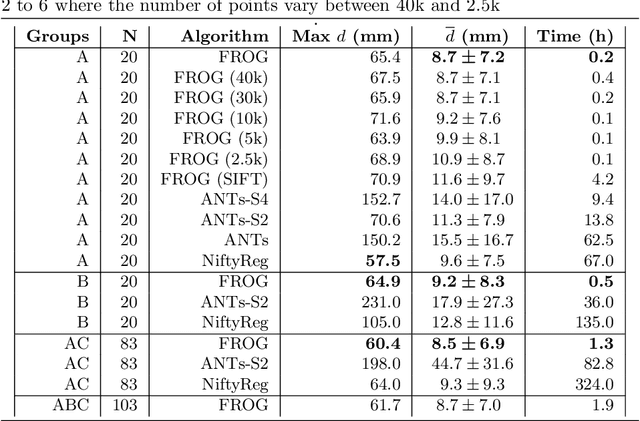
We present a novel deformable groupwise registration method, applied to large 3D image groups. Our approach extracts 3D SURF keypoints from images, computes matched pairs of keypoints and registers the group by minimizing pair distances in a hubless way i.e. without computing any central mean image. Using keypoints significantly reduces the problem complexity compared to voxel-based approaches, and enables us to provide an in-core global optimization, similar to the Bundle Adjustment for 3D reconstruction. As we aim at registering images of different patients, the matching step yields many outliers. Then we propose a new EM-weighting algorithm which efficiently discards outliers. Global optimization is carried out with a fast gradient descent algorithm. This allows our approach to robustly register large datasets. The result is a set of half transforms which link the volumes together and can be subsequently exploited for computational anatomy, landmark detection or image segmentation. We show experimental results on whole-body CT scans, with groups of up to 103 volumes. On a benchmark based on anatomical landmarks, our algorithm compares favorably with the star-groupwise voxel-based ANTs and NiftyReg approaches while being much faster. We also discuss the limitations of our approach for lower resolution images such as brain MRI.