 Add to Chrome
 Add to Firefox
 Add to Edge
Same or Not? Enhancing Visual Perception in Vision-Language Models
Dec 29, 2025
Vision-language models (VLMs) excel at broad visual understanding but remain coarse-grained, exhibit visual biases, and miss subtle visual details. Existing training corpora reinforce this limitation by emphasizing general recognition ("Is it a cat or a dog?") over fine-grained perception. To address this, we introduce a new training corpus and task designed to enhance the perceptual abilities of VLMs. TWIN is a large-scale dataset of 561,000 image-pair queries that task models to determine whether two visually similar images depict the same object, encouraging attention to nuanced visual cues. The dataset spans a diverse range of everyday objects across contexts, viewpoints, and appearances. Fine-tuning VLMs on TWIN yields notable gains in fine-grained recognition, even on unseen domains such as art, animals, plants, and landmarks. To quantify these gains, we introduce FGVQA, a benchmark suite of 12,000 queries that repurposes fine-grained recognition and retrieval datasets from multiple domains. While existing VLMs struggle on FGVQA, when fine-tuned on TWIN they improve by up to 19.3%, without compromising performance on general VQA benchmarks. Finally, our TWIN dataset scales favorably with object annotations, and our analysis shows that scale is key to performance. We envision TWIN as a drop-in addition to open-source VLM training corpora, advancing perceptual precision of future models. Project webpage: https://glab-caltech.github.io/twin/

CAT: Curvature-Adaptive Transformers for Geometry-Aware Learning
Oct 02, 2025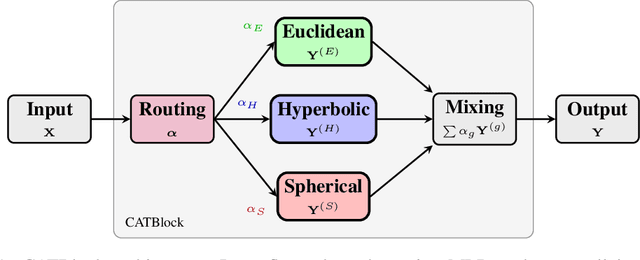
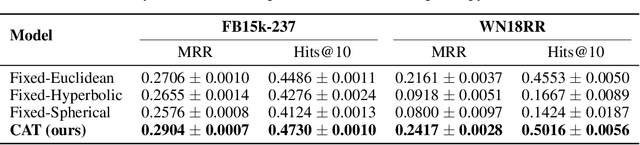
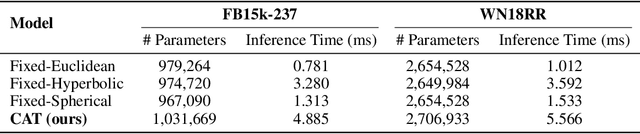
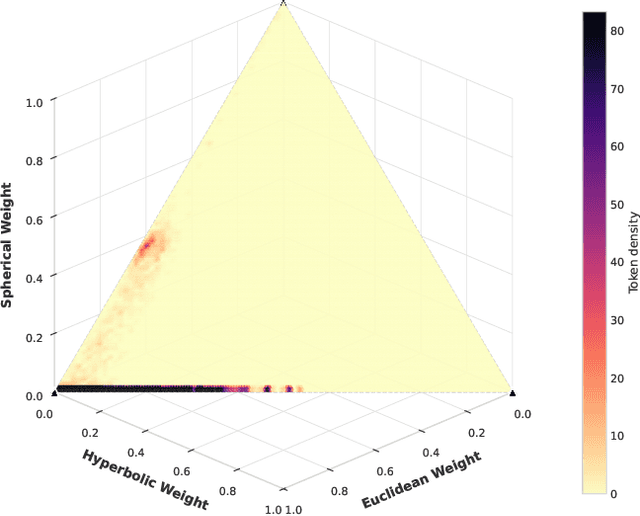
Transformers achieve strong performance across diverse domains but implicitly assume Euclidean geometry in their attention mechanisms, limiting their effectiveness on data with non-Euclidean structure. While recent extensions to hyperbolic and spherical spaces show promise for hierarchical and cyclical patterns, respectively, they require committing to a single geometry a priori, reducing flexibility when data exhibits mixed geometric properties. We introduce the Curvature-Adaptive Transformer (CAT), a novel architecture that dynamically learns per-token routing across three geometric attention branches through a lightweight, differentiable gating mechanism. Unlike fixed-geometry approaches, CAT enables adaptive geometric specialization, routing tokens to the appropriate curvature based on their local relational structure. The routing network provides interpretable curvature preferences while each branch employs geometry-specific operations optimized for its respective manifold. On knowledge graph completion benchmarks (FB15k-237, WN18RR), CAT achieves approximately 10% improvements in MRR and Hits@10 over fixed-geometry baselines with minimal overhead (5% parameter increase, comparable inference time). These results demonstrate that learned geometric adaptation outperforms any single fixed geometry for complex relational reasoning, establishing CAT as a scalable and interpretable foundation for mixture-of-geometry architectures across language, vision, and multimodal domains.
Enabling Automatic Differentiation with Mollified Graph Neural Operators
Apr 11, 2025Physics-informed neural operators offer a powerful framework for learning solution operators of partial differential equations (PDEs) by combining data and physics losses. However, these physics losses rely on derivatives. Computing these derivatives remains challenging, with spectral and finite difference methods introducing approximation errors due to finite resolution. Here, we propose the mollified graph neural operator (mGNO), the first method to leverage automatic differentiation and compute \emph{exact} gradients on arbitrary geometries. This enhancement enables efficient training on irregular grids and varying geometries while allowing seamless evaluation of physics losses at randomly sampled points for improved generalization. For a PDE example on regular grids, mGNO paired with autograd reduced the L2 relative data error by 20x compared to finite differences, although training was slower. It can also solve PDEs on unstructured point clouds seamlessly, using physics losses only, at resolutions vastly lower than those needed for finite differences to be accurate enough. On these unstructured point clouds, mGNO leads to errors that are consistently 2 orders of magnitude lower than machine learning baselines (Meta-PDE) for comparable runtimes, and also delivers speedups from 1 to 3 orders of magnitude compared to the numerical solver for similar accuracy. mGNOs can also be used to solve inverse design and shape optimization problems on complex geometries.