 Add to Chrome
 Add to Firefox
 Add to Edge
Read As Human: Compressing Context via Parallelizable Close Reading and Skimming
Feb 02, 2026
Large Language Models (LLMs) demonstrate exceptional capability across diverse tasks. However, their deployment in long-context scenarios is hindered by two challenges: computational inefficiency and redundant information. We propose RAM (Read As HuMan), a context compression framework that adopts an adaptive hybrid reading strategy, to address these challenges. Inspired by human reading behavior (i.e., close reading important content while skimming less relevant content), RAM partitions the context into segments and encodes them with the input query in parallel. High-relevance segments are fully retained (close reading), while low-relevance ones are query-guided compressed into compact summary vectors (skimming). Both explicit textual segments and implicit summary vectors are concatenated and fed into decoder to achieve both superior performance and natural language format interpretability. To refine the decision boundary between close reading and skimming, we further introduce a contrastive learning objective based on positive and negative query-segment pairs. Experiments demonstrate that RAM outperforms existing baselines on multiple question answering and summarization benchmarks across two backbones, while delivering up to a 12x end-to-end speedup on long inputs (average length 16K; maximum length 32K).

CoMeT: Collaborative Memory Transformer for Efficient Long Context Modeling
Feb 02, 2026The quadratic complexity and indefinitely growing key-value (KV) cache of standard Transformers pose a major barrier to long-context processing. To overcome this, we introduce the Collaborative Memory Transformer (CoMeT), a novel architecture that enables LLMs to handle arbitrarily long sequences with constant memory usage and linear time complexity. Designed as an efficient, plug-in module, CoMeT can be integrated into pre-trained models with only minimal fine-tuning. It operates on sequential data chunks, using a dual-memory system to manage context: a temporary memory on a FIFO queue for recent events, and a global memory with a gated update rule for long-range dependencies. These memories then act as a dynamic soft prompt for the next chunk. To enable efficient fine-tuning on extremely long contexts, we introduce a novel layer-level pipeline parallelism strategy. The effectiveness of our approach is remarkable: a model equipped with CoMeT and fine-tuned on 32k contexts can accurately retrieve a passkey from any position within a 1M token sequence. On the SCROLLS benchmark, CoMeT surpasses other efficient methods and achieves performance comparable to a full-attention baseline on summarization tasks. Its practical effectiveness is further validated on real-world agent and user behavior QA tasks. The code is available at: https://anonymous.4open.science/r/comet-B00B/
Forgetting Curve: A Reliable Method for Evaluating Memorization Capability for Long-context Models
Oct 07, 2024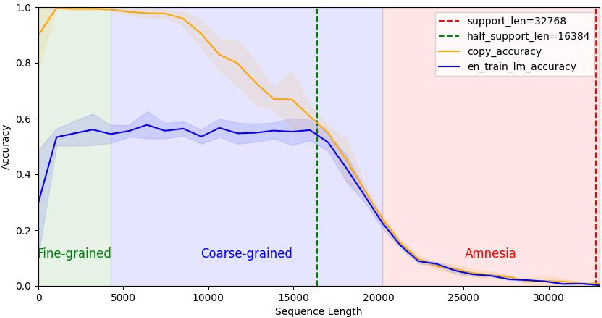
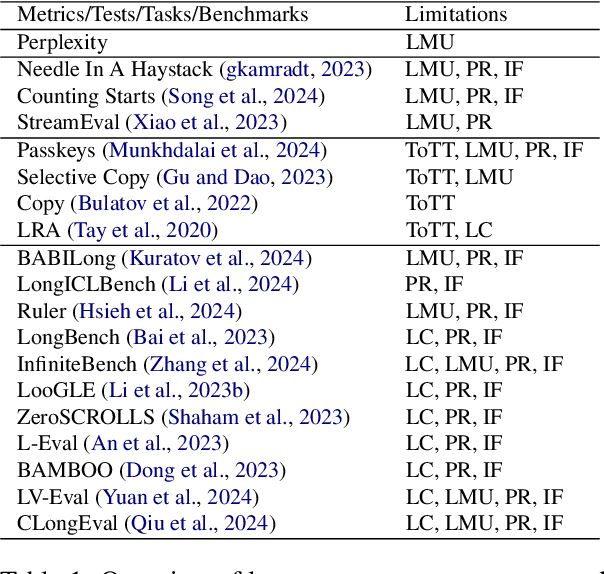
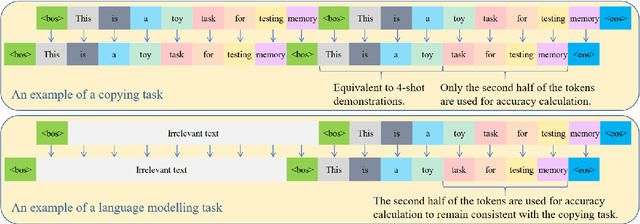
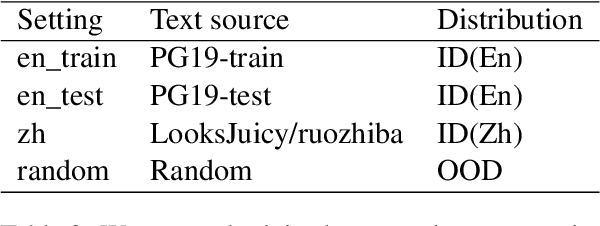
Numerous recent works target to extend effective context length for language models and various methods, tasks and benchmarks exist to measure model's effective memorization length. However, through thorough investigations, we find limitations for currently existing evaluations on model's memorization capability. We provide an extensive survey for limitations in this work and propose a new method called forgetting curve to measure the memorization capability of long-context models. We show that forgetting curve has the advantage of being robust to the tested corpus and the experimental settings, of not relying on prompts and can be applied to any model size. We apply our forgetting curve to a large variety of models involving both transformer and RNN/SSM based architectures. Our measurement provides empirical evidence for the effectiveness of transformer extension techniques while raises questions for the effective length of RNN/SSM based models. We also examine the difference between our measurement and existing benchmarks as well as popular metrics for various models. Our code and results can be found at https://github.com/1azybug/ForgettingCurve.
More Effective LLM Compressed Tokens with Uniformly Spread Position Identifiers and Compression Loss
Sep 22, 2024


Compressing Transformer inputs into compressd tokens allows running LLMs with improved speed and cost efficiency. Based on the compression method ICAE, we carefully examine the position identifier choices for compressed tokens and also propose a new compression loss. We demonstrate empirically that our proposed methods achieve significantly higher compression ratios (15x compared to 4x for ICAE), while being able to attain comparable reconstruction performance.