 Add to Chrome
 Add to Firefox
 Add to Edge
Multi-function Robotized Surgical Dissector for Endoscopic Pulmonary Thromboendarterectomy: Preclinical Study and Evaluation
Feb 03, 2026
Patients suffering chronic severe pulmonary thromboembolism need Pulmonary Thromboendarterectomy (PTE) to remove the thromb and intima located inside pulmonary artery (PA). During the surgery, a surgeon holds tweezers and a dissector to delicately strip the blockage, but available tools for this surgery are rigid and straight, lacking distal dexterity to access into thin branches of PA. Therefore, this work presents a novel robotized dissector based on concentric push/pull robot (CPPR) structure, enabling entering deep thin branch of tortuous PA. Compared with conventional rigid dissectors, our design characterizes slenderness and dual-segment-bending dexterity. Owing to the hollow and thin-walled structure of the CPPR-based dissector as it has a slender body of 3.5mm in diameter, the central lumen accommodates two channels for irrigation and tip tool, and space for endoscopic camera's signal wire. To provide accurate surgical manipulation, optimization-based kinematics model was established, realizing a 2mm accuracy in positioning the tip tool (60mm length) under open-loop control strategy. As such, with the endoscopic camera, traditional PTE is possible to be upgraded as endoscopic PTE. Basic physic performance of the robotized dissector including stiffness, motion accuracy and maneuverability was evaluated through experiments. Surgery simulation on ex vivo porcine lung also demonstrates its dexterity and notable advantages in PTE.

Ultra-slender Coaxial Antagonistic Tubular Robot for Ambidextrous Manipulation
Dec 25, 2024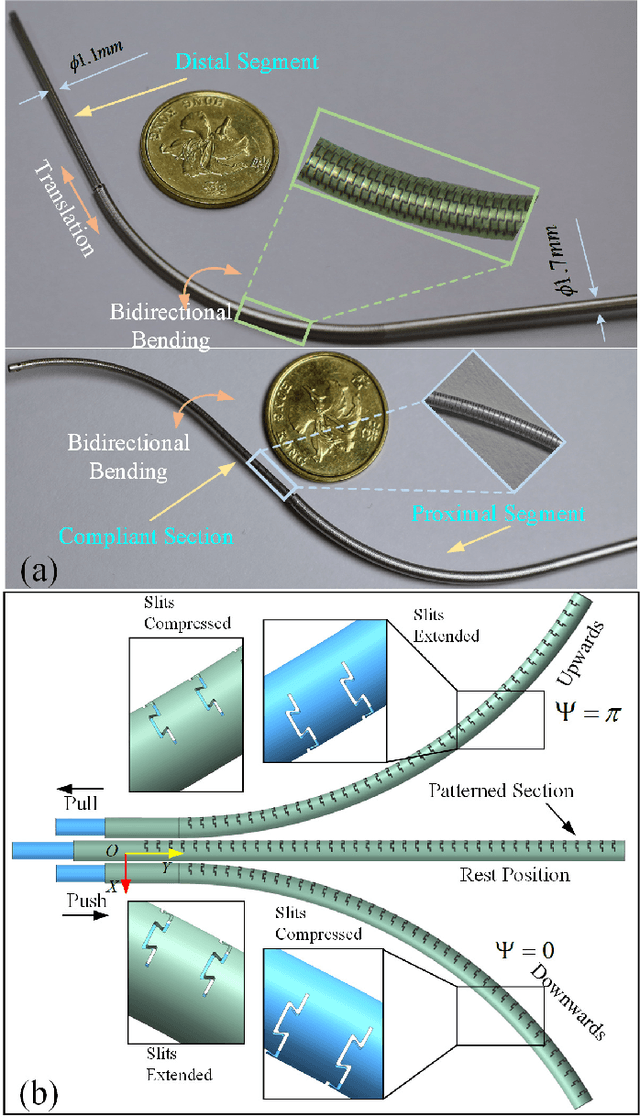

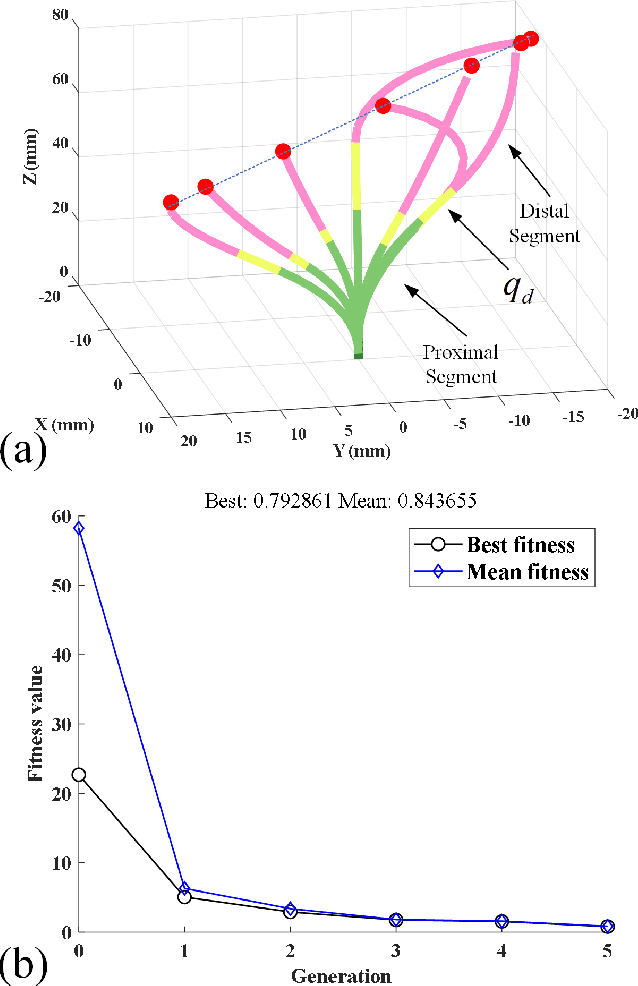
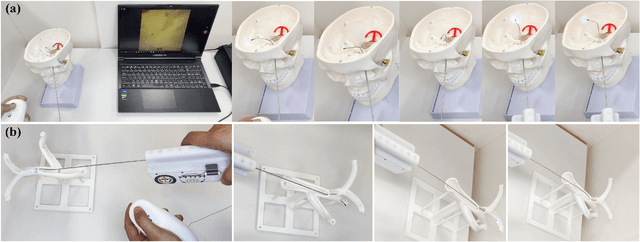
As soft continuum manipulators characterize terrific compliance and maneuverability in narrow unstructured space, low stiffness and limited dexterity are two obvious shortcomings in practical applications. To address the issues, a novel asymmetric coaxial antagonistic tubular robot (CATR) arm with high stiffness has been proposed, where two asymmetrically patterned metal tubes were fixed at the tip end with a shift angle of 180{\deg} and axial actuation force at the other end deforms the tube. Delicately designed and optimized steerable section and fully compliant section enable the soft manipulator high dexterity and stiffness. The basic kinetostatics model of a single segment was established on the basis of geometric and statics, and constrained optimization algorithm promotes finding the actuation inputs for a given desired task configuration. In addition, we have specifically built the design theory for the slits patterned on the tube surface, taking both bending angle and stiffness into account. Experiments demonstrate that the proposed robot arm is dexterous and has greater stiffness compared with same-size continuum robots. Furthermore, experiments also showcase the potential in minimally invasive surgery.