 Add to Chrome
 Add to Firefox
 Add to Edge
Landscaper: Understanding Loss Landscapes Through Multi-Dimensional Topological Analysis
Feb 06, 2026
Loss landscapes are a powerful tool for understanding neural network optimization and generalization, yet traditional low-dimensional analyses often miss complex topological features. We present Landscaper, an open-source Python package for arbitrary-dimensional loss landscape analysis. Landscaper combines Hessian-based subspace construction with topological data analysis to reveal geometric structures such as basin hierarchy and connectivity. A key component is the Saddle-Minimum Average Distance (SMAD) for quantifying landscape smoothness. We demonstrate Landscaper's effectiveness across various architectures and tasks, including those involving pre-trained language models, showing that SMAD captures training transitions, such as landscape simplification, that conventional metrics miss. We also illustrate Landscaper's performance in challenging chemical property prediction tasks, where SMAD can serve as a metric for out-of-distribution generalization, offering valuable insights for model diagnostics and architecture design in data-scarce scientific machine learning scenarios.

Capturing Cancer as Music: Cancer Mechanisms Expressed through Musification
Feb 09, 2024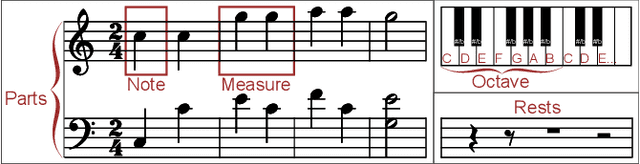
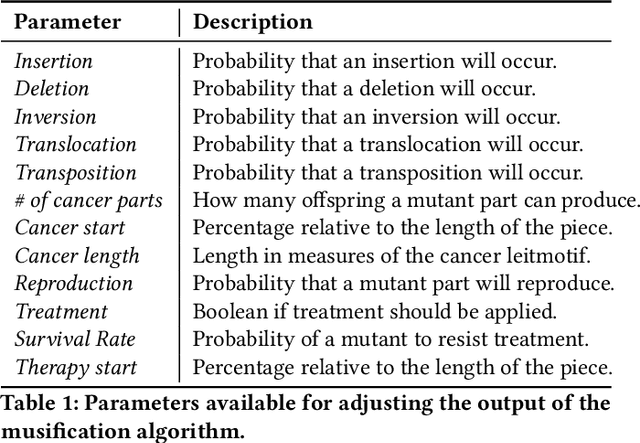
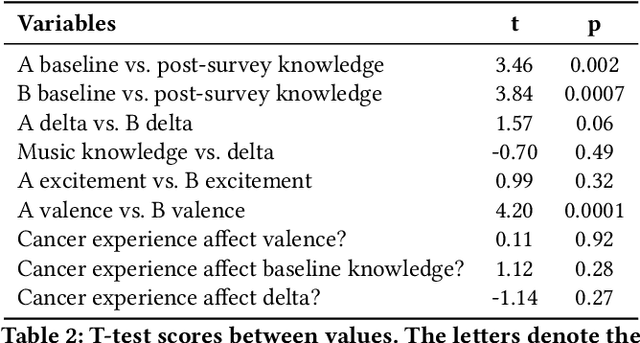
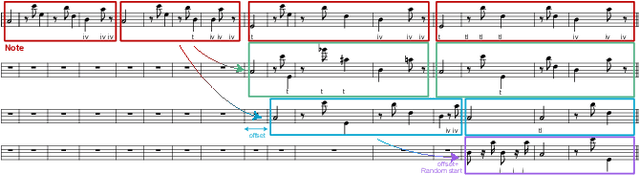
The development of cancer is difficult to express on a simple and intuitive level due to its complexity. Since cancer is so widespread, raising public awareness about its mechanisms can help those affected cope with its realities, as well as inspire others to make lifestyle adjustments and screen for the disease. Unfortunately, studies have shown that cancer literature is too technical for the general public to understand. We found that musification, the process of turning data into music, remains an unexplored avenue for conveying this information. We explore the pedagogical effectiveness of musification through the use of an algorithm that manipulates a piece of music in a manner analogous to the development of cancer. We conducted two lab studies and found that our approach is marginally more effective at promoting cancer literacy when accompanied by a text-based article than text-based articles alone.