 Add to Chrome
 Add to Firefox
 Add to Edge
NVIDIA Nemotron 3: Efficient and Open Intelligence
Dec 24, 2025
We introduce the Nemotron 3 family of models - Nano, Super, and Ultra. These models deliver strong agentic, reasoning, and conversational capabilities. The Nemotron 3 family uses a Mixture-of-Experts hybrid Mamba-Transformer architecture to provide best-in-class throughput and context lengths of up to 1M tokens. Super and Ultra models are trained with NVFP4 and incorporate LatentMoE, a novel approach that improves model quality. The two larger models also include MTP layers for faster text generation. All Nemotron 3 models are post-trained using multi-environment reinforcement learning enabling reasoning, multi-step tool use, and support granular reasoning budget control. Nano, the smallest model, outperforms comparable models in accuracy while remaining extremely cost-efficient for inference. Super is optimized for collaborative agents and high-volume workloads such as IT ticket automation. Ultra, the largest model, provides state-of-the-art accuracy and reasoning performance. Nano is released together with its technical report and this white paper, while Super and Ultra will follow in the coming months. We will openly release the model weights, pre- and post-training software, recipes, and all data for which we hold redistribution rights.

Nemotron 3 Nano: Open, Efficient Mixture-of-Experts Hybrid Mamba-Transformer Model for Agentic Reasoning
Dec 23, 2025We present Nemotron 3 Nano 30B-A3B, a Mixture-of-Experts hybrid Mamba-Transformer language model. Nemotron 3 Nano was pretrained on 25 trillion text tokens, including more than 3 trillion new unique tokens over Nemotron 2, followed by supervised fine tuning and large-scale RL on diverse environments. Nemotron 3 Nano achieves better accuracy than our previous generation Nemotron 2 Nano while activating less than half of the parameters per forward pass. It achieves up to 3.3x higher inference throughput than similarly-sized open models like GPT-OSS-20B and Qwen3-30B-A3B-Thinking-2507, while also being more accurate on popular benchmarks. Nemotron 3 Nano demonstrates enhanced agentic, reasoning, and chat abilities and supports context lengths up to 1M tokens. We release both our pretrained Nemotron 3 Nano 30B-A3B Base and post-trained Nemotron 3 Nano 30B-A3B checkpoints on Hugging Face.
NVIDIA Nemotron Nano 2: An Accurate and Efficient Hybrid Mamba-Transformer Reasoning Model
Aug 21, 2025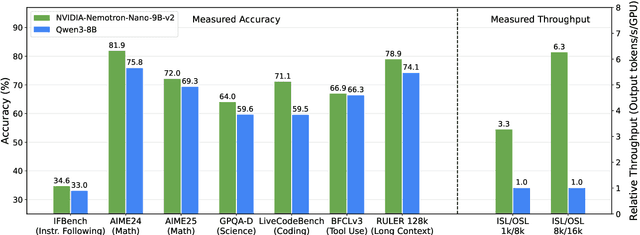

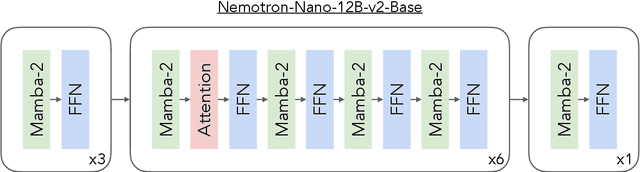
We introduce Nemotron-Nano-9B-v2, a hybrid Mamba-Transformer language model designed to increase throughput for reasoning workloads while achieving state-of-the-art accuracy compared to similarly-sized models. Nemotron-Nano-9B-v2 builds on the Nemotron-H architecture, in which the majority of the self-attention layers in the common Transformer architecture are replaced with Mamba-2 layers, to achieve improved inference speed when generating the long thinking traces needed for reasoning. We create Nemotron-Nano-9B-v2 by first pre-training a 12-billion-parameter model (Nemotron-Nano-12B-v2-Base) on 20 trillion tokens using an FP8 training recipe. After aligning Nemotron-Nano-12B-v2-Base, we employ the Minitron strategy to compress and distill the model with the goal of enabling inference on up to 128k tokens on a single NVIDIA A10G GPU (22GiB of memory, bfloat16 precision). Compared to existing similarly-sized models (e.g., Qwen3-8B), we show that Nemotron-Nano-9B-v2 achieves on-par or better accuracy on reasoning benchmarks while achieving up to 6x higher inference throughput in reasoning settings like 8k input and 16k output tokens. We are releasing Nemotron-Nano-9B-v2, Nemotron-Nano12B-v2-Base, and Nemotron-Nano-9B-v2-Base checkpoints along with the majority of our pre- and post-training datasets on Hugging Face.
Better Synthetic Data by Retrieving and Transforming Existing Datasets
Apr 26, 2024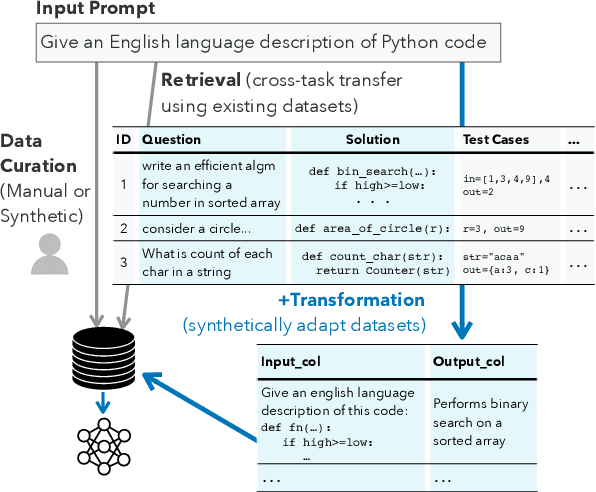
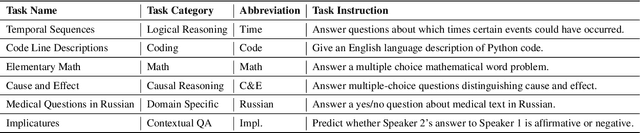
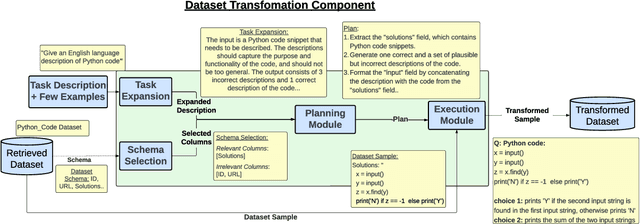
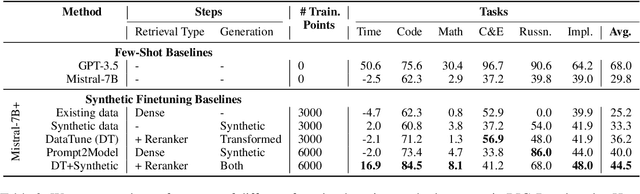
Despite recent advances in large language models, building dependable and deployable NLP models typically requires abundant, high-quality training data. However, task-specific data is not available for many use cases, and manually curating task-specific data is labor-intensive. Recent work has studied prompt-driven synthetic data generation using large language models, but these generated datasets tend to lack complexity and diversity. To address these limitations, we introduce a method, DataTune, to make better use of existing, publicly available datasets to improve automatic dataset generation. DataTune performs dataset transformation, enabling the repurposing of publicly available datasets into a format that is directly aligned with the specific requirements of target tasks. On a diverse set of language-based tasks from the BIG-Bench benchmark, we find that finetuning language models via DataTune improves over a few-shot prompting baseline by 49% and improves over existing methods that use synthetic or retrieved training data by 34%. We find that dataset transformation significantly increases the diversity and difficulty of generated data on many tasks. We integrate DataTune into an open-source repository to make this method accessible to the community: https://github.com/neulab/prompt2model.
Extending the Forward Forward Algorithm
Jul 14, 2023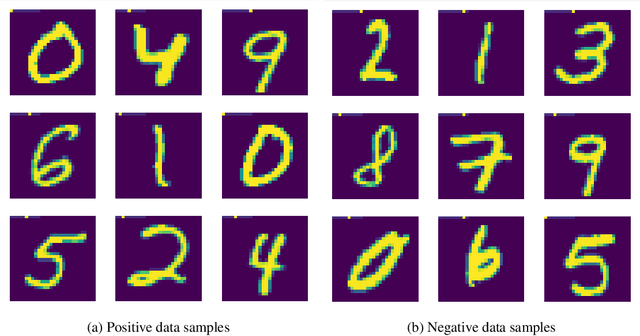

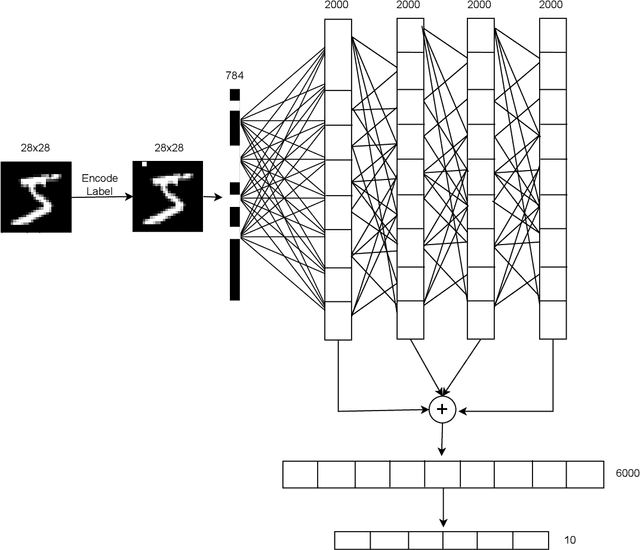
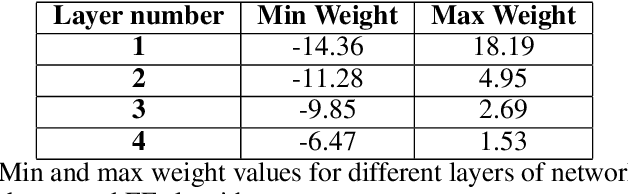
The Forward Forward algorithm, proposed by Geoffrey Hinton in November 2022, is a novel method for training neural networks as an alternative to backpropagation. In this project, we replicate Hinton's experiments on the MNIST dataset, and subsequently extend the scope of the method with two significant contributions. First, we establish a baseline performance for the Forward Forward network on the IMDb movie reviews dataset. As far as we know, our results on this sentiment analysis task marks the first instance of the algorithm's extension beyond computer vision. Second, we introduce a novel pyramidal optimization strategy for the loss threshold - a hyperparameter specific to the Forward Forward method. Our pyramidal approach shows that a good thresholding strategy causes a difference of up to 8% in test error. Lastly, we perform visualizations of the trained parameters and derived several significant insights, such as a notably larger (10-20x) mean and variance in the weights acquired by the Forward Forward network. Repository: https://github.com/Ads-cmu/ForwardForward
Real-Time Cognitive Evaluation of Online Learners through Automatically Generated Questions
Jun 06, 2021


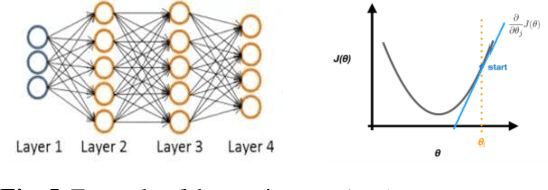
With the increased adoption of E-learning platforms, keeping online learners engaged throughout a lesson is challenging. One approach to tackle this challenge is to probe learn-ers periodically by asking questions. The paper presents an approach to generate questions from a given video lecture automatically. The generated questions are aimed to evaluate learners' lower-level cognitive abilities. The approach automatically extracts text from video lectures to generates wh-kinds of questions. When learners respond with an answer, the proposed approach further evaluates the response and provides feedback. Besides enhancing learner's engagement, this approach's main benefits are that it frees instructors from design-ing questions to check the comprehension of a topic. Thus, instructors can spend this time productively on other activities.