 Add to Chrome
 Add to Firefox
 Add to Edge
A Training-Free Large Reasoning Model-based Knowledge Tracing Framework for Unified Prediction and Prescription
Jan 05, 2026
Knowledge Tracing (KT) aims to estimate a learner's evolving mastery based on interaction histories. Recent studies have explored Large Language Models (LLMs) for KT via autoregressive nature, but such approaches typically require fine-tuning and exhibit unstable or near-random performance. Moreover, prior KT systems primarily focus on prediction and rely on multi-stage pipelines for feedback and recommendation, resulting in increased system complexity and resources. To address this gap, we propose Thinking-KT, a training-free KT framework that incorporates Test-Time Scaling (TTS), enabling even small LLMs to achieve competitive KT performance. Moreover, in this framework, a small LLM can jointly perform KT prediction, personalized feedback generation, and learning recommendation in a unified output without degrading prediction accuracy. Beyond performance, we present the systematic analysis of reasoning traces in KT. Our results demonstrate that TTS is a critical yet underexplored factor in LLM-based KT, and that small LLMs can serve as unified ITS engines.

DEFormer: DCT-driven Enhancement Transformer for Low-light Image and Dark Vision
Sep 13, 2023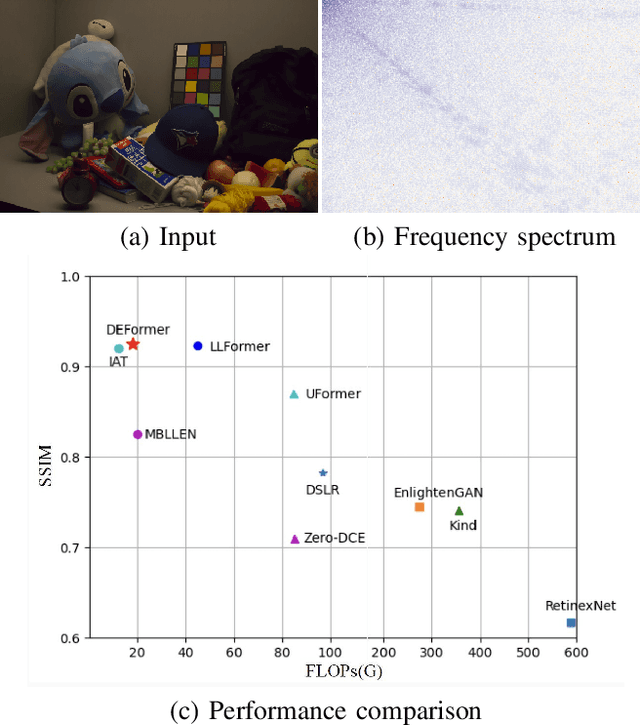
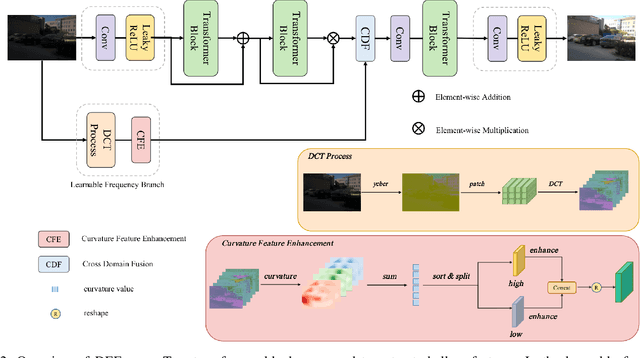
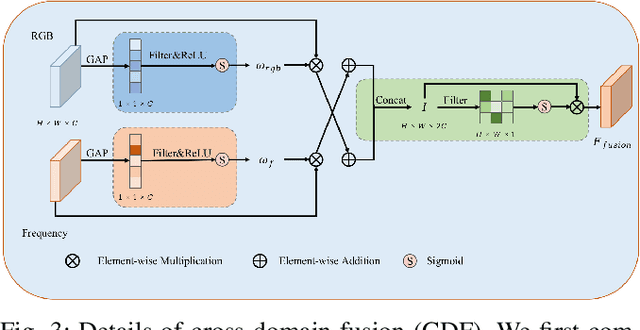
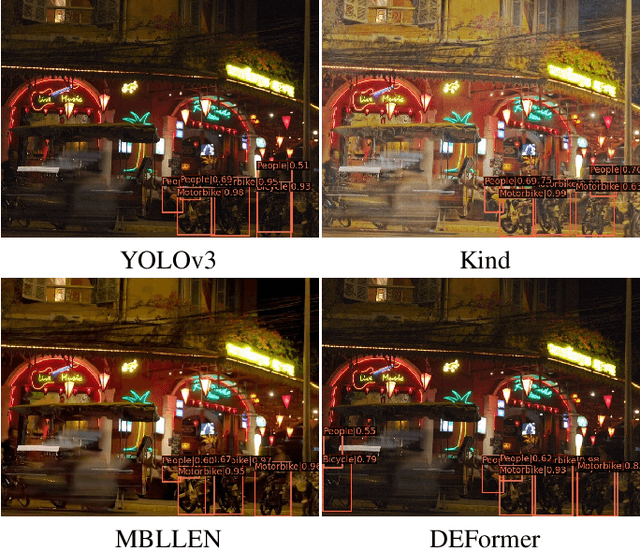
The goal of low-light image enhancement is to restore the color and details of the image and is of great significance for high-level visual tasks in autonomous driving. However, it is difficult to restore the lost details in the dark area by relying only on the RGB domain. In this paper we introduce frequency as a new clue into the network and propose a novel DCT-driven enhancement transformer (DEFormer). First, we propose a learnable frequency branch (LFB) for frequency enhancement contains DCT processing and curvature-based frequency enhancement (CFE). CFE calculates the curvature of each channel to represent the detail richness of different frequency bands, then we divides the frequency features, which focuses on frequency bands with richer textures. In addition, we propose a cross domain fusion (CDF) for reducing the differences between the RGB domain and the frequency domain. We also adopt DEFormer as a preprocessing in dark detection, DEFormer effectively improves the performance of the detector, bringing 2.1% and 3.4% improvement in ExDark and DARK FACE datasets on mAP respectively.