 Add to Chrome
 Add to Firefox
 Add to Edge
Disentanglement by means of action-induced representations
Feb 06, 2026
Learning interpretable representations with variational autoencoders (VAEs) is a major goal of representation learning. The main challenge lies in obtaining disentangled representations, where each latent dimension corresponds to a distinct generative factor. This difficulty is fundamentally tied to the inability to perform nonlinear independent component analysis. Here, we introduce the framework of action-induced representations (AIRs) which models representations of physical systems given experiments (or actions) that can be performed on them. We show that, in this framework, we can provably disentangle degrees of freedom w.r.t. their action dependence. We further introduce a variational AIR architecture (VAIR) that can extract AIRs and therefore achieve provable disentanglement where standard VAEs fail. Beyond state representation, VAIR also captures the action dependence of the underlying generative factors, directly linking experiments to the degrees of freedom they influence.

Learning Minimal Representations of Many-Body Physics from Snapshots of a Quantum Simulator
Sep 17, 2025Analog quantum simulators provide access to many-body dynamics beyond the reach of classical computation. However, extracting physical insights from experimental data is often hindered by measurement noise, limited observables, and incomplete knowledge of the underlying microscopic model. Here, we develop a machine learning approach based on a variational autoencoder (VAE) to analyze interference measurements of tunnel-coupled one-dimensional Bose gases, which realize the sine-Gordon quantum field theory. Trained in an unsupervised manner, the VAE learns a minimal latent representation that strongly correlates with the equilibrium control parameter of the system. Applied to non-equilibrium protocols, the latent space uncovers signatures of frozen-in solitons following rapid cooling, and reveals anomalous post-quench dynamics not captured by conventional correlation-based methods. These results demonstrate that generative models can extract physically interpretable variables directly from noisy and sparse experimental data, providing complementary probes of equilibrium and non-equilibrium physics in quantum simulators. More broadly, our work highlights how machine learning can supplement established field-theoretical techniques, paving the way for scalable, data-driven discovery in quantum many-body systems.
Hybrid Ground-State Quantum Algorithms based on Neural Schrödinger Forging
Jul 05, 2023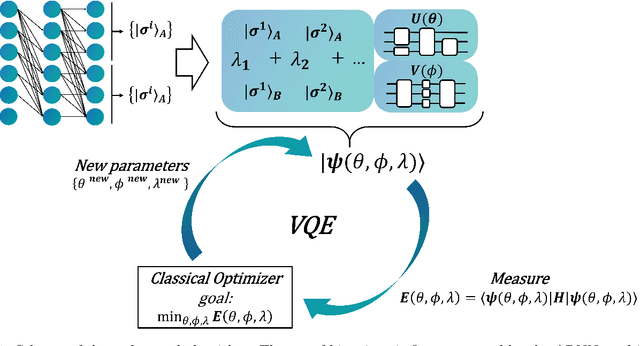
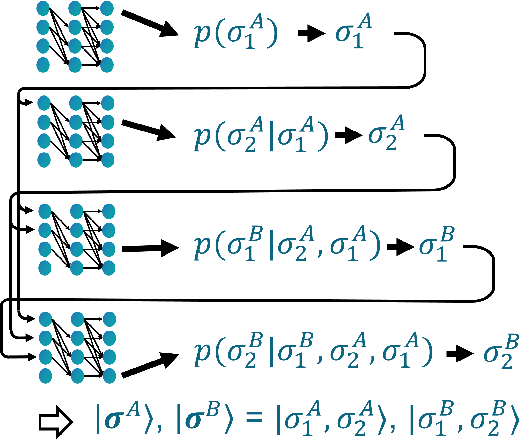
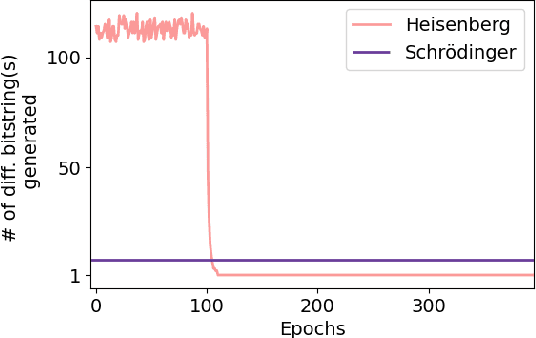
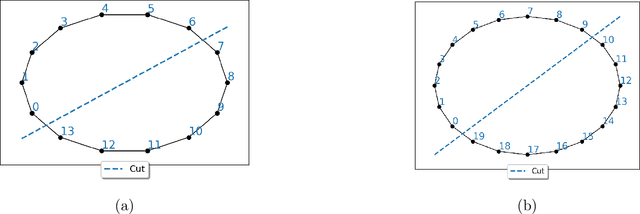
Entanglement forging based variational algorithms leverage the bi-partition of quantum systems for addressing ground state problems. The primary limitation of these approaches lies in the exponential summation required over the numerous potential basis states, or bitstrings, when performing the Schmidt decomposition of the whole system. To overcome this challenge, we propose a new method for entanglement forging employing generative neural networks to identify the most pertinent bitstrings, eliminating the need for the exponential sum. Through empirical demonstrations on systems of increasing complexity, we show that the proposed algorithm achieves comparable or superior performance compared to the existing standard implementation of entanglement forging. Moreover, by controlling the amount of required resources, this scheme can be applied to larger, as well as non permutation invariant systems, where the latter constraint is associated with the Heisenberg forging procedure. We substantiate our findings through numerical simulations conducted on spins models exhibiting one-dimensional ring, two-dimensional triangular lattice topologies, and nuclear shell model configurations.