 Add to Chrome
 Add to Firefox
 Add to Edge
Augmenting Question Answering with A Hybrid RAG Approach
Jan 19, 2026
Retrieval-Augmented Generation (RAG) has emerged as a powerful technique for enhancing the quality of responses in Question-Answering (QA) tasks. However, existing approaches often struggle with retrieving contextually relevant information, leading to incomplete or suboptimal answers. In this paper, we introduce Structured-Semantic RAG (SSRAG), a hybrid architecture that enhances QA quality by integrating query augmentation, agentic routing, and a structured retrieval mechanism combining vector and graph based techniques with context unification. By refining retrieval processes and improving contextual grounding, our approach improves both answer accuracy and informativeness. We conduct extensive evaluations on three popular QA datasets, TruthfulQA, SQuAD and WikiQA, across five Large Language Models (LLMs), demonstrating that our proposed approach consistently improves response quality over standard RAG implementations.

Boosting Imperceptibility of Stable Diffusion-based Adversarial Examples Generation with Momentum
Oct 17, 2024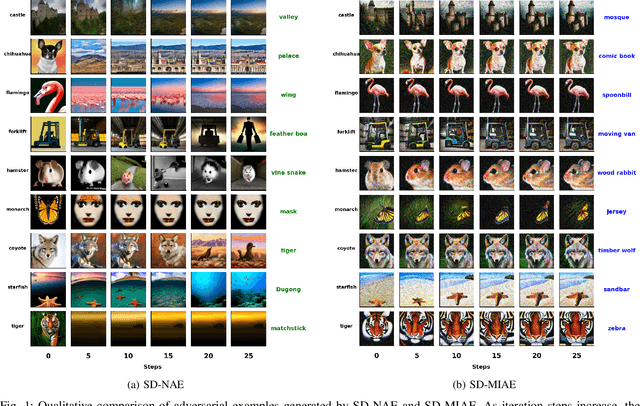
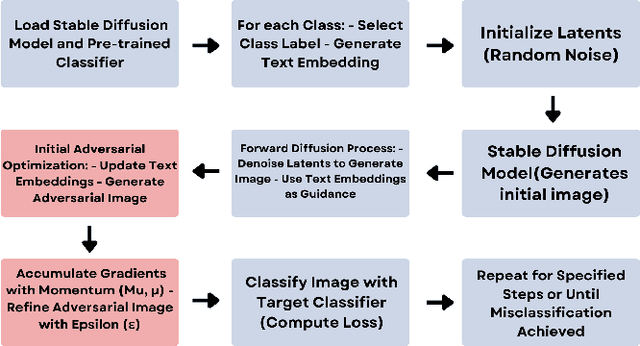


We propose a novel framework, Stable Diffusion-based Momentum Integrated Adversarial Examples (SD-MIAE), for generating adversarial examples that can effectively mislead neural network classifiers while maintaining visual imperceptibility and preserving the semantic similarity to the original class label. Our method leverages the text-to-image generation capabilities of the Stable Diffusion model by manipulating token embeddings corresponding to the specified class in its latent space. These token embeddings guide the generation of adversarial images that maintain high visual fidelity. The SD-MIAE framework consists of two phases: (1) an initial adversarial optimization phase that modifies token embeddings to produce misclassified yet natural-looking images and (2) a momentum-based optimization phase that refines the adversarial perturbations. By introducing momentum, our approach stabilizes the optimization of perturbations across iterations, enhancing both the misclassification rate and visual fidelity of the generated adversarial examples. Experimental results demonstrate that SD-MIAE achieves a high misclassification rate of 79%, improving by 35% over the state-of-the-art method while preserving the imperceptibility of adversarial perturbations and the semantic similarity to the original class label, making it a practical method for robust adversarial evaluation.