 Add to Chrome
 Add to Firefox
 Add to Edge
FloydNet: A Learning Paradigm for Global Relational Reasoning
Jan 27, 2026
Developing models capable of complex, multi-step reasoning is a central goal in artificial intelligence. While representing problems as graphs is a powerful approach, Graph Neural Networks (GNNs) are fundamentally constrained by their message-passing mechanism, which imposes a local bottleneck that limits global, holistic reasoning. We argue that dynamic programming (DP), which solves problems by iteratively refining a global state, offers a more powerful and suitable learning paradigm. We introduce FloydNet, a new architecture that embodies this principle. In contrast to local message passing, FloydNet maintains a global, all-pairs relationship tensor and learns a generalized DP operator to progressively refine it. This enables the model to develop a task-specific relational calculus, providing a principled framework for capturing long-range dependencies. Theoretically, we prove that FloydNet achieves 3-WL (2-FWL) expressive power, and its generalized form aligns with the k-FWL hierarchy. FloydNet demonstrates state-of-the-art performance across challenging domains: it achieves near-perfect scores (often >99\%) on the CLRS-30 algorithmic benchmark, finds exact optimal solutions for the general Traveling Salesman Problem (TSP) at rates significantly exceeding strong heuristics, and empirically matches the 3-WL test on the BREC benchmark. Our results establish this learned, DP-style refinement as a powerful and practical alternative to message passing for high-level graph reasoning.

MusicBERT: Symbolic Music Understanding with Large-Scale Pre-Training
Jun 10, 2021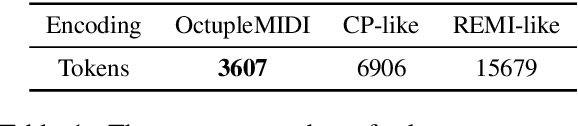

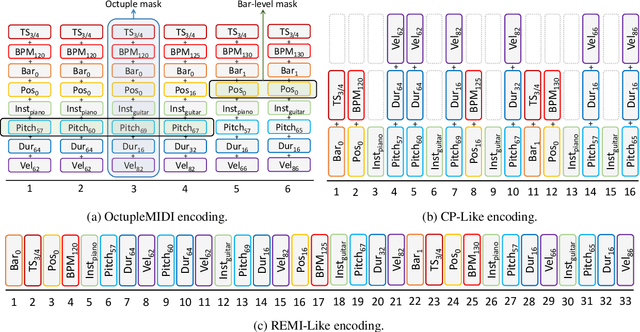

Symbolic music understanding, which refers to the understanding of music from the symbolic data (e.g., MIDI format, but not audio), covers many music applications such as genre classification, emotion classification, and music pieces matching. While good music representations are beneficial for these applications, the lack of training data hinders representation learning. Inspired by the success of pre-training models in natural language processing, in this paper, we develop MusicBERT, a large-scale pre-trained model for music understanding. To this end, we construct a large-scale symbolic music corpus that contains more than 1 million music songs. Since symbolic music contains more structural (e.g., bar, position) and diverse information (e.g., tempo, instrument, and pitch), simply adopting the pre-training techniques from NLP to symbolic music only brings marginal gains. Therefore, we design several mechanisms, including OctupleMIDI encoding and bar-level masking strategy, to enhance pre-training with symbolic music data. Experiments demonstrate the advantages of MusicBERT on four music understanding tasks, including melody completion, accompaniment suggestion, genre classification, and style classification. Ablation studies also verify the effectiveness of our designs of OctupleMIDI encoding and bar-level masking strategy in MusicBERT.