 Add to Chrome
 Add to Firefox
 Add to Edge
EvoSpark: Endogenous Interactive Agent Societies for Unified Long-Horizon Narrative Evolution
Apr 14, 2026
Realizing endogenous narrative evolution in LLM-based multi-agent systems is hindered by the inherent stochasticity of generative emergence. In particular, long-horizon simulations suffer from social memory stacking, where conflicting relational states accumulate without resolution, and narrative-spatial dissonance, where spatial logic detaches from the evolving plot. To bridge this gap, we propose EvoSpark, a framework specifically designed to sustain logically coherent long-horizon narratives within Endogenous Interactive Agent Societies. To ensure consistency, the Stratified Narrative Memory employs a Role Socio-Evolutionary Base as living cognition, dynamically metabolizing experiences to resolve historical conflicts. Complementarily, Generative Mise-en-Scène mechanism enforces Role-Location-Plot alignment, synchronizing character presence with the narrative flow. Underpinning these is the Unified Narrative Operation Engine, which integrates an Emergent Character Grounding Protocol to transform stochastic sparking into persistent characters. This engine establishes a substrate that expands a minimal premise into an open-ended, evolving story world. Experiments demonstrate that EvoSpark significantly outperforms baselines across diverse paradigms, enabling the sustained generation of expressive and coherent narrative experiences.

Improving transferability of 3D adversarial attacks with scale and shear transformations
Nov 02, 2022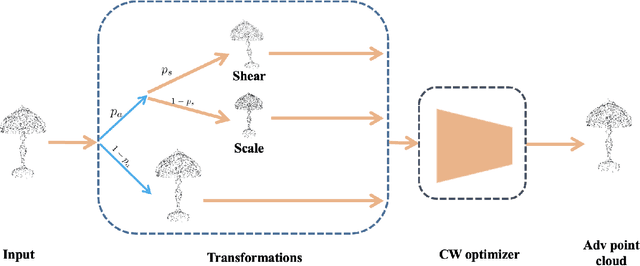
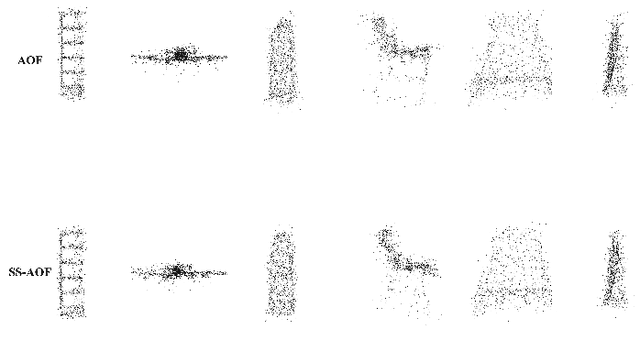
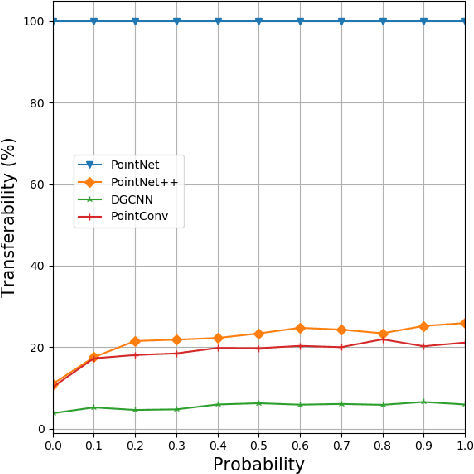
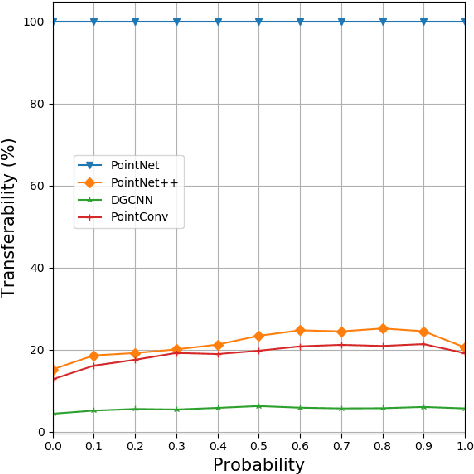
Previous work has shown that 3D point cloud classifiers can be vulnerable to adversarial examples. However, most of the existing methods are aimed at white-box attacks, where the parameters and other information of the classifiers are known in the attack, which is unrealistic for real-world applications. In order to improve the attack performance of the black-box classifiers, the research community generally uses the transfer-based black-box attack. However, the transferability of current 3D attacks is still relatively low. To this end, this paper proposes Scale and Shear (SS) Attack to generate 3D adversarial examples with strong transferability. Specifically, we randomly scale or shear the input point cloud, so that the attack will not overfit the white-box model, thereby improving the transferability of the attack. Extensive experiments show that the SS attack proposed in this paper can be seamlessly combined with the existing state-of-the-art (SOTA) 3D point cloud attack methods to form more powerful attack methods, and the SS attack improves the transferability over 3.6 times compare to the baseline. Moreover, while substantially outperforming the baseline methods, the SS attack achieves SOTA transferability under various defenses. Our code will be available online at https://github.com/cuge1995/SS-attack
The art of defense: letting networks fool the attacker
Apr 07, 2021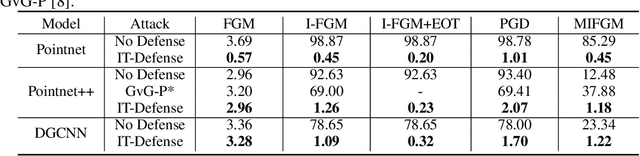
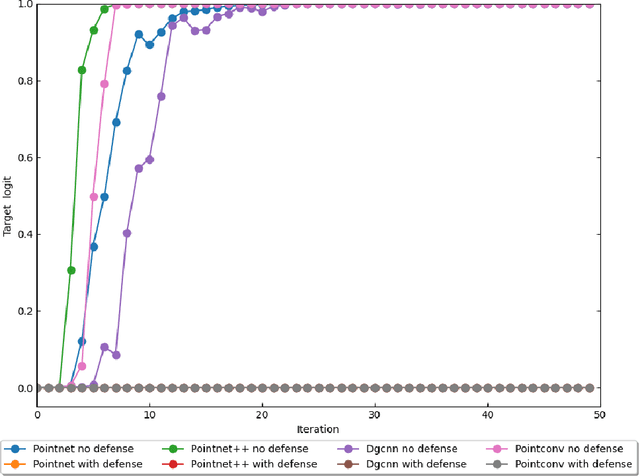
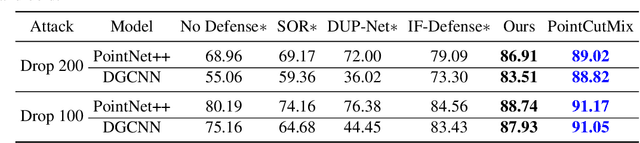
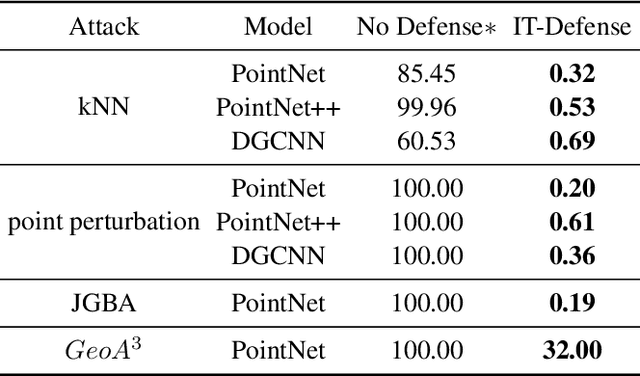
Some deep neural networks are invariant to some input transformations, such as Pointnetis permutation invariant to the input point cloud. In this paper, we demonstrated this property can be powerful in the defense of gradient based attacks. Specifically, we apply random input transformation which is invariant to networks we want to defend. Extensive experiments demonstrate that the proposed scheme outperforms the SOTA defense methods, and breaking the attack accuracy into nearly zero.