 Add to Chrome
 Add to Firefox
 Add to Edge
A Framework for Feature Discovery in Intracranial Pressure Monitoring Data Using Neural Network Attention
Jan 12, 2026
We present a novel framework for analyzing intracranial pressure monitoring data by applying interpretability principles. Intracranial pressure monitoring data was collected from 60 patients at Johns Hopkins. The data was segmented into individual cardiac cycles. A convolutional neural network was trained to classify each cardiac cycle into one of seven body positions. Neural network attention was extracted and was used to identify regions of interest in the waveform. Further directions for exploration are identified. This framework provides an extensible method to further understand the physiological and clinical underpinnings of the intracranial pressure waveform, which could lead to better diagnostic capabilities for intracranial pressure monitoring.

Optimal operating MR contrast for brain ventricle parcellation
Apr 04, 2023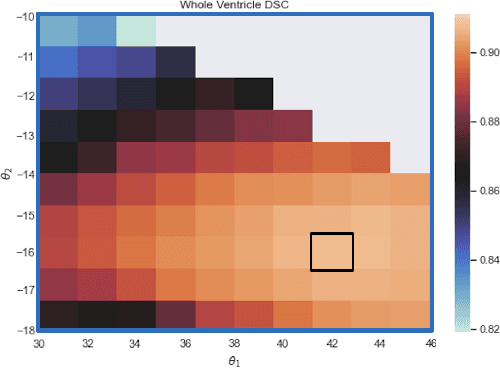
Development of MR harmonization has enabled different contrast MRIs to be synthesized while preserving the underlying anatomy. In this paper, we use image harmonization to explore the impact of different T1-w MR contrasts on a state-of-the-art ventricle parcellation algorithm VParNet. We identify an optimal operating contrast (OOC) for ventricle parcellation; by showing that the performance of a pretrained VParNet can be boosted by adjusting contrast to the OOC.
Automated Ventricle Parcellation and Evan's Ratio Computation in Pre- and Post-Surgical Ventriculomegaly
Mar 06, 2023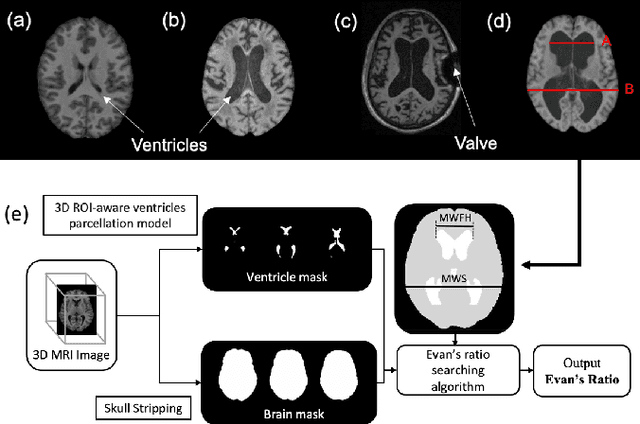
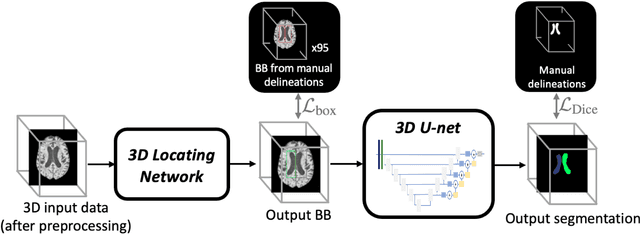
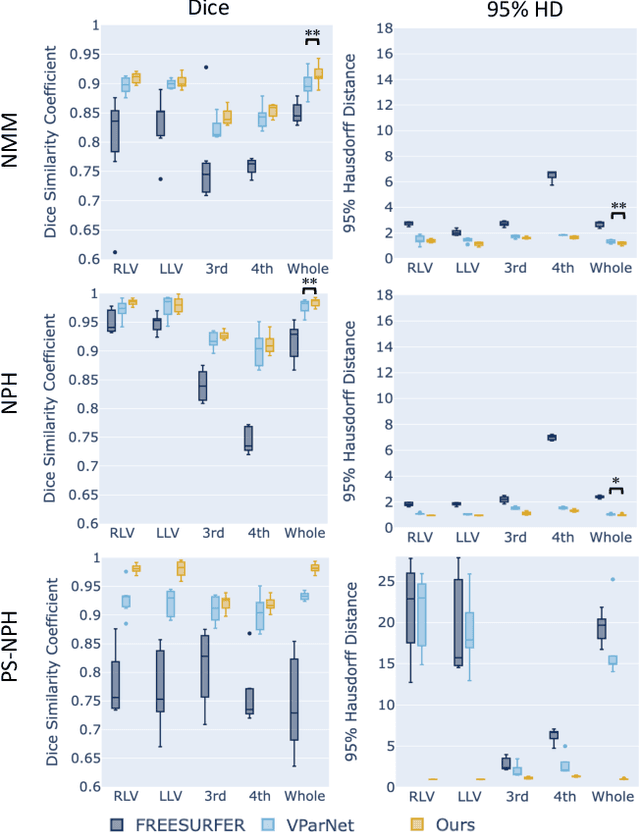
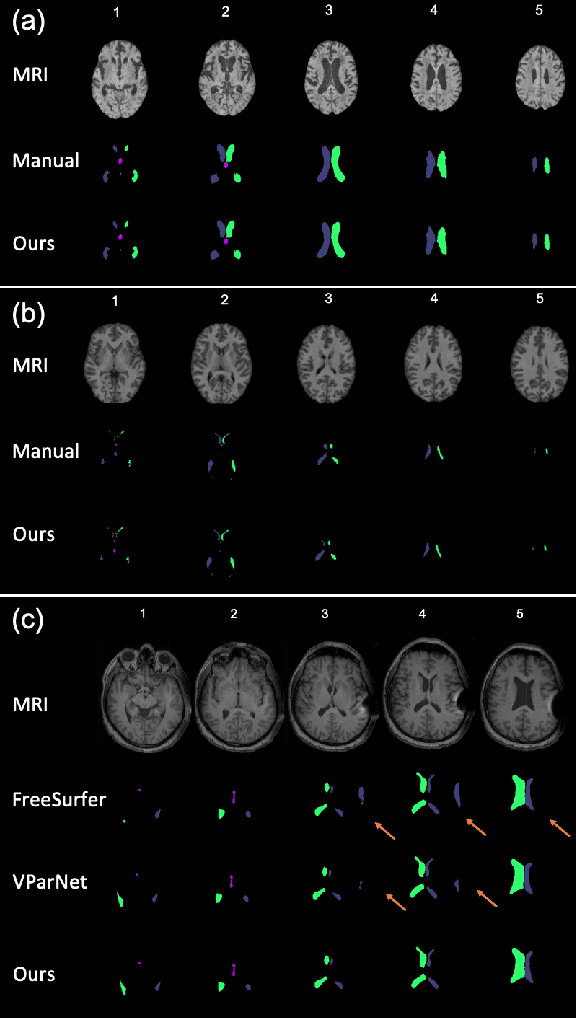
Normal pressure hydrocephalus~(NPH) is a brain disorder associated with enlarged ventricles and multiple cognitive and motor symptoms. The degree of ventricular enlargement can be measured using magnetic resonance images~(MRIs) and characterized quantitatively using the Evan's ratio (ER). Automatic computation of ER is desired to avoid the extra time and variations associated with manual measurements on MRI. Because shunt surgery is often used to treat NPH, it is necessary that this process be robust to image artifacts caused by the shunt and related implants. In this paper, we propose a 3D regions-of-interest aware (ROI-aware) network for segmenting the ventricles. The method achieves state-of-the-art performance on both pre-surgery MRIs and post-surgery MRIs with artifacts. Based on our segmentation results, we also describe an automated approach to compute ER from these results. Experimental results on multiple datasets demonstrate the potential of the proposed method to assist clinicians in the diagnosis and management of NPH.