 Add to Chrome
 Add to Firefox
 Add to Edge
SafeGPT: Preventing Data Leakage and Unethical Outputs in Enterprise LLM Use
Jan 10, 2026
Large Language Models (LLMs) are transforming enterprise workflows but introduce security and ethics challenges when employees inadvertently share confidential data or generate policy-violating content. This paper proposes SafeGPT, a two-sided guardrail system preventing sensitive data leakage and unethical outputs. SafeGPT integrates input-side detection/redaction, output-side moderation/reframing, and human-in-the-loop feedback. Experiments demonstrate SafeGPT effectively reduces data leakage risk and biased outputs while maintaining satisfaction.

Smart Privacy Policy Assistant: An LLM-Powered System for Transparent and Actionable Privacy Notices
Jan 09, 2026Most users agree to online privacy policies without reading or understanding them, even though these documents govern how personal data is collected, shared, and monetized. Privacy policies are typically long, legally complex, and difficult for non-experts to interpret. This paper presents the Smart Privacy Policy Assistant, an LLM-powered system that automatically ingests privacy policies, extracts and categorizes key clauses, assigns human-interpretable risk levels, and generates clear, concise explanations. The system is designed for real-time use through browser extensions or mobile interfaces, surfacing contextual warnings before users disclose sensitive information or grant risky permissions. We describe the end-to-end pipeline, including policy ingestion, clause categorization, risk scoring, and explanation generation, and propose an evaluation framework based on clause-level accuracy, policy-level risk agreement, and user comprehension.
Semantic NLP Pipelines for Interoperable Patient Digital Twins from Unstructured EHRs
Jan 09, 2026Digital twins -- virtual replicas of physical entities -- are gaining traction in healthcare for personalized monitoring, predictive modeling, and clinical decision support. However, generating interoperable patient digital twins from unstructured electronic health records (EHRs) remains challenging due to variability in clinical documentation and lack of standardized mappings. This paper presents a semantic NLP-driven pipeline that transforms free-text EHR notes into FHIR-compliant digital twin representations. The pipeline leverages named entity recognition (NER) to extract clinical concepts, concept normalization to map entities to SNOMED-CT or ICD-10, and relation extraction to capture structured associations between conditions, medications, and observations. Evaluation on MIMIC-IV Clinical Database Demo with validation against MIMIC-IV-on-FHIR reference mappings demonstrates high F1-scores for entity and relation extraction, with improved schema completeness and interoperability compared to baseline methods.
POLAR: Automating Cyber Threat Prioritization through LLM-Powered Assessment
Oct 02, 2025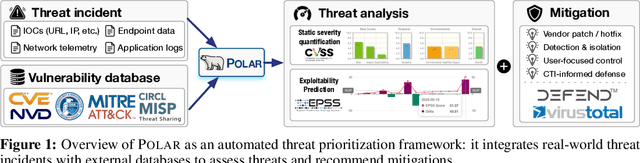
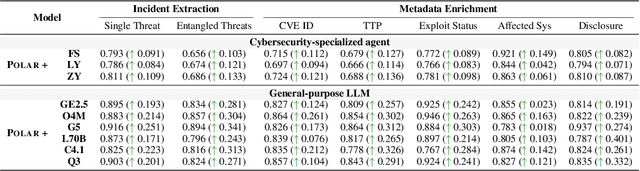
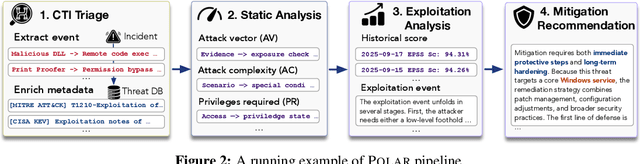
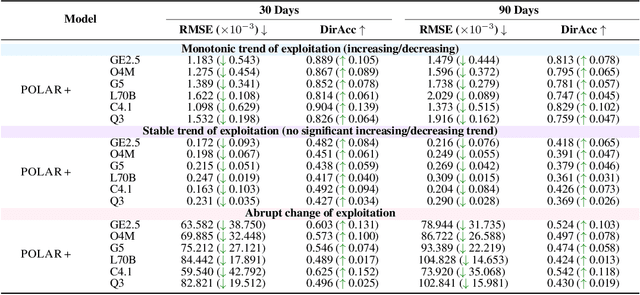
Large Language Models (LLMs) are intensively used to assist security analysts in counteracting the rapid exploitation of cyber threats, wherein LLMs offer cyber threat intelligence (CTI) to support vulnerability assessment and incident response. While recent work has shown that LLMs can support a wide range of CTI tasks such as threat analysis, vulnerability detection, and intrusion defense, significant performance gaps persist in practical deployments. In this paper, we investigate the intrinsic vulnerabilities of LLMs in CTI, focusing on challenges that arise from the nature of the threat landscape itself rather than the model architecture. Using large-scale evaluations across multiple CTI benchmarks and real-world threat reports, we introduce a novel categorization methodology that integrates stratification, autoregressive refinement, and human-in-the-loop supervision to reliably analyze failure instances. Through extensive experiments and human inspections, we reveal three fundamental vulnerabilities: spurious correlations, contradictory knowledge, and constrained generalization, that limit LLMs in effectively supporting CTI. Subsequently, we provide actionable insights for designing more robust LLM-powered CTI systems to facilitate future research.
On the Eligibility of LLMs for Counterfactual Reasoning: A Decompositional Study
May 17, 2025
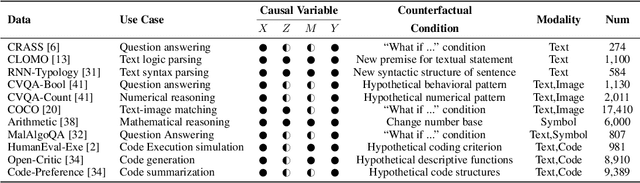

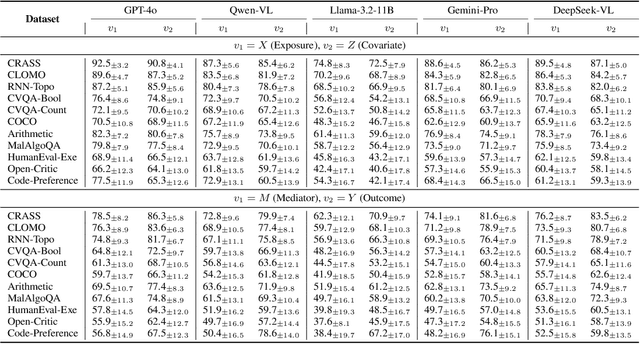
Counterfactual reasoning has emerged as a crucial technique for generalizing the reasoning capabilities of large language models (LLMs). By generating and analyzing counterfactual scenarios, researchers can assess the adaptability and reliability of model decision-making. Although prior work has shown that LLMs often struggle with counterfactual reasoning, it remains unclear which factors most significantly impede their performance across different tasks and modalities. In this paper, we propose a decompositional strategy that breaks down the counterfactual generation from causality construction to the reasoning over counterfactual interventions. To support decompositional analysis, we investigate 11 datasets spanning diverse tasks, including natural language understanding, mathematics, programming, and vision-language tasks. Through extensive evaluations, we characterize LLM behavior across each decompositional stage and identify how modality type and intermediate reasoning influence performance. By establishing a structured framework for analyzing counterfactual reasoning, this work contributes to the development of more reliable LLM-based reasoning systems and informs future elicitation strategies.
Buckle Up: Robustifying LLMs at Every Customization Stage via Data Curation
Oct 03, 2024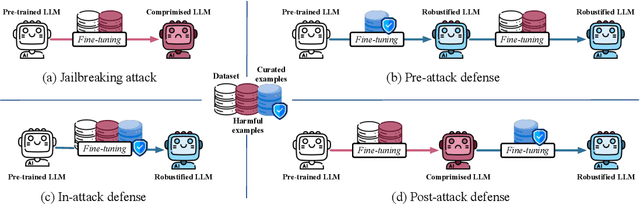
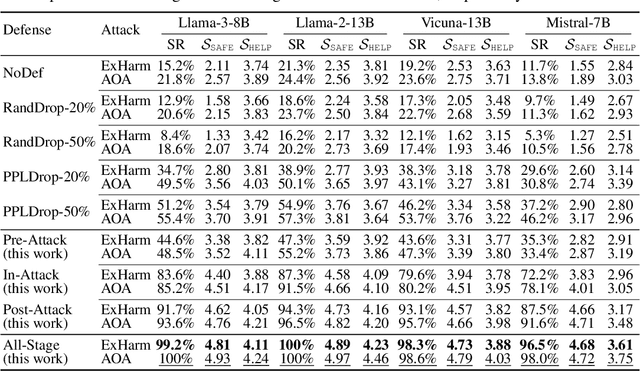
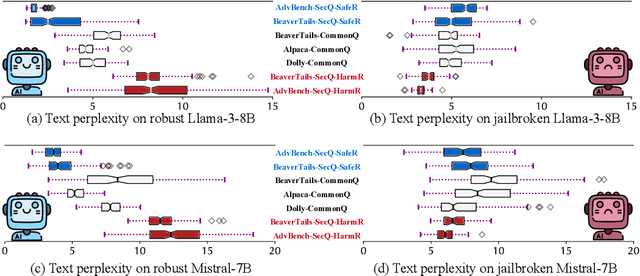
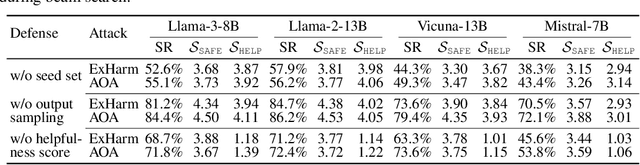
Large language models (LLMs) are extensively adapted for downstream applications through a process known as "customization," with fine-tuning being a common method for integrating domain-specific expertise. However, recent studies have revealed a vulnerability that tuning LLMs with malicious samples can compromise their robustness and amplify harmful content, an attack known as "jailbreaking." To mitigate such attack, we propose an effective defensive framework utilizing data curation to revise commonsense texts and enhance their safety implication from the perspective of LLMs. The curated texts can mitigate jailbreaking attacks at every stage of the customization process: before customization to immunize LLMs against future jailbreak attempts, during customization to neutralize jailbreaking risks, or after customization to restore the compromised models. Since the curated data strengthens LLMs through the standard fine-tuning workflow, we do not introduce additional modules during LLM inference, thereby preserving the original customization process. Experimental results demonstrate a substantial reduction in jailbreaking effects, with up to a 100% success in generating responsible responses. Notably, our method is effective even with commonsense texts, which are often more readily available than safety-relevant data. With the every-stage defensive framework and supporting experimental performance, this work represents a significant advancement in mitigating jailbreaking risks and ensuring the secure customization of LLMs.