 Add to Chrome
 Add to Firefox
 Add to Edge
DreamVAR: Taming Reinforced Visual Autoregressive Model for High-Fidelity Subject-Driven Image Generation
Jan 30, 2026
Recent advances in subject-driven image generation using diffusion models have attracted considerable attention for their remarkable capabilities in producing high-quality images. Nevertheless, the potential of Visual Autoregressive (VAR) models, despite their unified architecture and efficient inference, remains underexplored. In this work, we present DreamVAR, a novel framework for subject-driven image synthesis built upon a VAR model that employs next-scale prediction. Technically, multi-scale features of the reference subject are first extracted by a visual tokenizer. Instead of interleaving these conditional features with target image tokens across scales, our DreamVAR pre-fills the full subject feature sequence prior to predicting target image tokens. This design simplifies autoregressive dependencies and mitigates the train-test discrepancy in multi-scale conditioning scenario within the VAR paradigm. DreamVAR further incorporates reinforcement learning to jointly enhance semantic alignment and subject consistency. Extensive experiments demonstrate that DreamVAR achieves superior appearance preservation compared to leading diffusion-based methods.

Accelerating Diffusion Transformer via Gradient-Optimized Cache
Mar 07, 2025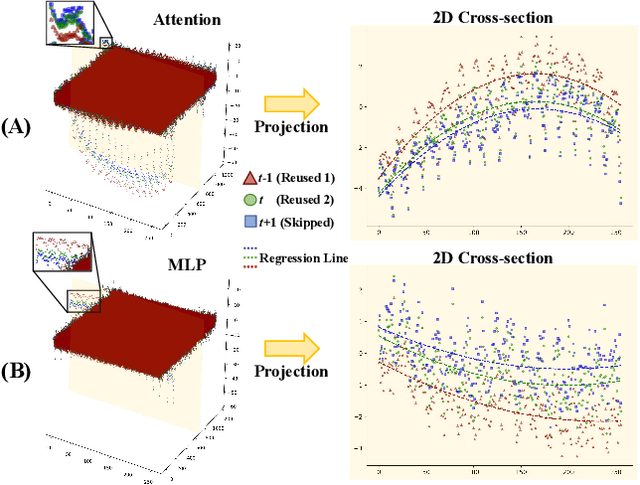
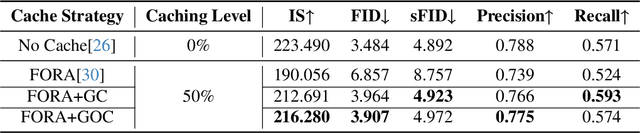
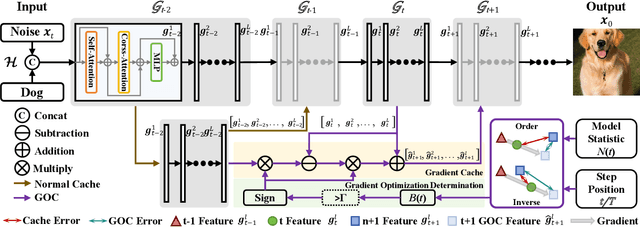
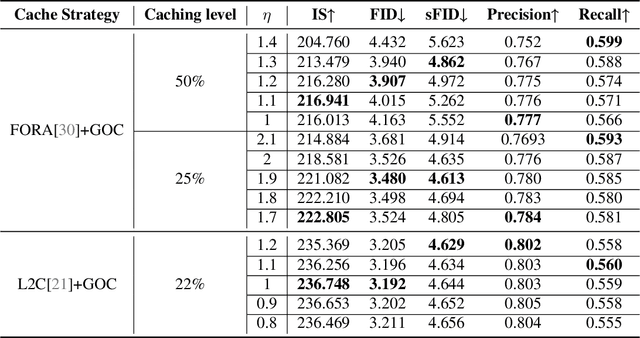
Feature caching has emerged as an effective strategy to accelerate diffusion transformer (DiT) sampling through temporal feature reuse. It is a challenging problem since (1) Progressive error accumulation from cached blocks significantly degrades generation quality, particularly when over 50\% of blocks are cached; (2) Current error compensation approaches neglect dynamic perturbation patterns during the caching process, leading to suboptimal error correction. To solve these problems, we propose the Gradient-Optimized Cache (GOC) with two key innovations: (1) Cached Gradient Propagation: A gradient queue dynamically computes the gradient differences between cached and recomputed features. These gradients are weighted and propagated to subsequent steps, directly compensating for the approximation errors introduced by caching. (2) Inflection-Aware Optimization: Through statistical analysis of feature variation patterns, we identify critical inflection points where the denoising trajectory changes direction. By aligning gradient updates with these detected phases, we prevent conflicting gradient directions during error correction. Extensive evaluations on ImageNet demonstrate GOC's superior trade-off between efficiency and quality. With 50\% cached blocks, GOC achieves IS 216.28 (26.3\% higher) and FID 3.907 (43\% lower) compared to baseline DiT, while maintaining identical computational costs. These improvements persist across various cache ratios, demonstrating robust adaptability to different acceleration requirements.