 Add to Chrome
 Add to Firefox
 Add to Edge
Quality Model for Machine Learning Components
Feb 04, 2026
Despite increased adoption and advances in machine learning (ML), there are studies showing that many ML prototypes do not reach the production stage and that testing is still largely limited to testing model properties, such as model performance, without considering requirements derived from the system it will be a part of, such as throughput, resource consumption, or robustness. This limited view of testing leads to failures in model integration, deployment, and operations. In traditional software development, quality models such as ISO 25010 provide a widely used structured framework to assess software quality, define quality requirements, and provide a common language for communication with stakeholders. A newer standard, ISO 25059, defines a more specific quality model for AI systems. However, a problem with this standard is that it combines system attributes with ML component attributes, which is not helpful for a model developer, as many system attributes cannot be assessed at the component level. In this paper, we present a quality model for ML components that serves as a guide for requirements elicitation and negotiation and provides a common vocabulary for ML component developers and system stakeholders to agree on and define system-derived requirements and focus their testing efforts accordingly. The quality model was validated through a survey in which the participants agreed with its relevance and value. The quality model has been successfully integrated into an open-source tool for ML component testing and evaluation demonstrating its practical application.

MLTEing Models: Negotiating, Evaluating, and Documenting Model and System Qualities
Mar 03, 2023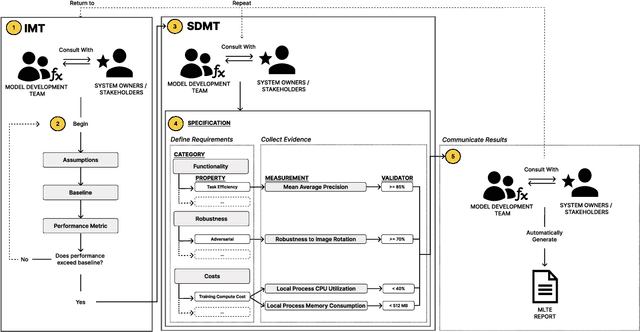
Many organizations seek to ensure that machine learning (ML) and artificial intelligence (AI) systems work as intended in production but currently do not have a cohesive methodology in place to do so. To fill this gap, we propose MLTE (Machine Learning Test and Evaluation, colloquially referred to as "melt"), a framework and implementation to evaluate ML models and systems. The framework compiles state-of-the-art evaluation techniques into an organizational process for interdisciplinary teams, including model developers, software engineers, system owners, and other stakeholders. MLTE tooling supports this process by providing a domain-specific language that teams can use to express model requirements, an infrastructure to define, generate, and collect ML evaluation metrics, and the means to communicate results.