 Add to Chrome
 Add to Firefox
 Add to Edge
Sim-and-Human Co-training for Data-Efficient and Generalizable Robotic Manipulation
Jan 27, 2026
Synthetic simulation data and real-world human data provide scalable alternatives to circumvent the prohibitive costs of robot data collection. However, these sources suffer from the sim-to-real visual gap and the human-to-robot embodiment gap, respectively, which limits the policy's generalization to real-world scenarios. In this work, we identify a natural yet underexplored complementarity between these sources: simulation offers the robot action that human data lacks, while human data provides the real-world observation that simulation struggles to render. Motivated by this insight, we present SimHum, a co-training framework to simultaneously extract kinematic prior from simulated robot actions and visual prior from real-world human observations. Based on the two complementary priors, we achieve data-efficient and generalizable robotic manipulation in real-world tasks. Empirically, SimHum outperforms the baseline by up to $\mathbf{40\%}$ under the same data collection budget, and achieves a $\mathbf{62.5\%}$ OOD success with only 80 real data, outperforming the real only baseline by $7.1\times$. Videos and additional information can be found at \href{https://kaipengfang.github.io/sim-and-human}{project website}.

ProS: Prompting-to-simulate Generalized knowledge for Universal Cross-Domain Retrieval
Dec 19, 2023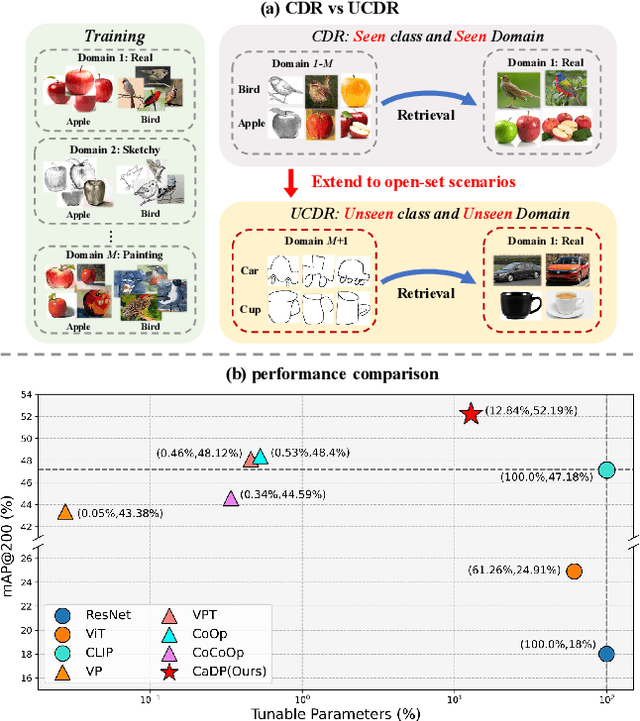
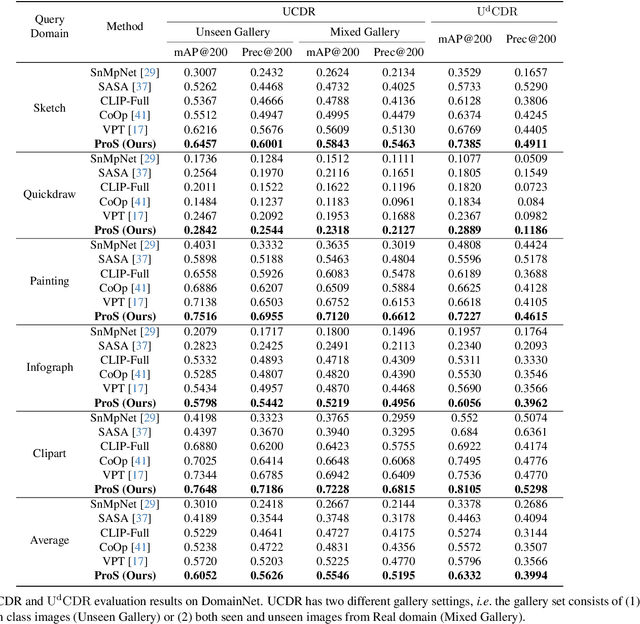
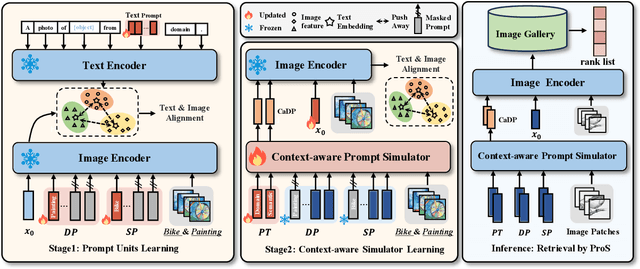
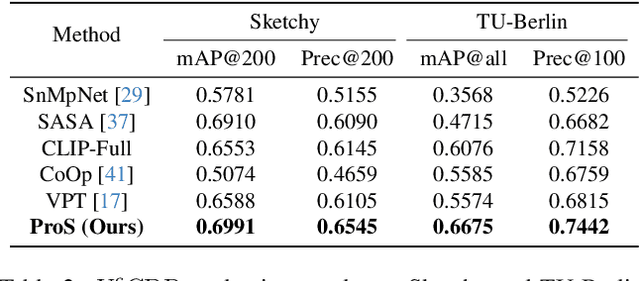
The goal of Universal Cross-Domain Retrieval (UCDR) is to achieve robust performance in generalized test scenarios, wherein data may belong to strictly unknown domains and categories during training. Recently, pre-trained models with prompt tuning have shown strong generalization capabilities and attained noteworthy achievements in various downstream tasks, such as few-shot learning and video-text retrieval. However, applying them directly to UCDR may not sufficiently to handle both domain shift (i.e., adapting to unfamiliar domains) and semantic shift (i.e., transferring to unknown categories). To this end, we propose Prompting-to-Simulate (ProS), the first method to apply prompt tuning for UCDR. ProS employs a two-step process to simulate Content-aware Dynamic Prompts (CaDP) which can impact models to produce generalized features for UCDR. Concretely, in Prompt Units Learning stage, we introduce two Prompt Units to individually capture domain and semantic knowledge in a mask-and-align way. Then, in Context-aware Simulator Learning stage, we train a Content-aware Prompt Simulator under a simulated test scenarios to produce the corresponding CaDP. Extensive experiments conducted on three benchmark datasets show that our method achieves new state-of-the-art performance without bringing excessive parameters. Our method is publicly available at https://anonymous.4open.science/r/ProS