 Add to Chrome
 Add to Firefox
 Add to Edge
Scaling Multiagent Systems with Process Rewards
Jan 30, 2026
While multiagent systems have shown promise for tackling complex tasks via specialization, finetuning multiple agents simultaneously faces two key challenges: (1) credit assignment across agents, and (2) sample efficiency of expensive multiagent rollouts. In this work, we propose finetuning multiagent systems with per-action process rewards from AI feedback (MAPPA) to address both. Through assigning credit to individual agent actions rather than only at task completion, MAPPA enables fine-grained supervision without ground truth labels while extracting maximal training signal from each rollout. We demonstrate our approach on competition math problems and tool-augmented data analysis tasks. On unseen math problems, MAPPA achieves +5.0--17.5pp on AIME and +7.8--17.2pp on AMC. For data analysis tasks, our method improves success rate by +12.5pp while quality metrics improve by up to 30%, validating that per-action supervision can lead to improvements across different multiagent system on various domains. By addressing these challenges, our work takes a first step toward scaling multiagent systems for complex, long-horizon tasks with minimal human supervision.

Pre-Training and Prompting for Few-Shot Node Classification on Text-Attributed Graphs
Jul 22, 2024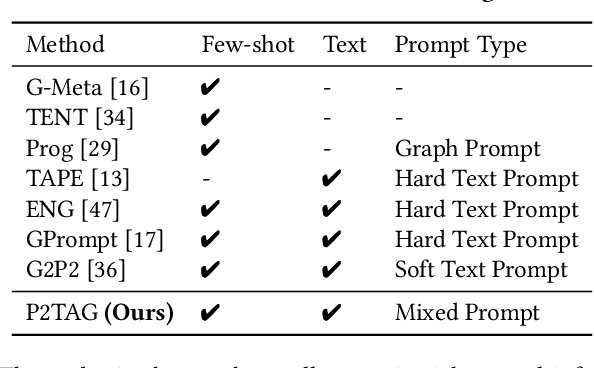
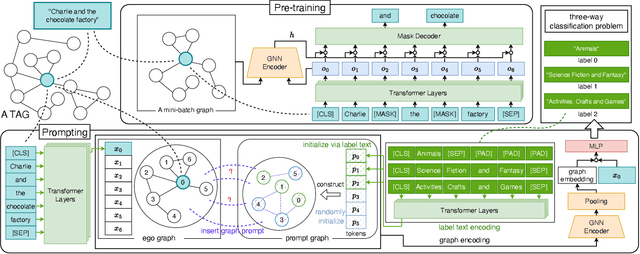
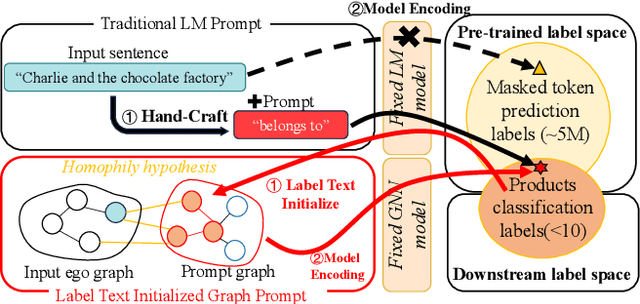
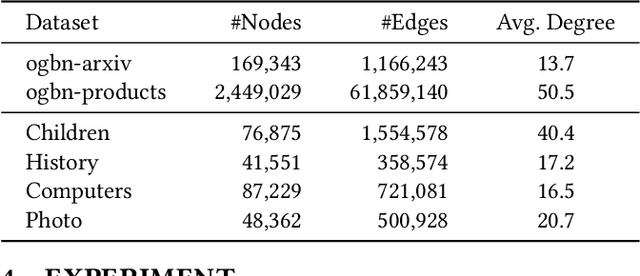
The text-attributed graph (TAG) is one kind of important real-world graph-structured data with each node associated with raw texts. For TAGs, traditional few-shot node classification methods directly conduct training on the pre-processed node features and do not consider the raw texts. The performance is highly dependent on the choice of the feature pre-processing method. In this paper, we propose P2TAG, a framework designed for few-shot node classification on TAGs with graph pre-training and prompting. P2TAG first pre-trains the language model (LM) and graph neural network (GNN) on TAGs with self-supervised loss. To fully utilize the ability of language models, we adapt the masked language modeling objective for our framework. The pre-trained model is then used for the few-shot node classification with a mixed prompt method, which simultaneously considers both text and graph information. We conduct experiments on six real-world TAGs, including paper citation networks and product co-purchasing networks. Experimental results demonstrate that our proposed framework outperforms existing graph few-shot learning methods on these datasets with +18.98% ~ +35.98% improvements.